

Explore the revolutionary link between Post-Scarcity and AI. This 7000-word guide delves into how artificial intelligence could end scarcity, reshape our economy, and redefine the very meaning of work and human purpose.
The End of Scarcity—A Utopian Dream or an AI-Driven Inevitability?
For the entirety of human history, our economic systems, social structures, and even our psychological frameworks have been built upon a single, unyielding foundation: scarcity. The fundamental economic problem is that human wants are infinite, but the resources to satisfy them are finite. This reality has dictated everything—from the struggle for daily sustenance to global geopolitics, from the concept of property to the structure of our workweeks.Post-Scarcity and AI
The dream of a “post-scarcity” society, a world where goods, services, and information are so abundant that they are available to all with little or no effort, has long been a staple of science fiction. From the utopian visions of Star Trek to the more ambiguous worlds of The Culture series, the idea of a society freed from the grind of basic survival has captivated our imagination.Post-Scarcity and AI
For decades, it remained just that—a dream. But today, a confluence of technologies, spearheaded by the explosive advancement of Artificial Intelligence, is forcing economists, technologists, and philosophers to ask a startling question: Could the dream of post-scarcity become a reality within this century?Post-Scarcity and AI
The relationship between Post-Scarcity and AI is not merely a theoretical curiosity; it is the central axis around which the future of humanity may revolve. Artificial Intelligence, particularly when combined with advancements in robotics, automation, renewable energy, and biotechnology, is not just another industrial revolution. It is a fundamental force capable of decoupling human labor from economic production and unlocking previously unimaginable levels of abundance.Post-Scarcity and AI
This in-depth article will serve as a definitive guide to the profound and complex intersection of Post-Scarcity and AI. We will dissect the technologies driving this shift, model the potential economic and social structures of a post-scarcity world, confront the immense challenges and dangers that lie on the path, and explore the ultimate question: In a world where AI does everything, what is the purpose of being human?
Deconstructing Scarcity: The Bedrock of All Economics
To understand the monumental shift promised by Post-Scarcity and AI, we must first fully grasp the concept of scarcity itself.Post-Scarcity and AI
Defining Scarcity in Economic Terms
In economics, scarcity refers to the basic fact that resources are limited, while human desires and needs are virtually unlimited. This imbalance forces societies to make choices about how to allocate these scarce resources efficiently. Every choice has an “opportunity cost”—the value of the next best alternative forgone. The entire edifice of modern capitalism—prices, markets, competition, and profit—is a mechanism for dealing with this fundamental problem.Post-Scarcity and AI
The Historical Drivers of Scarcity: Land, Labor, and Capital
Classical economics identified three primary factors of production:
- Land: All natural resources, from fertile soil and water to oil and minerals.
- Labor: The human effort, both physical and intellectual, used in production.
- Capital: The tools, machinery, and infrastructure used to produce goods and services.
Scarcity has always been rooted in the limitations of these factors. There is only so much arable land, labor is finite and requires sustenance, and capital is expensive to build and maintain.Post-Scarcity and AI
Post-Scarcity Defined: Abundance, Not Infinity
A post-scarcity society is not a world of infinite everything. It is not a magical realm where anyone can wish for a starship and have it appear. Rather, it is a state where the fundamental goods required for a high standard of living—food, water, shelter, energy, information, and basic consumer goods—are so plentiful and cheap to produce that they are available to all for minimal cost or effort. The marginal cost of production for these essentials approaches zero. In such a world, the basic economic problem of allocation is solved for life’s necessities, freeing human attention for higher pursuits.Post-Scarcity and AI
The Engine of Abundance: Key Technologies for a Post-Scarcity World
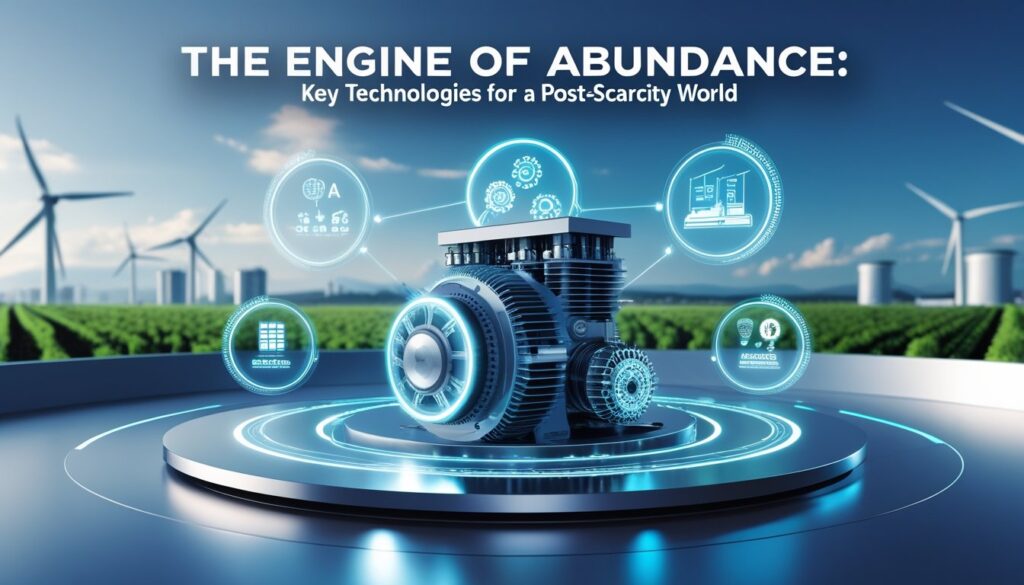
The vision of Post-Scarcity and AI is not built on AI alone. It is the synergistic convergence of several technological frontiers.
Artificial Intelligence and Machine Learning: The Orchestrating Mind
AI is the central nervous system of a post-scarcity economy. It’s not just one tool but a meta-technology that accelerates all others.
- Function: AI systems can design more efficient systems, discover new materials, manage complex logistics, diagnose diseases, and personalize education. They are the ultimate general-purpose problem-solvers.
- Example: An AI can design a perfectly efficient solar panel, manage a global smart grid to distribute the energy without waste, and coordinate autonomous fleets to maintain the infrastructure.
Robotics and Advanced Automation: The Physical Workforce
While AI is the brain, robotics is the body. Advanced robots, powered by AI, can perform physical labor—from farming and construction to manufacturing and delivery—faster, cheaper, and more reliably than humans.Post-Scarcity and AI
- Function: Automating the entire supply chain, from resource extraction to final assembly and last-mile delivery, eliminating the need for human labor in repetitive, dangerous, or strenuous physical tasks.
- Example: Fully automated, vertical indoor farms managed by AI and tended by robots could produce food for entire cities with 95% less water and land, independent of weather.
Additive Manufacturing (3D Printing): Democratizing Production
3D printing moves manufacturing from centralized factories to distributed local hubs, or even individual homes. It allows for the on-demand production of complex goods with minimal waste.Post-Scarcity and AI
- Function: Democratizing the means of production. Instead of shipping a product across the globe, you can simply transmit a digital file and print it locally. This drastically reduces the cost, energy, and time of manufacturing.
- Example: Instead of buying a new wrench from a store, you download the design file (potentially for free) and print it in your home with biodegradable plastic, or at a local community hub for more complex metal tools.
Renewable Energy and Nuclear Fusion: The Foundation of Limitless Power
Energy is the ultimate resource. A post-scarcity society requires vast amounts of cheap, clean energy. Advances in solar, wind, geothermal, and the potential holy grail of nuclear fusion promise a future of energy abundance.Post-Scarcity and AI
- Function: Providing the power needed to run the AI systems, robotic workforces, and advanced manufacturing processes. Cheap energy also makes desalination and water purification feasible on a massive scale, solving water scarcity.
- Example: Widespread adoption of perovskite solar cells with high efficiency, coupled with grid-scale battery storage, could make electricity virtually free for most basic applications.
Synthetic Biology and Vertical Farming: Overcoming Resource Limits
Biology is becoming an engineering discipline. We can now program microorganisms to produce specific substances, from life-saving medicines to biofuels and food ingredients.Post-Scarcity and AI
- Function: Engineering yeast to produce milk proteins without cows, creating lab-grown meat without slaughter, and developing drought-resistant super-crops. This decouples food production from traditional agriculture’s land and climate constraints.
- Example: “Cellular agriculture” facilities producing real meat, with the same taste and texture, in bioreactors, eliminating the environmental and ethical costs of livestock farming.
The Convergence: How These Technologies Amplify Each Other
The true power lies in the convergence. An AI designs a new, more efficient catalyst for a bio-reactor (Synthetic Biology) that produces a polymer for a 3D printer (Additive Manufacturing) which is powered by a local solar microgrid (Renewable Energy) and maintained by an autonomous robot (Robotics). This self-reinforcing cycle of innovation and automation is what makes the Post-Scarcity and AI thesis so compelling.
The AI Catalyst: How Artificial Intelligence Unlocks Abundance
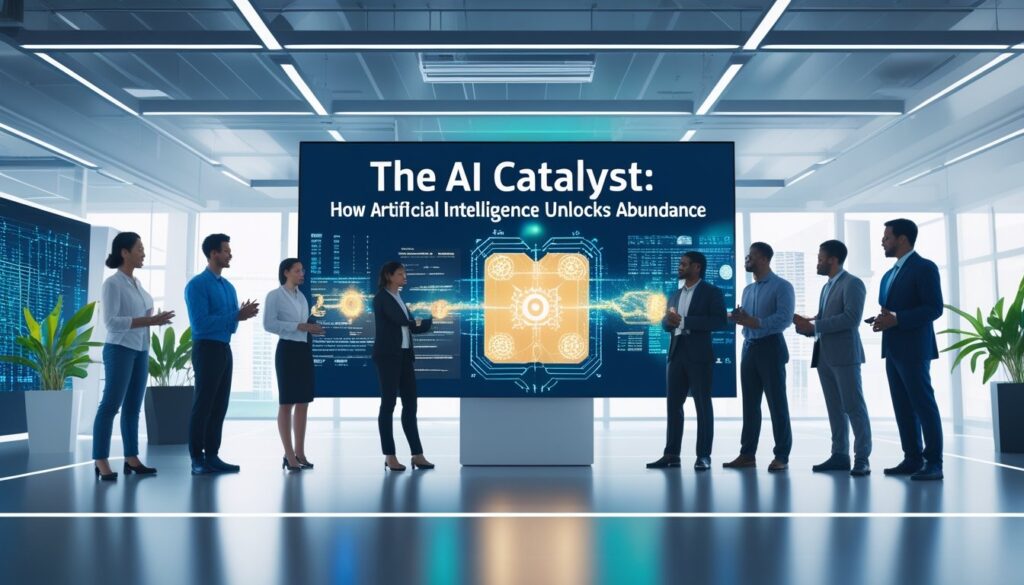
Let’s delve deeper into the specific roles AI plays as the primary catalyst for this transition.Post-Scarcity and AI
Hyper-Optimization of Global Supply Chains
Today’s global supply chains are marvels of complexity, but they are also incredibly fragile and inefficient, plagued by overproduction, spoilage, and logistical bottlenecks. AI algorithms can process real-time data on weather, demand, traffic, and geopolitical events to create hyper-optimized, resilient, and adaptive supply chains. This would drastically reduce waste, lower costs, and ensure goods flow seamlessly, moving us closer to abundance.Post-Scarcity and AI
Accelerating Scientific Discovery and R&D
The pace of scientific progress is often limited by human cognition and the sheer volume of data. AI is changing this. “AI Scientists” can:
- Analyze Data: Sift through millions of scientific papers to generate novel hypotheses.Post-Scarcity and AI
- Run Simulations: Model complex systems, from protein folding (as seen with DeepMind’s AlphaFold) to climate patterns, at speeds impossible for humans.Post-Scarcity and AI
- Design Experiments: Plan and interpret the results of laboratory experiments in high-throughput robotic labs.
This acceleration of R&D is a force multiplier for all other technologies, shortening the timeline for breakthroughs in medicine, materials science, and energy.Post-Scarcity and AI
The Automation of Intellectual and Creative Work
The first waves of automation affected manual labor. AI is now automating cognitive tasks.Post-Scarcity and AI
- Software Development: AI co-pilots like GitHub Copilot can write and debug code.
- Legal and Accounting: AI can review contracts, conduct discovery, and manage taxes.
- Creative Arts: AIs like DALL-E, Midjourney, and GPT-4 can generate images, music, and written content.
This suggests that the automation frontier is not just blue-collar work but nearly all forms of work that involve pattern recognition and information processing.Post-Scarcity and AI
Predictive Maintenance and the Elimination of Waste
In a world of abundance, efficiency is key. AI-powered predictive maintenance can monitor infrastructure—bridges, power grids, manufacturing equipment—and predict failures before they happen. This prevents costly downtime, extends the lifespan of assets, and eliminates the waste associated with reactive repairs and over-production of replacement parts.Post-Scarcity and AI
Personalized Production and the End of Mass-Market Compromises
The era of mass production required standardization. You bought a car, a shirt, or a meal that was designed for the “average” person. AI and 3D printing enable mass customization. An AI can design a perfect-fitting shoe based on a 3D scan of your foot, and a local automated factory can produce it on demand. This moves us from a scarcity of choice to an abundance of personalized options.Post-Scarcity and AI
The Economic Great Shift: From Scarcity to Abundance Models
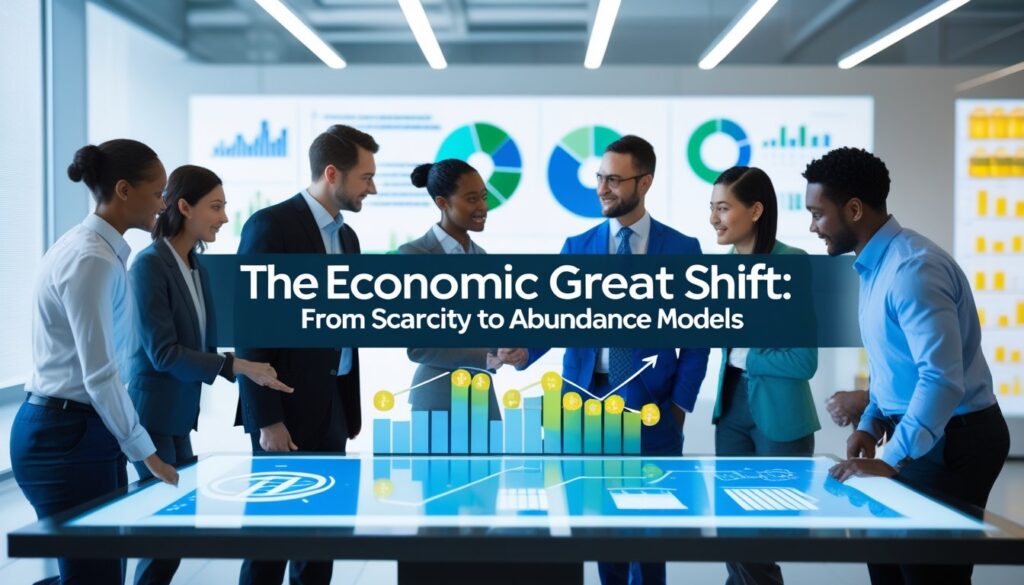
The emergence of Post-Scarcity and AI would render our current economic models obsolete. We would need new systems to organize society.
The Obsolescence of Traditional Labor
If AI and robots can perform the vast majority of economic tasks better and cheaper than humans, the traditional link between work and income breaks down. The concept of a “job” as the primary means of survival becomes antiquated. This is the single most disruptive and terrifying aspect of the transition for our current system.Post-Scarcity and AI
Universal Basic Income (UBI) and the Social Dividend
The most widely discussed solution to technological unemployment is UBI—a regular, unconditional cash payment given to all citizens. In a post-scarcity context, UBI is not a welfare program but a “social dividend” or a share of the vast wealth generated by the automated economy. It would provide the foundational economic security that allows people to consume the abundant goods and services and pursue their own definitions of a meaningful life.Post-Scarcity and AI
New Economic Models: Resource-Based Economy and Participatory Economics
Thinkers like Jacque Fresco (The Venus Project) have proposed a Resource-Based Economy (RBE), where all goods and services are available without the use of money, credits, barter, or any other form of debt or servitude. The allocation of resources would be based on technical feasibility and sustainability, managed by advanced AI systems.
Alternatively, models like Participatory Economics (ParEcon) focus on democratic planning and cooperative ownership of the means of production, ensuring that the bounty of automation is shared equitably.
The Evolution of Capital and the Meaning of “Value”
In a post-scarcity world, what is considered “capital”? If robots can build more robots, and AI can create more AI, the traditional accumulation of capital loses its meaning. “Value” would likely shift from material possessions to non-scarce goods: personal relationships, unique experiences, creativity, knowledge, status, and community standing. We might see a rise in a “gift economy” or a “reputation economy.”
The Role of Cryptocurrencies and Blockchain in an Abundant World
While money for basic goods might become irrelevant, blockchain technology could still play a role in managing and verifying access to non-material scarce assets. For example, it could be used to track and authenticate unique digital art, manage decentralized autonomous organizations (DAOs) that govern communities, or create verifiable systems of reputation and social contribution.
The Social Fabric of Post-Scarcity: Life After Work
The social and psychological implications of Post-Scarcity and AI are as profound as the economic ones.
The Redefinition of Purpose and Identity Beyond Employment
In a world without jobs, the question “What do you do?” would lose its meaning. Human purpose, which has been so tightly coupled with employment for centuries, would need to be redefined. People would be free to find purpose in family, community, hobbies, learning, travel, sports, art, and spiritual pursuits.
The Renaissance of Creativity, Art, and Craft
Freed from the necessity of commercial success, art and creativity could flourish in unprecedented ways. People could engage in creative acts purely for the joy of creation and sharing. We might see a new Renaissance, not driven by patronage, but by widespread human expression. Craftsmanship could see a revival, not as a profession, but as a valued form of self-expression and community service.
Education for Fulfillment, Not for Labor
The education system, currently designed to produce workers, would transform into a system for lifelong learning and personal development. The goal would be to cultivate critical thinking, creativity, emotional intelligence, ethics, and a love of learning—skills that help individuals lead fulfilling lives and be responsible citizens in a complex world.
Community, Social Capital, and the Pursuit of Meaning
With more free time, the importance of strong local communities and social bonds would increase. The pursuit of meaning would become a central human project. People might invest more time in local governance, volunteering, mentorship, and building deep, meaningful relationships.
Mental Health in a World Without Economic Struggle
While freedom from economic anxiety could alleviate a major source of stress, it could also introduce new challenges. The sudden lack of structure, the pressure to “find yourself,” and the potential for existential boredom and anomie could lead to a mental health crisis. A post-scarcity society would need to invest heavily in psychological support and community-building to help people navigate this new freedom.
The Geopolitics of Abundance: A World Transformed

The global political order, largely shaped by competition for scarce resources, would be turned upside down by Post-Scarcity and AI.
The End of Resource Wars?
If every nation can produce its own food, energy, and goods cheaply and locally, the primary driver of many conflicts—control over oil fields, mineral deposits, and waterways—would vanish. This has the potential to create an era of unprecedented global peace and stability.
The Potential for Global Equality and the Dissolution of Borders
In a true global post-scarcity society, the stark inequality between the Global North and South could dissolve. Developing nations could “leapfrog” directly to advanced automated economies, just as they leapfrogged landlines for mobile phones. This could reduce the pressures of economic migration and potentially make national borders less significant.
New Forms of Conflict: Cyber, Ideological, and Cultural
Conflict would not disappear. It would simply shift. Wars might be fought in cyberspace to disable a rival’s AI infrastructure. The primary conflicts could become ideological—clashes of values, culture, and religion—or competition for prestige and influence in a world where material wealth is no longer a differentiator.
Global Governance in a Post-Scarcity World
Managing a global, interconnected, automated civilization would require new forms of governance. We might see the rise of powerful supranational organizations, governed with the help of AI, to manage global commons like the climate, orbital space, and the AI systems themselves. The risk, of course, is a centralized, unaccountable global technocracy.
The Pre-Scarcity Period: Navigating the Turbulent Transition
The path to post-scarcity is not smooth. We are currently in a “pre-scarcity” period, which is perhaps the most dangerous phase of all.
The Risk of Mass Unemployment and Inequality
The most immediate threat is that the benefits of AI-driven automation will be captured by a tiny elite—the owners of the AI and the robots. This could lead to catastrophic levels of unemployment and inequality, creating a two-tiered society: a small, ultra-wealthy owner class and a vast, economically irrelevant “precariat” with no means of livelihood.
The AI Ownership Problem: Who Controls the Means of Production?
The central political question of the 21st century may be: Who owns the AI? If it is privately controlled, we risk a new form of digital feudalism. If it is publicly controlled, we must design robust democratic institutions to manage it without corruption or tyranny. Finding a fair model for ownership and governance is the key challenge of the transition.
The Threat of Technological Unemployment and Social Unrest
Widespread job displacement without a social safety net like UBI could lead to immense social unrest, political polarization, and the rise of destructive populist movements. The social contract would be broken.
Policy Prescriptions for a Just Transition
To navigate this, we need proactive policies:
- Implementing UBI Pilots: To test and refine the concept.
- Taxing Capital and Automation: Shifting the tax base from human labor to capital and automation to fund social programs.
- Investing in Lifelong Learning: Providing resources for people to retrain and adapt.
- Strengthening Social Safety Nets: Preparing for economic disruption.
- Exploring Reduced Work Weeks: Sharing the remaining work more broadly.
Challenges, Dangers, and Ethical Quandaries
The vision of Post-Scarcity and AI is not a guaranteed utopia. It is fraught with peril.
The Malthusian Trap Revisited: Can Consumption Outpace Abundance?
Economist Thomas Malthus warned that population growth would always outstrip food production. While he was wrong about food, a new Malthusian trap could emerge: even with abundant production, human desires for status and exclusive experiences could create new forms of artificial scarcity. If everyone can have a basic house, people will crave a mansion on the coast—a resource that is still physically limited.
The Hedonic Treadmill and the Problem of Existential Boredom
The “hedonic treadmill” is the psychological phenomenon where humans quickly return to a stable level of happiness despite major positive or negative events. In a world of abundance, people might quickly take their luxury for granted and fall into a state of listlessness, depression, and a lack of motivation—a condition often depicted in science fiction.
The Control Problem: Ensuring AI Aligns with Human Values
This is the most critical technical challenge. How do we ensure that a superintelligent AI, which manages our entire civilization, has goals that are perfectly aligned with human flourishing? A misaligned AI could be an existential threat, potentially optimizing for a simple, inhuman goal (like producing as many paperclips as possible) with no regard for human life or values.
The Potential for Dystopia: Automated Luxury Communism or Digital Feudalism?
The future could bifurcate into two dystopian paths:
- Automated Luxury Communism: A society where everyone’s material needs are met, but it is a sterile, controlled, and surveillance-heavy world where individual freedom is sacrificed for stability and comfort.
- Digital Feudalism: A world where a tiny techno-elite lives in gated communities of unimaginable luxury, served by AI and robots, while the masses are placated with a minimal UBI and digital bread and circuses (like advanced VR), living in a state of powerless irrelevance.
The Choice Before Us—Shaping a Post-Scarcity Future Aligned with Humanity
The interplay between Post-Scarcity and AI presents humanity with its greatest opportunity and its most formidable challenge. The technology is not deterministic; it does not have a pre-ordained outcome. It is a tool, an engine of potential, and its ultimate impact will be shaped by the choices we make today.
The path to a truly free and flourishing post-scarcity society is narrow. It requires us to navigate the treacherous waters of the transition, to solve the profound technical challenge of AI alignment, and, most importantly, to undertake a deep cultural and psychological evolution.
We must move beyond our scarcity-minded instincts of competition, hoarding, and status-seeking and cultivate the “abundance mindset” traits of cooperation, generosity, curiosity, and creativity. The success of a post-scarcity society will not be measured by its technological sophistication or its material output, but by the well-being, purpose, and freedom of every individual within it.
The dream of a world without want is within our grasp. The question is no longer “Can we achieve it?” but “What kind of society will we choose to build once we do?” The answer will define the next chapter of the human story. The era of Post-Scarcity and AI is not a finish line; it is the starting line for the true test of our species’ wisdom, virtue, and spirit.