
Explore the transformative role of AI and Space Exploration. This in-depth guide covers autonomous rovers, mission planning, data analysis, and the future of interstellar travel, showcasing how artificial intelligence is the key to unlocking the universe’s secrets.
The Dawn of a New Cosmic Era
For millennia, humanity has gazed at the stars with a mixture of wonder and curiosity. The quest to explore the cosmos represents one of our most profound and ambitious endeavors. Yet, the challenges of space are immense: vast distances, extreme environments, and a sheer, overwhelming scale of data. For decades, space missions were meticulously pre-programmed, with every command sent from Earth, leading to inherent limitations in responsiveness and efficiency.AI and Space Exploration.
Today, we are witnessing a paradigm shift, a fusion of two of the most cutting-edge fields of human innovation: Artificial Intelligence and Space Exploration. This is not merely an incremental improvement; it is a symbiotic revolution.AI and Space Exploration are becoming inextricably linked, with machine learning, computer vision, and autonomous systems transforming every facet of our journey to the stars. From navigating the treacherous terrain of distant worlds to sifting through the torrent of data from deep-space telescopes, AI is the force multiplier that is making space exploration smarter, safer, and more profound than ever before.
This extensive article will delve deep into the multifaceted relationship between AI and Space Exploration. We will journey from the inner solar system to the edges of the observable universe, exploring how intelligent machines are acting as our robotic avatars, our data analysts, and our mission co-pilots. We will examine the current state of the art, the groundbreaking missions powered by AI, and peer into the future to envision a time when autonomous AI systems may lead the charge in humanity’s greatest adventure.
Understanding the Core AI Technologies Powering Space Missions
Before we can appreciate the applications, it’s crucial to understand the fundamental AI technologies that make advanced AI and Space Exploration possible. These are not monolithic systems but a suite of tools, each suited for specific tasks.
Machine Learning (ML) and Deep Learning (DL): At its core, ML is a method of data analysis that automates analytical model building. It allows systems to learn from data, identify patterns, and make decisions with minimal human intervention. Deep Learning, a subset of ML, uses artificial neural networks with multiple layers (hence “deep”) to process data in complex ways. In the context of AI and Space Exploration, ML/DL is used for:
- Classification: Identifying types of celestial objects (e.g., stars, galaxies, asteroids) in telescope images.
- Regression: Predicting solar flare activity or the trajectory of space debris.
- Anomaly Detection: Spotting unusual readings in spacecraft telemetry that could indicate a system failure.
Computer Vision: This field enables machines to interpret and understand visual information from the world. For AI and Space Exploration, computer vision is the “eyes” of a robotic system. It allows rovers to distinguish between safe terrain and a sand trap, enables spacecraft to dock autonomously with space stations, and helps satellites map Earth’s surface with incredible accuracy. Algorithms can identify craters, rocks, and other geological features, creating 3D maps of uncharted worlds.AI and Space Exploration.
Natural Language Processing (NLP): While often associated with chatbots on Earth, NLP plays a vital role in streamlining AI and Space Exploration. With thousands of scientific papers, mission logs, and engineering documents generated, NLP algorithms can help researchers quickly find relevant information, summarize complex reports, and even translate engineering constraints into executable mission plans. It’s also key for developing more intuitive interfaces between astronauts and their complex spacecraft systems.
Robotics and Autonomous Systems: This is the physical manifestation of AI and Space Exploration. It combines AI with mechanical engineering to create systems that can perform tasks in unstructured environments without continuous human guidance. This includes the Mars rovers driving themselves, robotic arms on the International Space Station (ISS) performing delicate maneuvers, and future robots that will assemble structures in orbit or on the Moon.AI and Space Exploration.
Swarm Intelligence: Inspired by the collective behavior of social insects like ants and bees, swarm robotics involves coordinating multiple, simple robots to achieve a complex goal. In space, this could mean a fleet of small, inexpensive satellites working together to form a giant radio telescope or a swarm of rovers collaboratively mapping a vast lava tube on Mars. The AI here manages the decentralized coordination, ensuring the swarm acts as a cohesive unit.AI and Space Exploration.
AI on the Ground: Revolutionizing Mission Design and Operations
Long before a rocket ever leaves the launchpad, AI and Space Exploration are hard at work in mission control centers and engineering labs.
Predictive Modeling and Simulation: Space missions are incredibly complex, with millions of variables. AI-driven simulations can model every aspect of a mission, from launch dynamics to orbital mechanics and atmospheric entry. Machine learning algorithms can run through thousands of “what-if” scenarios, identifying potential failure points and optimizing trajectories for fuel efficiency. For example, NASA used AI to design the complex trajectory for the Cassini mission to Saturn, finding a path that would have been nearly impossible for humans to conceive alone.AI and Space Exploration.
Autonomous Mission Planning and Scheduling: A single spacecraft like the James Webb Space Telescope (JWST) or a Mars rover has a long list of scientific objectives. Manually scheduling these tasks for maximum efficiency is a Herculean effort. AI-powered scheduling systems, such as NASA’s ASPEN (Automated Scheduling and Planning Environment), can autonomously generate detailed timelines, taking into account constraints like power levels, data storage, and communication windows. These systems can also dynamically re-schedule tasks in response to unexpected events, like a dust storm on Mars or a new scientific discovery.AI and Space Exploration.
Ground Station Operations and Anomaly Detection: Ground stations receive a constant stream of telemetry data—the heartbeat of a spacecraft. Monitoring this data for signs of trouble is a 24/7 job. AI algorithms are now being deployed to act as a first line of defense. They can learn the normal patterns of a spacecraft’s systems and instantly flag any anomalous readings—a slight pressure drop, an unexpected temperature spike—allowing engineers to address problems before they become critical. This proactive approach to system health management is a game-changer for mission longevity.AI and Space Exploration.
AI in Orbit: The Brains Behind Modern Spacecraft
Once in space, the connection between AI and Space Exploration becomes even more critical due to communication delays and the need for rapid response.
Autonomous Navigation and Station-Keeping: Satellites in orbit need to maintain their position accurately. AI enables them to use star trackers and other sensors to determine their orientation and make micro-adjustments without waiting for commands from Earth. For missions like the ESA’s Proba- series of satellites, AI allows for incredible feats of autonomy, such as automatically identifying and photographing pre-defined points of interest on Earth’s surface.AI and Space Exploration.
System Health Management and Self-Healing Spacecraft: The concept of a “self-healing” spacecraft, once science fiction, is becoming a reality thanks to AI and Space Exploration. AI systems can diagnose faults and, in some cases, implement solutions autonomously. This could involve switching to a backup component, rebooting a system, or even reconfiguring software to work around a hardware failure. This resilience is absolutely essential for long-duration missions to the outer planets, where a signal from Earth can take hours to arrive.
Onboard Data Processing and Real-Time Decision Making: The volume of data collected by modern scientific instruments is staggering. Transmitting all of it to Earth is often impractical. AI can be deployed directly on the spacecraft to process this data in real-time. For instance, a satellite studying solar physics can use an AI to identify and prioritize the most interesting solar flares for transmission, effectively “thinking” for itself about what data is most valuable. This concept of “science-driven autonomy” is a cornerstone of modern AI and Space Exploration.
AI-Powered Satellite Constellations: Mega-constellations like SpaceX’s Starlink rely on sophisticated AI for collision avoidance. Each satellite is equipped with an automated system that uses AI to assess the risk of collision with space debris or other satellites and can perform an evasion maneuver without human input. This is a critical capability for managing the increasingly crowded orbital environment.AI and Space Exploration.
AI on Other Worlds: The Rise of the Robotic Explorer
The most visible and celebrated application of AI and Space Exploration is on the surface of other planets, particularly Mars. The evolution of the Mars rovers provides a perfect case study in the growing role of AI.
Case Study: The Mars Rovers – From Sojourner to Perseverance:
- Sojourner (1997): A technological demonstration with minimal autonomy. Its movements were meticulously planned and commanded from Earth.
- Spirit and Opportunity (2004): Introduced significantly more autonomy with software called AutoNav. This allowed the rovers to calculate a safe path for themselves over short distances, though they still relied heavily on ground control for long-range navigation.
- Curiosity (2012): Took a major leap forward. Its autonomous navigation capabilities were more advanced, allowing it to cover more ground each day. It also began to use AI for science, though in a limited capacity.
- Perseverance (2021): Represents the current pinnacle of AI and Space Exploration on another world. It boasts a suite of autonomous systems that make it the most independent robotic explorer ever sent to another planet.
Autonomous Navigation and Hazard Avoidance: Perseverance uses a powerful AI-driven system for navigation. Its “brains” process stereo images from its navigation cameras to create a 3D map of the terrain ahead. It then identifies hazards like large rocks, steep slopes, and sand traps, and plans a safe path around them—all without consulting engineers on Earth. This allows it to drive much faster and farther than its predecessors, covering complex terrain that would be too risky to navigate via remote control with a 20-minute communication delay.AI and Space Exploration.
The AEGIS System: AI as a Science Co-Investigator: One of the most groundbreaking examples of AI and Space Exploration is the AEGIS (Autonomous Exploration for Gathering Increased Science) system. Originally tested on Curiosity and now fully operational on Perseverance, AEGIS allows the rover to autonomously select and target rocks for scientific analysis.
Here’s how it works: Scientists on Earth upload high-level criteria (e.g., “look for light-colored, layered rocks”). When the rover is in a new location, it uses its cameras to take images. The AEGIS AI, trained on thousands of rock images, then analyzes this new imagery in real-time. It identifies rocks that match the scientific criteria, ranks them based on their interest level, and autonomously commands the rover’s ChemCam laser spectrometer to fire at the best candidate. This entire process happens in minutes, without any input from Earth. This means the rover can conduct valuable science even when it’s not in contact with its human team, dramatically increasing the scientific return of the mission.AI and Space Exploration.
AI in Sample Collection and Analysis: Perseverance’s primary mission is to collect and cache rock and soil samples for eventual return to Earth. This is an incredibly complex process. AI assists in this by using computer vision to guide the precise coring mechanism. It can adjust for the movement of the rover’s arm and ensure the drill is perfectly positioned. Future instruments could use AI to perform initial, simple analyses of the samples onboard, helping to decide which are the most pristine and worthy of return.
AI and the Data Deluge: Deciphering the Cosmos
Modern astronomy is drowning in data. Telescopes like the Hubble, the James Webb Space Telescope (JWST), and ground-based observatories like the Vera C. Rubin Observatory generate terabytes of data every night. The synergy between AI and Space Exploration is the only way to manage and extract knowledge from this deluge.
The Challenge of Big Data in Astronomy: Manually classifying the billions of galaxies, stars, and other objects in these vast surveys is impossible. This is where machine learning shines. Astronomers “train” ML models on datasets that have been pre-classified by humans. The model learns the subtle patterns that distinguish, for example, a spiral galaxy from an elliptical one. Once trained, it can classify millions of new objects with speed and accuracy far surpassing human capabilities.
Discovering Exoplanets with Machine Learning: The primary method for finding exoplanets is the “transit method,” which looks for tiny, periodic dips in a star’s brightness as a planet passes in front of it. The signals are incredibly faint and can be mimicked by stellar activity. ML algorithms are exceptionally good at sifting through the light-curve data from missions like Kepler and TESS (Transiting Exoplanet Survey Satellite), identifying the tell-tale signatures of planets with a much higher degree of confidence and at a much faster rate than traditional methods. They are even being used to predict the potential habitability of these distant worlds.
Mapping the Universe and Understanding Dark Matter: To understand the large-scale structure of the universe and the nature of dark matter and dark energy, cosmologists need to map the distribution of galaxies. AI is used to analyze the shapes of billions of galaxies, looking for the subtle distortions caused by gravitational lensing—where the gravity of dark matter bends the light from background galaxies. This “weak lensing” analysis is a massive data problem that is perfectly suited for deep learning, helping us create the most detailed maps of the dark matter scaffolding of the cosmos.
Searching for Technosignatures and SETI: The Search for Extraterrestrial Intelligence (SETI) has evolved. Instead of just looking for deliberate radio signals, modern SETI uses AI to search for “technosignatures”—any sign of technology, such as unusual atmospheric chemicals (e.g., pollution), city lights on exoplanets, or giant alien megastructures. AI algorithms are trained to distinguish between natural astrophysical phenomena and potential artificial signals, bringing a new level of sophistication to this timeless quest.
The Future Frontier: AI’s Role in Manned Missions and Deep Space Travel
The next giant leap for AI and Space Exploration will be in support of human astronauts. For missions to the Moon, Mars, and beyond, AI will transition from a remote tool to an integrated member of the crew.
AI as a Crewmate: Cognitive Assistants and Decision Support: On a multi-year mission to Mars, astronauts cannot be experts in every possible contingency. AI-powered cognitive assistants, like a more advanced version of Alexa or Siri, will serve as a centralized knowledge base. An astronaut could ask, “What is the procedure for replacing a faulty CO2 scrubber?” or “Show me the historical data for this life support sensor.” More advanced systems could act as a “co-pilot,” monitoring crew health, mission timelines, and system status to provide proactive recommendations and alert the crew to potential issues before they become emergencies.
Managing Life Support and Habitat Systems: Closed-loop life support systems that recycle air and water are incredibly complex. AI can optimize these systems in real-time, managing the balance of oxygen and carbon dioxide, controlling hydroponic gardens for food production, and predicting maintenance needs. On a Martian habitat, an AI could manage power distribution between solar panels, batteries, and a nuclear reactor, ensuring energy is always available for critical systems.
AI in In-Situ Resource Utilization (ISRU): The key to sustainable exploration is “living off the land.” ISRU involves using local resources, like extracting water from lunar ice or producing oxygen from the Martian atmosphere. These processes are complex and must be highly automated. AI will be essential for controlling and optimizing these robotic factories, adapting to varying soil conditions and managing the production chain with minimal human intervention.
Navigating the Void: AI for Interstellar Precursor Missions: For missions beyond our solar system, such as a probe to a nearby star like Proxima Centauri, the communication delay makes real-time control impossible. A spacecraft on such a journey would need to be almost entirely autonomous. Its AI would need to be capable of navigating interstellar space, managing its systems for centuries, conducting science upon arrival, and making complex decisions about what data to send back to Earth. This represents the ultimate challenge and culmination of AI and Space Exploration—creating a truly intelligent, self-sufficient ambassador from humanity.
The Challenges and Ethical Considerations of AI in Space
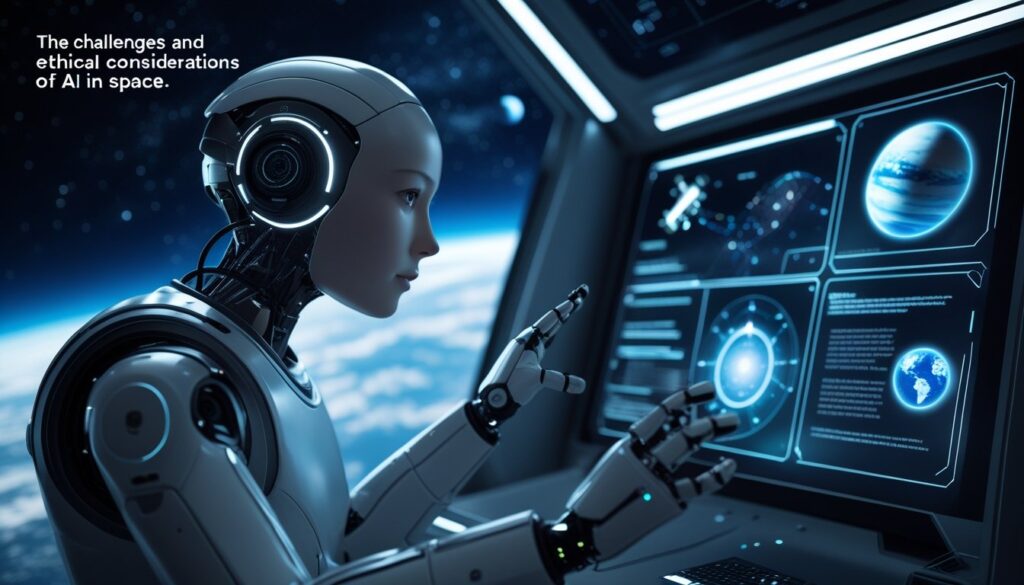
While the potential is staggering, the integration of AI and Space Exploration is not without its significant challenges and ethical dilemmas.
The Latency Problem: Why Autonomy is Non-Negotiable: As missions venture farther from Earth, the time lag for communications grows. It takes about 20 minutes for a signal to travel one-way between Earth and Mars. For Jupiter, it’s around 45 minutes. For a spacecraft near Pluto, it can be over 4 hours. This latency makes direct remote control impossible for dynamic situations like landing, navigating tricky terrain, or avoiding sudden hazards. This is the primary driver for developing advanced autonomy—it’s not a luxury, but a fundamental requirement for survival and success in deep space.
Reliability and the “Black Box” Dilemma: Many advanced AI models, particularly deep neural networks, can be “black boxes.” We can see their inputs and outputs, but the internal decision-making process can be opaque and difficult to interpret. For a mission costing billions of dollars and representing years of work, engineers need to trust the AI’s decisions. If a rover decides to avoid a particular path, we need to understand why to ensure it’s not being overly cautious or, worse, making a mistake. Research into “explainable AI” (XAI) is therefore critical for high-stakes applications in AI and Space Exploration.
Space Debris and AI-Driven Collision Avoidance: As mentioned, AI is already used for collision avoidance. However, as low Earth orbit becomes more congested, the potential for a cascade of collisions (known as the Kessler Syndrome) increases. The ethics of autonomous collision avoidance become complex. What if two manned spacecraft from different nations both have AIs that make conflicting avoidance maneuvers? International standards and transparent “rules of the road” for AI in space traffic management are urgently needed.
The Future of Autonomy: Ethical AI for Cosmic Governance: Looking far ahead, if we deploy fully autonomous AI systems with the capability to self-replicate and utilize resources (e.g., for asteroid mining or building large structures), we must imbue them with a robust ethical framework. Isaac Asimov’s “Three Laws of Robotics” were a fictional starting point, but real-world AI will need to be programmed with priorities that align with humanity’s long-term interests, especially when operating far beyond our direct oversight. The development of AI and Space Exploration must go hand-in-hand with the field of AI ethics and safety.
An Inseparable Partnership for the Final Frontier
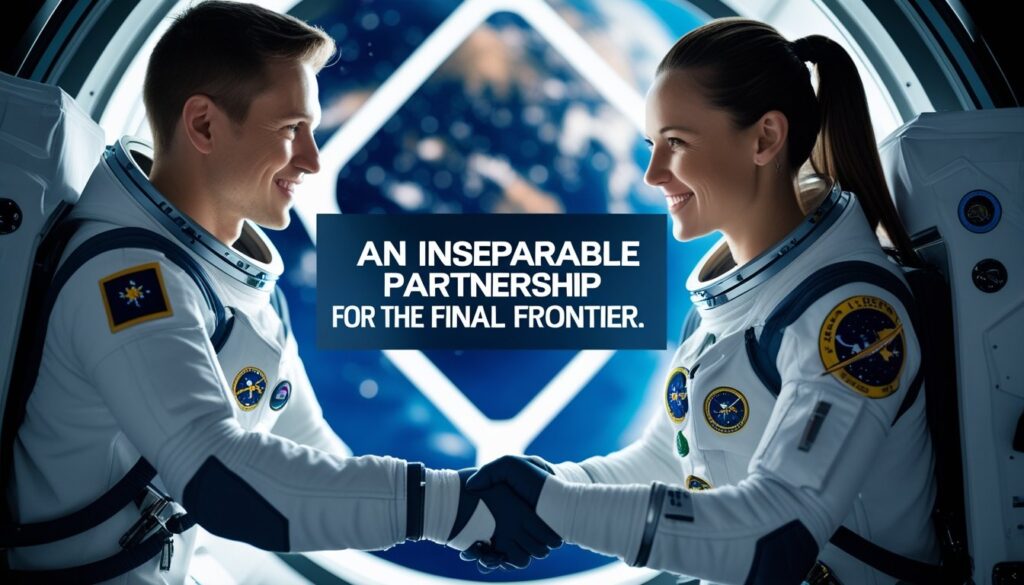
The journey of AI and Space Exploration has evolved from a nascent partnership to a deeply symbiotic relationship that is reshaping our capabilities and our vision for the future. Artificial intelligence is no longer just a supporting tool; it is becoming the central nervous system of our cosmic endeavors.
From the autonomous rovers trundling across Martian landscapes to the intelligent algorithms sifting through the cosmic noise to find new worlds, AI is extending our senses, amplifying our intellect, and granting our robotic proxies a degree of independence that was once the realm of science fiction. It is tackling the most pressing problems of spaceflight: the tyranny of distance, the challenge of big data, and the complexity of operating in unforgiving environments.
As we stand on the cusp of returning humans to the Moon and setting our sights on Mars, the role of AI will only become more profound. It will be the silent crewmate, the vigilant guardian of life support, and the expert geologist. It will be the key to living sustainably on other worlds and the only way to send our curiosity into the interstellar void.
The challenges of reliability, explainability, and ethics are real and must be addressed with rigor and foresight. But the trajectory is clear. AI and Space Exploration are now two threads inextricably woven into the same tapestry. Together, they form the most powerful engine for discovery we have ever created, promising to unlock the secrets of the universe and secure humanity’s future as a multi-planetary species. The final frontier is vast, dark, and silent, but with artificial intelligence as our guide and partner, we are learning to listen, to see, and to navigate its mysteries like never before.