
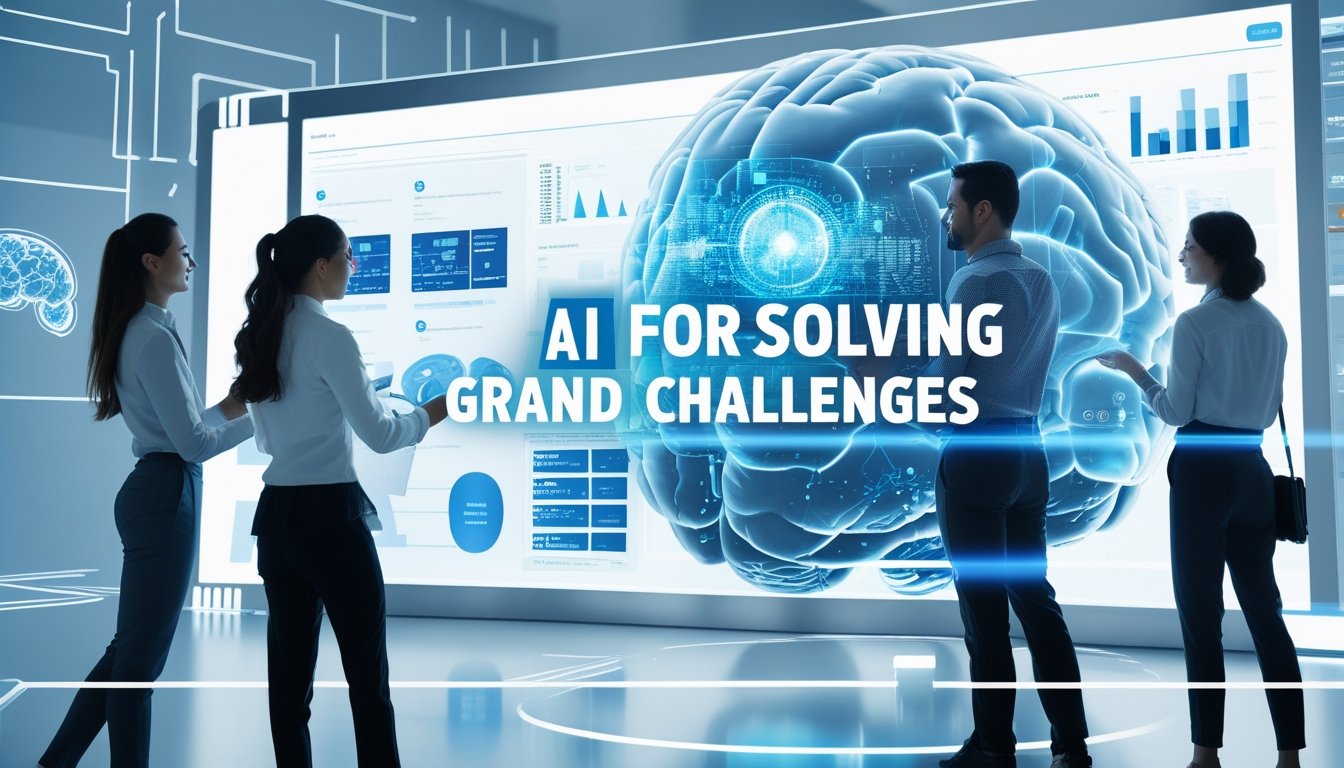
Explore how AI for Solving Grand Challenges is revolutionizing healthcare, climate action, and equity. This 7000-word guide delves into real-world applications, key technologies, and the critical ethics behind using AI as a force for global good.
The Dawn of a New Partner in Progress
For millennia, humanity’s greatest advancements have been born from our unique ability to identify monumental problems and marshal our collective intellect, resources, and will to solve them. From the agricultural revolution that ended nomadic hunter-gatherer societies to the scientific method that unlocked the laws of physics, our journey has been defined by overcoming obstacles that once seemed insurmountable. Today, we stand at the precipice of another such transformative epoch. The challenges we face—climate change, pandemics, chronic disease, and systemic inequality—are increasingly complex, global, and interconnected. They are, in essence, “Grand Challenges,” problems so vast and multifaceted that they defy solution by any single nation, discipline, or traditional approach.AI for Solving Grand Challenges
Enter Artificial Intelligence (AI). Once the stuff of science fiction, AI has rapidly evolved from a theoretical concept to a powerful, pervasive force reshaping every facet of our modern world. But beyond optimizing ad placements and powering virtual assistants, AI’s most profound and promising application lies in its potential to serve as humanity’s most powerful ally in tackling these Grand Challenges. AI for Solving Grand Challenges represents a paradigm shift, offering us not just better tools, but a new kind of cognitive partner capable of finding patterns and solutions in oceans of data that are simply invisible to the human eye.
This article is a deep dive into this revolutionary convergence. We will explore how AI for Solving Grand Challenges is moving from theoretical promise to tangible impact across the most critical domains of human existence. We will dissect the specific mechanisms—from machine learning and computer vision to natural language processing and predictive modeling—that are enabling breakthroughs in healthcare, climate science, education, and economic development. Furthermore, we will confront the critical ethical considerations and practical hurdles that must be navigated to ensure that the power of AI for Solving Grand Challenges is deployed responsibly, equitably, and for the ultimate benefit of all humanity. This is not merely a story of technological advancement; it is the story of how we are forging a new toolkit for survival, prosperity, and a sustainable future on this planet.
Defining the Landscape – What Are Grand Challenges and Why is AI the Key?
Before delving into specific applications, it’s crucial to understand what constitutes a “Grand Challenge” and why artificial intelligence is uniquely suited to address them.AI for Solving Grand Challenges
The Anatomy of a Grand Challenge
Grand Challenges are not merely large problems; they are a specific class of problem characterized by several key attributes:
- Scale and Global Impact: Their effects are felt across national borders, continents, and generations. Climate change, for instance, impacts every ecosystem and human society on Earth.
- Immense Complexity: They are not single-issue problems but complex systems with countless interdependent variables. Solving global poverty involves economics, education, healthcare, infrastructure, governance, and culture.
- Data-Intensive Nature: Understanding, modeling, and addressing these challenges requires the synthesis of unimaginably vast and heterogeneous datasets—from satellite imagery and genomic sequences to economic indicators and social media feeds.
- Resistance to Traditional Solutions: Linear, siloed approaches fail. These problems require interdisciplinary, agile, and adaptive strategies.
- High Stakes: The cost of failure is catastrophic, threatening human civilization, biodiversity, and the stability of the planet itself.
The Unique Capabilities of AI for Solving Grand Challenges
Traditional computational tools are inadequate for this level of complexity. AI, particularly modern machine learning and deep learning, brings a suite of capabilities that are perfectly aligned with the nature of Grand Challenges:
- Pattern Recognition at Scale: AI algorithms, especially deep neural networks, excel at identifying subtle, non-linear patterns within massive, high-dimensional datasets. This is fundamental to AI for Solving Grand Challenges like disease outbreak prediction, where signals are hidden in global health data.
- Predictive Modeling and Simulation: AI can create highly accurate models of complex systems, such as global climate or the spread of a virus. These models allow us to run “what-if” scenarios, testing the potential outcomes of different interventions without real-world risks.AI for Solving Grand Challenges
- Optimization of Scarce Resources: Many Grand Challenges involve the optimal allocation of limited resources—be it medical supplies, renewable energy, or humanitarian aid. AI-driven optimization algorithms can find the most efficient distribution pathways, saving time, money, and lives.AI for Solving Grand Challenges
- Automation of Labor-Intensive Tasks: AI can automate the analysis of data that would take humans centuries to process, such as reviewing satellite images to track deforestation or analyzing microscopic slides for disease diagnosis, freeing up human experts for higher-level strategy and decision-making.AI for Solving Grand Challenges
- Accelerating Scientific Discovery: From generating novel hypotheses to analyzing the results of experiments, AI is dramatically speeding up the scientific R&D cycle, a critical component of AI for Solving Grand Challenges in fields like materials science and drug discovery.
The synergy is clear: Grand Challenges are data-rich, complex systems problems, and AI is the most powerful set of technologies ever devised for understanding and optimizing complex systems from data. This alignment is what makes the pursuit of AI for Solving Grand Challenges so compelling and urgent.
AI in the Frontlines – Applications Across Critical Domains
The theoretical potential of AI for Solving Grand Challenges is now being realized in concrete, groundbreaking applications across the globe. Let’s explore the most impactful domains.
Healthcare and Pandemic Preparedness

The COVID-19 pandemic was a stark reminder of our vulnerability to novel pathogens. It also served as a real-world proving ground for the power of AI for Solving Grand Challenges in global health.
- Drug Discovery and Repurposing: The traditional drug discovery process can take over a decade and cost billions. AI is compressing this timeline. Deep learning models can analyze the structure of proteins (including the SARS-CoV-2 spike protein) and predict how potential drug molecules will interact with them. Companies like DeepMind (with its AlphaFold system) have made quantum leaps in protein folding prediction, a foundational problem in biology. During the pandemic, AI systems screened thousands of existing drugs to identify those with the potential to be repurposed against COVID-19, a process that would have been impossibly slow using manual methods.
- Early Outbreak Prediction and Surveillance: BlueDot, a Canadian AI startup, famously flagged the emergence of an unusual pneumonia cluster in Wuhan days before official international announcements. It did this by analyzing news reports in multiple languages, airline ticket data, and animal disease networks. This is a prime example of AI for Solving Grand Challenges in biosecurity, providing a crucial early warning system.
- Personalized Medicine and Diagnostics: AI is revolutionizing diagnostics. Convolutional Neural Networks (CNNs) can now analyze medical images (MRIs, CT scans, X-rays, retinal scans) with an accuracy that often rivals or exceeds that of trained radiologists. This is not about replacement but augmentation—freeing up experts and improving access to diagnosis in underserved areas. Furthermore, AI can integrate genomic data, electronic health records, and lifestyle information to tailor prevention strategies and treatments to the individual, moving us from a one-size-fits-all model to truly personalized healthcare.
- Epidemiological Modeling: AI-enhanced models provided governments with critical forecasts on infection rates, hospital bed occupancy, and the potential impact of various public health measures (like lockdowns or mask mandates). These models, while imperfect, were essential for evidence-based policy-making during a crisis.
Climate Change and Environmental Sustainability
Perhaps no Grand Challenge is more existential than climate change. Here, AI for Solving Grand Challenges is being deployed to mitigate emissions, adapt to changes, and understand the complex Earth system.
- Climate Modeling and Prediction: The physics-based models used by the IPCC are incredibly complex but computationally expensive. AI is being used to create “emulators” or “surrogates” that can run thousands of times faster, allowing scientists to explore a much wider range of climate scenarios and uncertainties. Machine learning is also improving the resolution and accuracy of weather forecasting, which is crucial for managing renewable energy grids and preparing for extreme weather events.
- Optimization of Renewable Energy Grids: The transition to renewables is hampered by the intermittent nature of solar and wind power. AI algorithms are critical for forecasting energy generation (predicting wind speed and sunlight) and optimizing the distribution and storage of this energy across smart grids. This maximizes the use of clean energy and ensures grid stability.
- Monitoring Deforestation and Biodiversity Loss: Organizations like Global Forest Watch use AI to analyze satellite imagery in near-real-time to identify and alert authorities to illegal deforestation activities. Similarly, AI can analyze camera trap images and audio recordings to monitor wildlife populations and track biodiversity, providing vital data for conservation efforts. This application of AI for Solving Grand Challenges directly supports the protection of our planet’s ecosystems.
- Precision Agriculture: Agriculture is a major source of emissions and water usage. AI-powered systems can analyze data from drones and soil sensors to enable “precision agriculture.” This means applying water, fertilizers, and pesticides only where and when they are needed, dramatically reducing waste and environmental impact while increasing yields.
Economic Inequality and Social Equity
Bridging the gap between the haves and the have-nots is a foundational Grand Challenge. AI for Solving Grand Challenges in this domain must be deployed with careful attention to ethics, but its potential is significant.
- Improving Access to Financial Services: In many developing countries, a lack of credit history prevents people from accessing loans to start businesses or improve their lives. AI can analyze alternative data sources (e.g., mobile phone usage patterns) to assess creditworthiness, a practice known as “alternative credit scoring.” This can financially include millions of “unbanked” individuals.
- Optimizing Humanitarian Aid and Disaster Response: When a natural disaster strikes, getting aid to the right people at the right time is a matter of life and death. AI can analyze satellite imagery to map damage, optimize logistics routes for supply delivery despite damaged infrastructure, and even analyze social media posts to identify areas of greatest need.
- Fighting Bias and Promoting Fairness: Ironically, AI can be a tool to combat the very human biases that perpetuate inequality. Algorithms can be designed to audit hiring processes, loan applications, and judicial systems for discriminatory patterns. While AI can inherit bias, carefully designed and audited “de-biasing” algorithms can help create more transparent and equitable systems.
Education and Knowledge Disparity
Education is the great equalizer, but access to quality education is not universal. AI for Solving Grand Challenges in education focuses on personalization and scalability.
- Personalized Learning Platforms: AI-powered educational software can adapt to the individual learning pace and style of each student. It can identify knowledge gaps, provide targeted exercises, and offer hints when a student is struggling, creating a custom-tailored learning path for everyone. This is a powerful example of how AI for Solving Grand Challenges can democratize high-quality education.
- Automating Administrative Tasks: AI can grade assignments, manage schedules, and handle routine administrative queries, freeing up teachers to focus on what they do best: mentoring, inspiring, and providing human connection to their students.
- Bridging the Language Gap: Real-time AI translation tools are breaking down language barriers, allowing educational materials to be accessible to speakers of any language and facilitating global collaboration among students and researchers.
The Engine Room – Key AI Technologies Powering the Solutions
The term “AI” is broad. It’s important to understand the specific technologies underpinning these advancements in AI for Solving Grand Challenges.
- Machine Learning (ML) & Deep Learning: The cornerstone of modern AI. ML algorithms learn from data to make predictions or decisions without being explicitly programmed for every task. Deep Learning, a subset of ML using multi-layered neural networks, is responsible for breakthroughs in image and speech recognition, natural language processing, and complex game playing (like protein folding).
- Natural Language Processing (NLP): This technology allows machines to understand, interpret, and generate human language. It’s crucial for analyzing scientific literature, monitoring outbreak reports from global news, and making educational content accessible.
- Computer Vision: This gives AI the ability to “see” and interpret visual information from the world. Its applications range from diagnosing diseases in medical scans to monitoring deforestation and assessing disaster damage from satellite and drone imagery.
- Reinforcement Learning: In this paradigm, an AI “agent” learns to make decisions by performing actions in an environment and receiving rewards or penalties. It’s exceptionally powerful for optimization problems, such as managing a complex energy grid or discovering new chemical compounds with desired properties.
- Generative AI: Models like GPT-4 and DALL-E can generate novel text, images, and even protein structures. In the context of AI for Solving Grand Challenges, this is transformative for accelerating scientific discovery, such as generating candidate molecules for new drugs or creating realistic climate simulation data.
Navigating the Minefield – Ethical Considerations and Risks

The power of AI for Solving Grand Challenges is immense, but it is not a panacea. Its development and deployment are fraught with ethical pitfalls that must be proactively managed. Ignoring these risks could exacerbate the very problems we seek to solve.
- Algorithmic Bias and Fairness: AI systems are trained on data produced by humans, and this data often reflects historical and social biases. An AI used for allocating healthcare resources, if trained on biased data, could systematically disadvantage minority groups. Ensuring fairness requires diverse training data, rigorous bias auditing, and algorithmic transparency. The goal of AI for Solving Grand Challenges is to reduce inequality, not entrench it.
- The Black Box Problem: Many complex AI models, particularly deep neural networks, are “black boxes.” It can be difficult or impossible to understand exactly why they arrived at a particular decision. This lack of explainability is a major problem in high-stakes domains like medicine and criminal justice, where understanding the rationale for a decision is as important as the decision itself.
- Data Privacy and Security: Tackling Grand Challenges requires vast amounts of data, much of it personal and sensitive (health records, genetic information, financial data). Robust data governance frameworks, anonymization techniques, and secure computing environments are non-negotiable to prevent misuse and protect individual privacy.
- Job Displacement and Economic Disruption: While AI will create new jobs, it will also automate many existing tasks. A just transition requires massive investments in re-skilling and up-skilling programs to prepare the workforce for the new economy shaped by AI.
- Concentration of Power and Access: The development of advanced AI requires significant computational resources and expertise, which are concentrated in a handful of corporations and wealthy nations. We must guard against a scenario where the benefits of AI for Solving Grand Challenges are only available to the privileged, creating a new “AI divide.” Open-source models, public-private partnerships, and international collaboration are essential to democratize access.
The Path Forward – A Blueprint for Responsible Implementation
To fully and safely harness the potential of AI for Solving Grand Challenges, a coordinated, multi-stakeholder approach is essential.
- Robust Governance and International Collaboration: We need global standards and regulatory frameworks for the ethical development and use of AI, similar to those for nuclear technology or human genome editing. This must be a collaborative effort involving governments, academia, industry, and civil society.
- Investment in Public-Good AI: Significant public funding should be directed towards AI research aimed explicitly at solving Grand Challenges, not just commercial applications. This includes funding for “AI for Science” initiatives and creating public, non-profit AI research labs.
- Fostering Interdisciplinary “AI+X” Teams: The most impactful solutions will come from teams where AI experts work side-by-side with domain experts—climatologists, epidemiologists, ecologists, and economists. Siloed approaches will fail.
- Prioritizing Explainable AI (XAI): The research community must prioritize the development of more interpretable and explainable AI models, especially for high-stakes applications in healthcare and public policy.
- Continuous Public Engagement and Education: Demystifying AI and fostering a public dialogue about its benefits and risks is crucial for building trust and ensuring that its development aligns with human values and societal goals.
A Partner, Not a Panacea

The narrative of AI for Solving Grand Challenges is one of cautious optimism. Artificial Intelligence is not a magic wand that will effortlessly erase the profound problems of the 21st century. It is, however, the most powerful amplifier of human intelligence we have ever created. It extends our senses, augments our reasoning, and allows us to navigate complexity at a scale that was previously unimaginable.
The journey ahead is not about ceding our agency to algorithms. It is about building a synergistic partnership—one where human wisdom, ethics, and compassion guide the application of AI’s immense analytical power. The ultimate success of AI for Solving Grand Challenges will not be measured by the sophistication of the algorithms, but by the tangible improvement in human welfare and planetary health they help us achieve. It is a tool, and like all tools, its value is determined by the hands that wield it and the vision that guides it. By choosing to direct this transformative technology toward our most pressing global problems, we are making a profound statement about our priorities as a species. We are choosing to harness our collective ingenuity not just for profit or convenience, but for survival, equity, and a thriving future for generations to come. The grandest challenge, it turns out, may be to use this powerful new intelligence wisely.