


Introduction: The Invisible Helper in Your Pocket
Artificial Intelligence is changing everydaylife .Remember when computers looked like giant boxes with blinking lights? Those days feel like ancient history now. Today, we carry supercomputers in our pockets. But something even bigger happened while we weren’t looking. Artificial intelligence quietly slipped into our daily routines.
What Exactly Is Artificial Intelligence?

Before diving deep, let’s get on the same page. Artificial intelligence means computers doing tasks that normally need human brains. Think learning, problem-solving, understanding language, or recognizing patterns.
The AI we use daily falls into two main types:
Narrow AI
Generative AI
Both types now shape how we live, work, and play.
AI in Your Morning Routine: Before You Leave Bed
Let’s start from the moment you wake up. Your day already involves AI long before you brush your teeth.
Smart Alarms That Understand Sleep
Weather Predictions You Trust
You check weather apps before dressing. Those accurate forecasts? AI processes satellite images, historical data, and current conditions. It predicts rain chances better than old methods. When your app says “40% chance of rain,” AI crunched millions of data points to tell you that.
News Curated Just for You
Morning news check shows stories picked by AI algorithms. Google News, Apple News, or Flipboard study what you read. They learn your interests. Sports fans see scores. Tech lovers get gadget news. AI filters the firehose of information into a personalized stream.
The Commute: AI Gets You There Smarter

Now you’re heading to work or running errands. AI rides shotgun.
GPS and Traffic Prediction
Ride-Sharing Magic
Uber and Lyft use AI everywhere. Matching you with nearby drivers uses AI algorithms. Calculating your fare? AI again. Predicting where drivers should wait for the next ride? Yep, AI handles that too. The app learns demand patterns across your city.
Public Transport Optimization
Even buses and trains now use AI. Cities analyze passenger data to adjust schedules. Some systems predict maintenance needs before breakdowns happen. Fewer delays mean you get where you’re going faster.
AI at Work: Your Silent Coworker
Whether you work from home or an office, AI probably helps you right now.
Email Gets Smarter
Spam filters use AI to spot suspicious messages. But modern email goes further. Smart replies suggesting “Sounds good!” or “I’ll check and get back to you”? That’s AI studying how you respond. Priority inboxes learn which emails matter to you. Some tools even draft entire emails based on your writing style.
Search and Research
Looking up information takes seconds. Google processes over 3.5 billion searches daily. AI understands your questions better than ever. Type “why my head hurts after coffee” and Google knows you want medical reasons, not coffee recipes.
Writing Assistance
Tools like Grammarly or Microsoft Editor check your writing. They spot typos, suggest better words, and fix grammar. Beyond spelling, they adjust tone. Writing a complaint email? The tool might suggest softer language. These improvements come from AI trained on millions of well-written sentences.
Meeting Schedulers
Ever played email ping-pong scheduling meetings? AI schedulers now handle that. Tools like Calendly or x.ai coordinate everyone’s availability. They find open slots, send invites, and reschedule when needed. No more “How about Tuesday?” back-and-forth.
AI at Home: Making Life Easier
After work, you come home to more AI helpers.
Streaming Services Know Your Taste
Netflix estimates 80% of watched content comes through recommendations. Think about that. You probably discovered your favorite show through AI suggestions. The algorithm learns what you finish, what you skip, and what you rewatch. Same with Spotify, YouTube, and TikTok.
Smart Speakers and Assistants
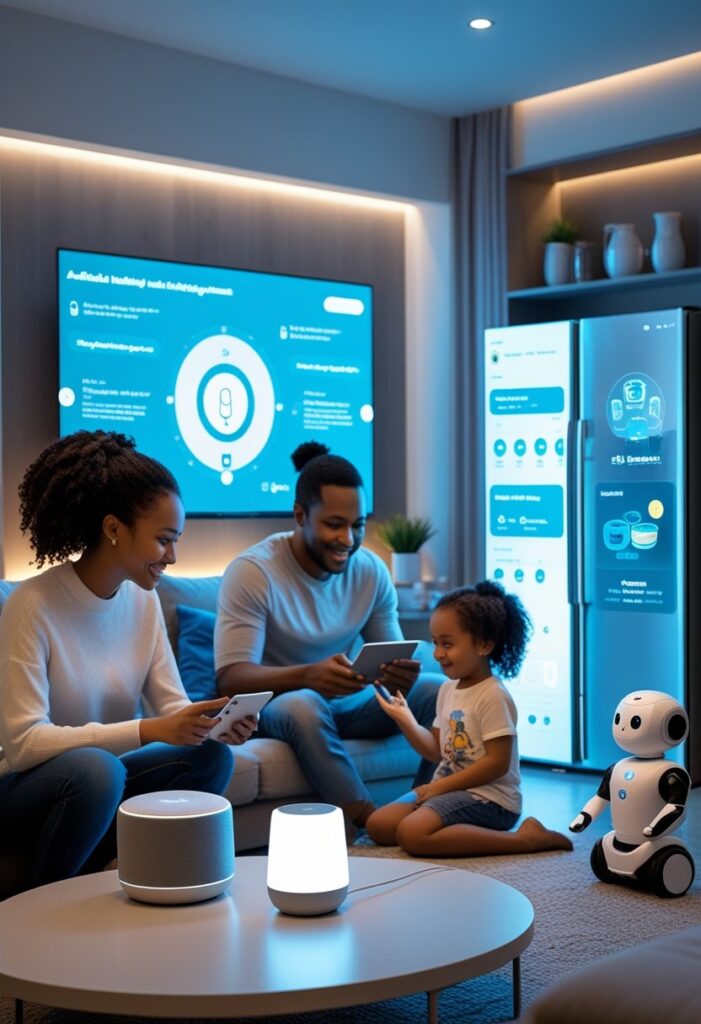
Alexa, Google Assistant, or Siri sit in millions of homes. You ask about weather, set timers, or play music. Each request teaches these assistants. They learn your voice, your preferences, and your habits. Tell Alexa “good morning” and it might turn on lights, read news, and start coffee. That automation happens through AI understanding routines.
Smart Thermostats Save Money
Nest and similar thermostats learn your schedule. They warm the house before you wake. They lower temperatures when you leave. Over weeks, they study how quickly your home heats and cools. Results show 10-15% savings on energy bills. All without you touching the thermostat.
Robot Vacuums That Learn Your Home
Roomba and competitors now map your floor plan. They remember where furniture sits. They know which rooms need more cleaning. Some even empty themselves and suggest cleaning schedules based on how dirty floors get.
Shopping and Money: AI Has Your Wallet
Your spending habits now teach AI systems constantly.
Online Shopping Recommendations
Amazon’s “Customers who bought this also bought” section? Pure AI. The system analyzes millions of purchases. It finds patterns humans would miss. You buy a tent, it suggests sleeping bags. You buy a grill, it offers spatulas. These suggestions drive over 35% of Amazon’s sales.
Fraud Protection
Banks use AI to watch your spending. When you swipe your card in another city, the system checks if that fits your patterns. Unusual purchase? You might get a fraud alert text. This happens in seconds, preventing billions in theft. The AI learns what “normal” looks like for you specifically.
Personal Finance Apps
Apps like Mint or YNAB categorize your spending automatically. They show you spent $400 on restaurants last month. They predict upcoming bills. Some even suggest budgets based on your income and habits. AI turns your transaction list into useful financial advice.
Dynamic Pricing
Ever notice flight prices changing? AI adjusts prices based on demand, time until departure, and competitor rates. Hotels and ride-sharing do this too. The price you see depends on AI’s calculation of what you’ll pay.
Health and Fitness: AI Watches Your Back
Health tracking exploded thanks to AI.
Fitness Trackers Go Beyond Steps
Modern wearables monitor heart rate, sleep stages, and activity. But they also detect patterns. Your watch might notice irregular heartbeats and suggest doctor visits. Some devices now detect falls and automatically call for help. These features save lives daily.
Personalized Workout Plans
Apps like Fitbod or Freeletics create custom workouts. They track your progress, adjust weights, and suggest new exercises. The AI learns what works for your body. Plateau on bench press? The app changes your routine automatically.
Nutrition Tracking
Take a photo of your meal, and apps estimate calories. AI recognizes foods and portions. Over time, these apps learn your eating habits. They suggest healthier alternatives or warn when you skip vegetables too often.
Telehealth and Symptom Checkers
Before calling doctors, many use symptom checkers. You describe what hurts, and AI suggests possible causes. These tools don’t diagnose but help you decide if you need professional help. During COVID, such systems guided millions to appropriate care.
AI in Communication: Breaking Barriers
Talking to people worldwide got easier through AI.
Real-Time Translation
Google Translate now works conversationally. Speak English into your phone, and it speaks Spanish back. The translation happens almost instantly. Microsoft Teams offers live captions in multiple languages during meetings. These tools use AI trained on billions of translated sentences.
Accessibility Features
Captioning automatically generates subtitles for videos. Deaf and hard-of-hearing users follow along easily. Image descriptions help blind users understand photos. These AI features open digital worlds to people previously excluded.
Social Media Content Moderation
Platforms moderate billions of posts daily. Humans can’t review everything. AI flags hate speech, violence, or harassment. It catches problems quickly, though imperfectly. Behind every flagged comment sits an AI that learned what crosses the line.
Education and Learning: AI as Personal Tutor
Learning new skills transformed with AI help.
Personalized Learning Platforms
Khan Academy, Duolingo, and Coursera adapt to you. Struggling with French verbs? The app gives extra practice. Mastering algebra quickly? It moves you forward. These platforms track millions of learners to find what teaching methods work best.
Writing Feedback for Students
Tools help students improve essays. They check structure, argument strength, and clarity. Teachers use AI to grade assignments faster, spending more time actually teaching. Students get immediate feedback instead of waiting days.
Skill Development at Work
Corporate training uses AI to identify skill gaps. Your manager might not know you need Excel training, but the system notices patterns. It suggests courses, tracks progress, and measures improvement. Professional development becomes continuous rather than occasional.
AI and Entertainment: Beyond Recommendations

Your fun time also involves AI behind the scenes.
Video Games Get Smarter
Game characters now react realistically. Non-player characters adapt to your playing style. Racing games learn your driving and adjust opponent difficulty. Sports games feature AI teammates who move intelligently. Games feel more alive because AI controls the virtual world around you.
Music Creation
Some artists use AI to generate beats or suggest melodies. Tools help bedroom producers sound professional. Even if you don’t create music, AI-enhanced audio improves your listening. Noise cancellation, sound equalization, and spatial audio all use AI processing.
Photography Enhancements
Your phone camera does more than capture light. It recognizes scenes and adjusts settings. Taking a sunset photo? The camera boosts colors. Night shot? It combines multiple exposures. Portrait mode? AI separates you from background. These computational photography tricks create stunning images automatically.
Privacy Concerns: The Price We Pay
All this convenience comes with trade-offs. Let’s talk honestly about concerns.
Data Collection
Every AI needs data to learn. Your preferences, location, and habits get collected constantly. Companies promise anonymity, but data leaks happen. Consider what information you share and who benefits from it.
Algorithm Bias
AI learns from human-created data. If that data contains bias, AI learns bias too. Job screening tools sometimes discriminate. Facial recognition works better on some skin tones than others. These problems require constant attention and correction.
Job Displacement Worries
Some jobs change or disappear due to AI. Manufacturing, customer service, and data entry feel the biggest effects. But new jobs also emerge. AI trainers, prompt engineers, and automation specialists didn’t exist ten years ago.
Mental Health Impacts
AI-driven social media maximizes engagement, sometimes at mental health costs. Infinite scroll, notification tricks, and recommendation algorithms keep you online longer. Understanding these mechanics helps you set healthier boundaries.
What’s Coming Next: AI in the Near Future
The changes so far only scratch the surface. Here’s what develops soon.
Autonomous Vehicles
Self-driving cars already test on public roads. Over the next decade, they’ll become common. Imagine sleeping during your commute or sending your car to park itself. Traffic might flow smoother with AI coordination between vehicles.
Healthcare Breakthroughs
AI detects cancers earlier than human eyes. It discovers new drugs faster. Soon, your doctor might consult AI for diagnoses. Wearables might predict heart attacks before symptoms appear. Preventative medicine becomes truly possible.
Personalized Education Revolution
Every child learns differently. AI tutors will provide truly individualized instruction. Your child practices math at their exact level while classmates learn reading. Teachers focus on mentoring rather than one-size-fits-all lectures.
Smart Cities
Traffic lights coordinate to reduce congestion. Power grids balance renewable energy sources. Waste collection happens when bins fill, not on fixed schedules. Cities become more livable through invisible AI optimization.
How to Embrace AI Wisely
You don’t need to understand every technical detail. But these habits help navigate the AI-powered world.
Stay Curious
When technology surprises you, ask “how did that happen?” Understanding the basics helps you use tools better. Read articles, watch explainers, and stay informed.
Protect Your Data
Check privacy settings regularly. Share only what feels comfortable. Use strong passwords and two-factor authentication. Think before clicking “allow” on app permissions.
Keep Human Connections
AI enhances life but doesn’t replace human interaction. Balance screen time with real conversations. Use technology to enable connections, not replace them.
Learn Continuously
Skills evolve as tools change. Take advantage of AI learning platforms. Stay adaptable. The willingness to learn matters more than current knowledge.
Frequently Asked Questions About AI
Q: Will AI take my job?
A: AI changes jobs more than eliminates them. Some tasks automate, but new roles emerge. Focus on skills AI struggles with – creativity, emotional intelligence, complex problem-solving.
Q: Is AI dangerous?
A: Like any tool, AI has risks. Responsible development and regulation matter more than fear. Current AI lacks consciousness or desire to harm. It follows programming and training data.
Q: Can AI think like humans?
A: Not really. AI recognizes patterns without understanding meaning. It doesn’t feel emotions or have experiences. Today’s AI mimics thinking but differs fundamentally from human consciousness.
Q: How do companies get my data?
A: Through apps, websites, purchases, and devices you use. Every interaction potentially collects data. Reading privacy policies helps you understand what companies track.
Q: What’s the difference between AI and machine learning?
A: AI is the broader goal of creating intelligent machines. Machine learning is one method – teaching computers by showing examples rather than programming rules explicitly.
Q: Can AI be creative?
A: AI generates creative content by remixing existing examples. It produces novel combinations but lacks genuine inspiration or intent. The creativity reflects training data, not original thought.
Q: Should I let my kids use AI tools?
A: With supervision, yes. AI tools offer learning opportunities. Teach critical thinking about AI-generated content. Discuss privacy and appropriate use together.
Conclusion: Your AI-Powered Life
Artificial intelligence stopped being science fiction. It became your morning alarm, your commute helper, your work assistant, and your evening entertainment. The technology evolves constantly, bringing new possibilities and new challenges.
What strikes me most? AI succeeded by becoming invisible. You don’t think about algorithms when Netflix suggests your next favorite show. You don’t thank AI when your navigation app avoids traffic. The best technology fades into the background, simply making life better.
Twenty years ago, these capabilities seemed magical. Today, children grow up assuming computers understand spoken questions and translate languages instantly. They’ll never know a world without AI helpers.
The question becomes not whether AI changes your life – it already does. The question is how you navigate this changing world. Stay curious. Protect what matters. Keep learning. And maybe thank Alexa occasionally for setting that morning alarm.