


The Future of Work: How AI Will Really Impact Your Job (And Why You Shouldn’t Panic. Let’s be honest.You’ve probably had that moment. You’re watching a video of a robot doing a backflip, or you see a story about an AI that writes poetry, and a little thought creeps into your head: “Is this thing going to take my job?”
How AI Will Really Impact Your Job

And look, I get it. The headlines can be scary. They scream about mass unemployment and a future where humans are obsolete. But here’s the thing: the future isn’t written yet. And if you look closely, the story of AI and jobs isn’t just a simple tale of robots vs. humans. It’s much more interesting, and a lot less scary, than that.
Think of it this way: Imagine you’re a farmer in the 1800s. You spend your days planting seeds by hand, a slow and back-breaking job. Then, someone invents the mechanical reaper. Would you panic? Maybe at first. But that machine didn’t eliminate farming. It changed farming. It allowed you to farm more land, grow more food, and ultimately, it freed you up to learn new skills. The same thing is happening right now, just a lot faster.
H1: What is AI Really Good At? (And What It’s Terrible At)
To understand how AI will change jobs, we first need to understand what AI actually is. It’s not a single, thinking brain. It’s more like a collection of incredibly powerful tools.
Right now, the AI we interact with most is called “Narrow AI.” This means it’s designed to do one specific thing really well.
H2: The Superhuman Skills of AI
AI is absolutely amazing at a few key things:
- Speed and Scale: AI can process millions of data points in the time it takes you to blink. It can analyze every single customer review for a massive company in seconds, finding patterns a human team would take months to uncover.
- Pattern Recognition: This is AI’s superpower. It can spot tiny patterns in data that our brains simply miss. Think about Netflix recommendations. AI watches what you watch, compares it to millions of other users, and finds the pattern to suggest your next favorite show. It’s the same with fraud detection at your bank. AI spots unusual spending patterns instantly.
- Repetitive Tasks with Precision: Have you ever had to copy and paste data from one spreadsheet to another for hours? It’s mind-numbing, and you’re bound to make a mistake. An AI tool can do that same task perfectly, every single time, without getting bored or tired.
- 24/7 Availability: AI doesn’t need sleep, coffee breaks, or vacations. A chatbot on a website can answer customer questions at 3 AM on a Sunday. A monitoring system can watch for equipment failures in a factory around the clock.
H2: The Very Human Skills AI Lacks
Now, for the good part. What is AI terrible at? A whole lot, actually.
- True Creativity and Original Thought: AI can remix existing ideas in clever ways. It can write a poem in the style of Shakespeare because it has read all of his work. But can it have a truly original, world-changing idea? Can it feel the spark of inspiration that leads to a masterpiece like the Mona Lisa or a theory like relativity? Not really. It creates from data; humans create from experience, emotion, and consciousness.
- Emotional Intelligence and Empathy: This is a huge one. AI can detect that you typed angry words, but it cannot feel your anger. It can’t sit with you, understand the complex emotions behind your frustration, and offer genuine comfort. A therapist, a teacher, a nurse—their value isn’t just in the information they provide, but in the human connection they build.
- Common Sense and Real-World Understanding: AI knows everything about the rules of a game, but it doesn’t understand the game itself. You can show it a million pictures of chairs, and it will learn to identify a chair. But if you show it a pile of logs and ask it to build a chair, it would have no idea where to start. It lacks the common sense and physical intuition that humans develop from living in the world.
- Complex Problem-Solving and Adaptability: Life throws curveballs. We constantly adapt to new, unexpected situations. If your usual route to work is closed, you figure out a new one. If a project at work suddenly changes direction, you pivot. AI struggles with situations it hasn’t been specifically trained to handle. It’s great within its box, but it can’t think outside of it.
H1: The Three Big Waves: How Jobs Will Actually Change

So, with those strengths and weaknesses in mind, let’s talk about the real impact. It’s not about jobs disappearing overnight. It’s more like a three-wave process.
H2: Wave 1: Job Disruption (What We’re Seeing Now)
Real-life examples you might recognize:
- Customer Service: Instead of a human answering the same five basic questions all day (“What’s your return policy?”), a chatbot handles them. The human agent now steps in for complex, sensitive, or angry customers where true problem-solving and empathy are needed.
- Writing and Content: A journalist might use AI to quickly summarize a lengthy financial report, pulling out the key numbers. Then, the journalist uses their own expertise and interviews to build a compelling story around those facts. The AI handles the data gathering; the human handles the storytelling.
- Law: A junior lawyer used to spend weeks sifting through thousands of documents for a single piece of evidence (discovery). AI can now do that in hours. This changes the junior lawyer’s job from a document reviewer to a strategic analyst who decides which evidence matters most for the case.
H2: Wave 2: Job Transformation (The Near Future)
As AI gets smarter, the second wave will hit. This is the “Reimagining Roles” phase. Entire job descriptions will start to change. New jobs we can’t even imagine today will be created.
Jobs that will be transformed:
- Teachers: AI won’t replace teachers, but it will revolutionize their role. Imagine an AI tutor that works with each student at their own pace. It figures out exactly where a student is struggling with math and gives them personalized practice problems. This frees the human teacher from giving the same one-size-fits-all lesson to everyone. The teacher can now focus on what matters most: mentoring, inspiring creativity, facilitating group projects, and providing the emotional support that a child needs to learn.
- Doctors and Nurses: AI is already better at reading certain medical scans, like mammograms, than humans. But we won’t have robot doctors. Instead, the doctor of the future will use AI as a powerful diagnostic tool. AI will analyze the patient’s history, genetic data, and latest research to suggest possible diagnoses and treatment plans. The doctor then uses their years of training and human judgment to have a conversation with the patient, explain the options, and decide on the best course of action together. The nurse will spend less time on paperwork and more time on patient care.
- Software Developers: AI coding assistants are already here. They can write small chunks of code, find bugs, and even suggest improvements. In the future, a developer’s job will be less about typing every line of code and more about being an architect. They will design the overall system, tell the AI what needs to be built, and then review, test, and integrate the AI-generated code. The job becomes more creative and strategic.
H2: Wave 3: Job Emergence (The Long-Term Horizon)
This is the most exciting wave. This is when we will see the creation of brand-new jobs that are built around AI.
Think about the year 2005. Could you have explained the job of a “Social Media Manager” to someone? It would have sounded like nonsense. “You mean, you manage… friends? On a… wall?” But the invention of social media created that role.
Here are some potential jobs of the AI future:
- AI Ethicist: A person who ensures that AI systems are fair, unbiased, and used responsibly. They will work for companies and governments to ask the tough questions: “Is this facial recognition software racist? Is this hiring algorithm discriminating against women?”
- AI-Human Interaction Designer: A specialist who designs how we talk to and interact with AI. They make sure the experience feels natural, helpful, and not creepy. They are the architects of our future conversations with machines.
- Prompt Engineers and AI Trainers: We already have these! These are people who are experts at talking to AI to get the best possible results. They train the models, fine-tune them, and teach others how to use them effectively.
- Data Detectives: As AI handles more of our lives, data becomes more valuable. We will need experts who can investigate data breaches, find hidden patterns of fraud, and ensure our digital information is safe and secure.
H1: Which Jobs Are Most (and Least) at Risk?
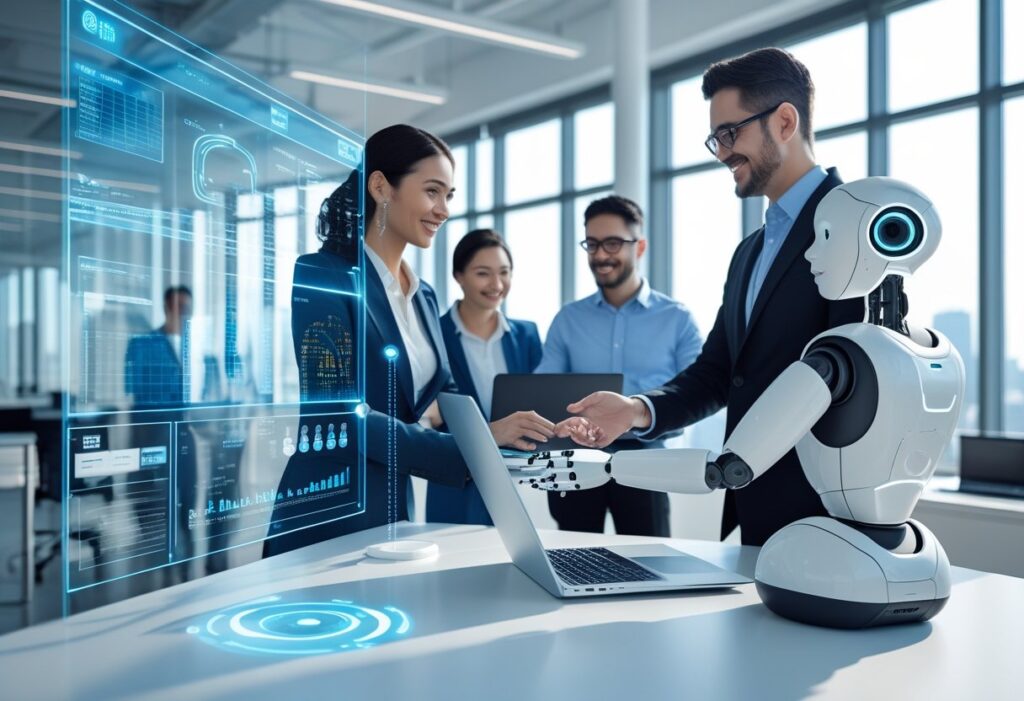
It’s a natural question. Let’s break down which types of jobs are most likely to be impacted.
H2: The “High Risk” Jobs (For Automation)
Jobs that are highly routine, repetitive, and follow clear rules are the most likely to be heavily automated. These are often jobs where the main task is processing information, not dealing with people or physical objects.
- Data Entry Clerks: AI can handle data faster and more accurately.
- Telemarketers: AI-powered robocalls and chatbots are already taking over.
- Bookkeepers and Accountants (for basic tasks): Software can now categorize expenses, reconcile transactions, and even file simple taxes.
- Factory Assembly Line Workers: We’ve seen this for decades. Robots are already doing much of this work.
- Cashiers: Self-checkout and Amazon’s “Just Walk Out” technology are a clear sign of this trend.
- Bank Tellers: With online banking and apps, fewer people need to visit a physical branch for routine transactions.
The important note here: These jobs won’t vanish overnight. But the number of these roles will likely decline significantly. People in these fields will have the opportunity to upskill into new roles within their industries.
H2: The “Low Risk” Jobs (AI Augments, Doesn’t Replace)
Jobs that rely heavily on human interaction, creativity, empathy, complex problem-solving, and physical dexterity in unpredictable environments are the safest.
- Healthcare Professionals (Doctors, Nurses, Therapists): The human touch is irreplaceable in healing.
- Skilled Trades (Electricians, Plumbers, Carpenters): Every house is different. Every problem is unique. You need a human to diagnose the issue and physically fix it in a messy, unpredictable environment. An AI can’t crawl under your house to fix a pipe.
- Teachers and Childcare Workers: Nurturing and educating young minds is deeply human work.
- Creative Professionals (Artists, Writers, Musicians, Designers): While AI can create content, the soul of art comes from human experience. The demand for authentic human creativity will likely increase, not decrease.
- Managers and Leaders: Making tough decisions, motivating a team, navigating office politics, and setting a vision are all profoundly human skills.
- First Responders (Police, Firefighters, Paramedics): These jobs require split-second decisions in life-or-death situations, driven by instinct and courage, not just data.
H1: How to “AI-Proof” Your Career: A Practical Guide
Okay, so we know the future is about change. The big question is: what can you do about it? How do you make sure you’re on the right side of this shift?
It’s simpler than you think. You don’t need to become a computer programmer. You just need to become a better human. Focus on the skills that AI lacks.
H2: Develop Your “Soft Skills” (Which Are Actually Your Hard Skills)
These are your superpowers. In an automated world, these will be your most valuable assets.
- Critical Thinking: Don’t just accept information. Question it. Why is this project failing? What’s the real root of this customer’s problem? AI can give you data, but you need to think critically about what it means.
- Emotional Intelligence (EQ): Work on understanding your own emotions and those of others. Learn to manage conflict. Practice active listening. Be the person on the team who can read the room and build bridges.
- Creativity and Innovation: Train your brain to think of new ideas. Read books outside your field. Pick up a hobby. Take a different route to work. Novel experiences fuel creative thinking.
- Communication and Collaboration: Can you clearly explain a complex idea? Can you lead a team meeting effectively? Can you write an email that actually gets people to take action? These skills are pure gold.
- Adaptability and a Growth Mindset: This is the most important one. Believe that you can learn new things. See challenges as opportunities to grow. Be excited about change, not scared of it.
H2: Learn to Work With AI, Not Against It
You don’t have to build AI, but you should learn how to use it.
- Get Hands-On: Go play with some free AI tools. Try ChatGPT or Gemini. Use an AI image generator like Midjourney or DALL-E 2 (there are free versions). See what they’re good at and what they’re bad at. The more you use them, the less scary they become.
- Think About Your Own Job: This week, pay attention to your daily tasks. Ask yourself: “Which of these tasks is repetitive and rule-based?” “Could AI help me do this faster?” For example, could AI help you draft emails, summarize long reports, brainstorm ideas for a project, or organize your data? If you can identify these tasks, you can start using AI as your personal assistant.
- Become the “Translator”: In every company, there will be a gap between what the business needs and what the technology can do. You can become the person who bridges that gap. You can learn enough about AI to say to the tech team, “I need an AI tool that can help our sales team with X,” and enough about sales to explain to the team how to use it.
H2: Focus on Lifelong Learning
The idea of getting one degree and working for 40 years is over. The future is about constantly adding new skills.
- Online Courses: There are millions of free or cheap courses online on platforms like Coursera, edX, and Khan Academy. Want to learn the basics of data analysis? There’s a course for that. Want to improve your public speaking? There’s a course for that.
- Micro-Credentials: Look for short, focused certifications in areas like project management, digital marketing, or even “AI for Everyone.”
- Read and Stay Curious: Just read one article a week about how technology is changing your industry. Talk to people in your field. Ask them what new tools they’re using.
H1: Frequently Asked Questions About AI and Jobs
Let’s tackle some of the common questions that might still be on your mind.
H3: Will AI cause mass unemployment?
Most experts don’t think so. History shows us that technology creates more jobs than it destroys, but the jobs are different. The challenge isn’t a lack of jobs, but a mismatch of skills. The focus needs to be on helping people retrain for the new roles that are created.
H3: What about Universal Basic Income (UBI)?
UBI is the idea that the government gives every citizen a regular sum of money, regardless of their job status. It’s a hot topic in AI discussions. Some believe it will be necessary to support people displaced by automation. Others think the economy will adapt on its own. It’s a complex idea, and it’s not clear yet if it will be needed or how it would work.
H3: Is my creative job safe? (Writer, Artist, Musician)
Your job is safe from being replaced, but it will definitely be changed. Think of AI as a new, powerful tool in your creative toolbox. A photographer didn’t stop being an artist when cameras went from film to digital. They just had a new way to create. The same is true here. The value will shift from the technical act of creation to the creative idea and the unique human perspective behind it.
H3: I’m a student. What should I study?
This is a great question! Instead of picking one narrow field, think about building a “T-shaped” skillset. The vertical bar of the “T” represents deep expertise in one area (like nursing, teaching, or graphic design). The horizontal bar represents a broad understanding of many things, especially the human skills we talked about (communication, collaboration, critical thinking). And it’s a great idea to have some basic digital literacy, like understanding how to work with data.
Conclusion: Don’t Fear the Future, Build It

Look, it’s natural to feel a little anxious. Change can be unsettling. But the story of AI and the future of work doesn’t have to be a scary movie. It can be an exciting story of human potential.
AI is not a job-killer. It’s a task-changer, a job-transformer, and a new-tool-creator. It’s a mirror that reflects what makes us uniquely human: our creativity, our empathy, our ability to connect, and our drive to solve problems.
The future belongs not to the AI, but to the people who learn to work with it. It belongs to the electrician who uses AI to diagnose a complex problem faster. It belongs to the nurse who uses AI to handle paperwork so she can spend more time with her patients. It belongs to the teacher who uses AI to give each student a personalized learning experience.
The jobs of the future will be built at the intersection of human and machine. So, stay curious, keep learning, and double down on what makes you human. That’s a job security plan that no robot can ever take away from you.