
For decades, Venus has been known as Earth’s hotter, cloud‑shrouded twin, a world of crushing pressure and scorching heat. Now, scientists have discovered something else beneath that broiling surface—a vast underground cave carved by volcanoes long ago.Using old radar data from NASA’s Magellan mission, a team from the University of Trento has found a giant lava tube running under the volcano Nyx Mons, demarcated by a mysterious “skylight” and strange radar patterns. This is the first time researchers have seen direct radar evidence of a genuine subsurface conduit on Venus, and the findings have been published in a Nature study.
Astronomers confirm a giant volcanic cave on Venus
For the first time, astronomers have strong evidence of a giant volcanic cave hidden beneath the surface of Venus. By reanalyzing radar images from NASA’s Magellan mission, a team at the University of Trento has identified what appears to be a massive lava tube under the volcano, Nyx Mons, a large shield volcano and mountain region on Venus. “The study marks the first direct radar evidence of a subsurface conduit on our neighboring world,” as the paper explains.
Representative Image
A hidden cave beneath Nyx Mons volcano
The structure lies on the western flank of Nyx Mons, a broad shield volcano about 362 kilometers across, often described as being “a mighty 225 miles wide”. On the Magellan radar images, the unique landscape is a dark, collapsed pit surrounded by a chain of similar depressions. The researchers call the main one “Pit A.”On most such pits, the radar echo simply shows a steep hole, but Pit A behaves differently. Its signs include a bright, asymmetric streak that stretches beyond the rim, a pattern that matches when radar waves enter a skylight, bounce along an underground tunnel and then scatter back to the spacecraft sensors. The team therefore interprets Pit A as a skylight, or a collapsed roof opening into a lava tube that once carried molten rock beneath the surface.
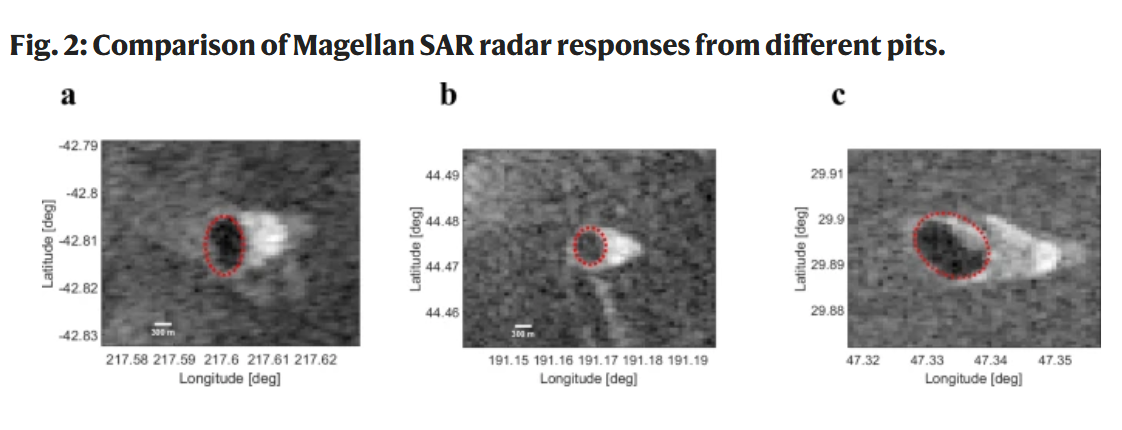
A pit near Idunn Mons. b A pit in Ganiki Planitia and c the candidate skylight denoted A near Nyx Mons shown in Fig. 1. (Photo: Nature study)
Reading a cave from radar echoes
Because Venus is wrapped in thick clouds that block normal light, optical cameras cannot see the ground, so Magellan relied on Synthetic Aperture Radar in the early 1990s to build a global map instead. The Italian team treated these radar images “like an X‑ray of the terrain,” using techniques initially developed to study lava tubes on the Moon and Earth.By measuring the length of the radar brightening inside Pit A and the shadow it casts, they could estimate the shape of the hidden void. The tube is estimated to be roughly 1 kilometer wide on average, with a roof at least 150 meters thick and an empty space below that is no less than about 375 meters high, according to the study. Radar echoes show the signal traveling inside the tube for at least 300 meters from the skylight, and the alignment of nearby pits and the slope of the terrain suggests the full system may extend for around 45 kilometers beneath Nyx Mons volcanoes.
Why are lava tubes on Venus important?
Lava tubes are more than just geological curiosities; they preserve a record of how volcanoes erupted and cooled over time. On Mars and the Moon, such tubes are also considered potential shelters for future explorers, since rock walls can block radiation and micrometeorites.On Venus, the surface is far too hot, almost above 450 degrees Celsius, and the air pressure is more than ninety times that of Earth for anyone to camp in such a cave soon.Even so, the discovery is significant because Venus is often called Earth’s twin that took a very different path, ending up with a runaway‑greenhouse atmosphere loaded with carbon dioxide and sulfuric‑acid clouds,So, understanding how its volcanoes work helps scientists piece together how the planet lost any past oceans and turned into the extreme world we see today.