
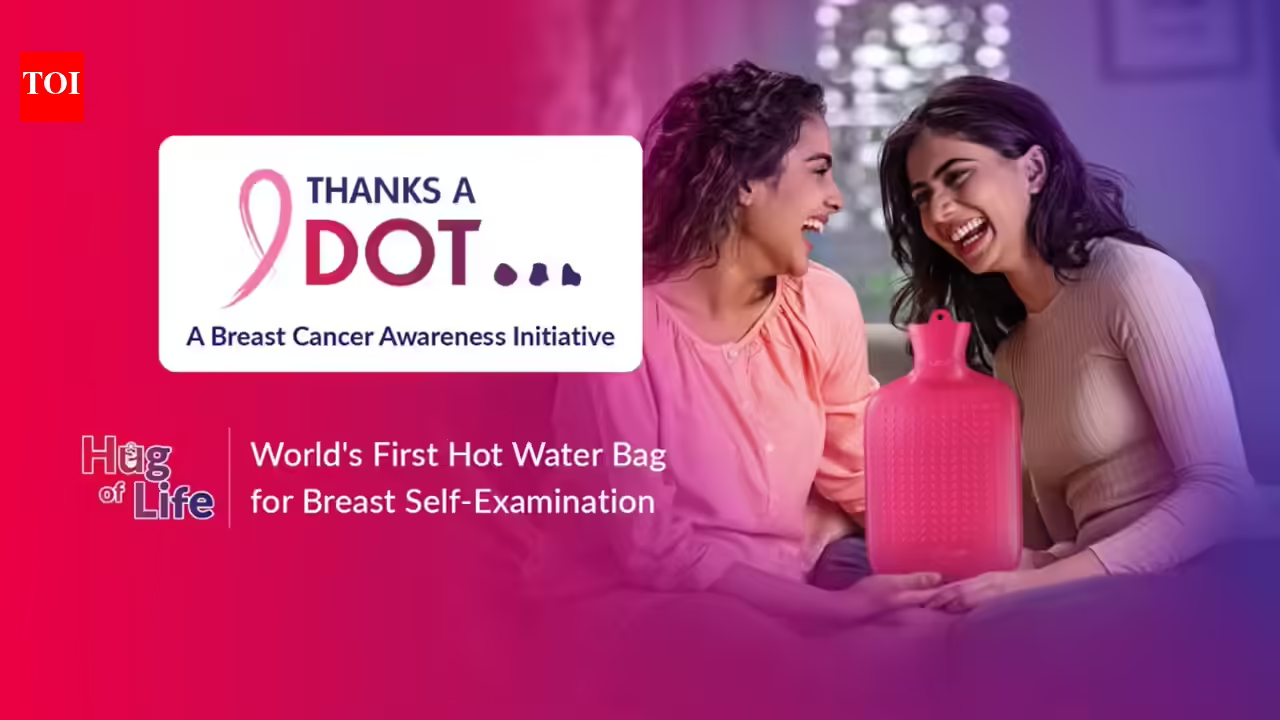
Indian women run homes, build careers, and hold families together, often all at once. In the rhythm of daily responsibilities, one thing is frequently overlooked: their own health. Not out of neglect, but because there is always something else that feels more urgent.And when it comes to breast health, that silence runs even deeper. Breast cancer is today the most common cancer among Indian women, accounting for 13.5% of all new cancer cases.1. Yet awareness about it and the habits that can make a real difference remain limited. A monthly breast self-examination is simple, free, and takes under ten minutes, but continues to be under-practiced, largely but due to lack of awareness and conversation.The habit that starts with youThe most powerful tool in breast health is not a machine or a medical procedure but a woman’s own awareness of her body. According to the American College of Obstetricians and Gynecologists2approximately 71% of breast cancer cases in women under 50 are first detected by the women themselves. A monthly self-examination is not a clinical exercise reserved for hospitals. It is a simple, ten-minute habit that any woman can adopt in the privacy and comfort of her own home.Since 2019, SBI Life’s Thanks A Dot– a breast cancer awareness initiative has been working towards turning this simple practice into monthly habit for women across India. The initiative champions three interconnected ideas: regular self-examination, open conversation within families and communities, and the understanding that early detection is the most powerful tool a woman has in protecting her own health. The initiative also underscores that being prepared emotionally, physically, and financially is part of taking charge of one’s health.The initiative took this mission a step further with the Hug of Lifea reimagined hot water bag, already familiar in most Indian households. These lumps help women develop tactile sensation on their fingertips, training them to understand what a real lump feels like. Heat-responsive design on the bag changes color when filled with hot water, serving as a monthly reminder to self-examine. The ideal time to self-examine is seven days after the start of the menstrual cycle, when breast tissue is least dense. The Hug of Life integrates this practice into an existing moment of quiet comfort of warmth, turning it into a potentially life-saving habit.If anything feels different like a lump, a change in texture, or any irregularity, the step forward is clear: visit the nearest doctor without delay. ICMR-supported research3,4 consistently highlights that early detection remains one of the most viable and impactful tools for improving breast cancer outcomes in India, particularly in settings where access to organized screening is limited. Awareness is only one part of the journey. Thanks A Dot also encourages women to think about financial preparedness as an integral aspect of their health journey. A timely diagnosis means little if the path to treatment feels financially out of reach. SBI Life, as an insurance provider, recognizes that being health-aware and financially prepared are two sides of the same coin and that empowering women means addressing both.One conversation, one household at a timeThe Hug of Life kit is designed to bring breast health into the living room. For a subject that has long been spoken about in whispers, if at all, the kit becomes a reason for mothers and daughters, friends and neighbors, to have the conversation openly. That cultural shift from silence to dialogue is at the heart of what Thanks A Dot has always set out to achieve.The invitation is simple: learn the habit, and share it with the women around you. Because awareness, passed from one woman to another, is how a quiet conversation at home becomes a movement.For more information, visit the website.References –
- PMC / World Journal of Clinical Oncology, Mehrotra, R., & Yadav, K. (2022). Breast cancer in India: Present scenario and the challenges ahead. World Journal of Clinical Oncology, 13(3), 209–218. https://doi.org/10.5306/wjco.v13.i3.209
- ACOG Practice Bulletin No. 179 (Obstetrics & Gynecology / LWW), Committee on Practice Bulletins—Gynecology. (2017). Practice Bulletin Number 179: Breast cancer risk assessment and screening in average-risk women. Obstetrics & Gynecology, 130(1), e1–e16. https://doi.org/10.1097/AOG.00000000000002158
- ICMR Breast Cancer Guidelines (Government of India), Indian Council of Medical Research. (nd). Consensus document for management of breast cancer. Ministry of Health and Family Welfare, Government of India. https://www.icmr.gov.in/icmrobject/custom_data/pdf/resource-guidelines/Breast_Cancer.pdf
- JCO Global Oncology / ASCO (NCRP Cancer Statistics), Mathur, P., Sathishkumar, K., Chaturvedi, M., Das, P., Sudarshan, KL, Santhappan, S., Nallasamy, V., John, A., Narasimhan, S., Roselind, FS, & ICMR-NCDIR-NCRP Investigator Group. (2020). Cancer statistics, 2020: Report from National Cancer Registry Programme, India. JCO Global Oncology, 6, 1063–1075. https://doi.org/10.1200/GO.20.00122
Note: This should not be considered a substitute for medical advice. Please consult your treating physician for more details.Disclaimer: This article has been produced on behalf of SBI Life Insurance by Times Internet’s Spotlight team.