
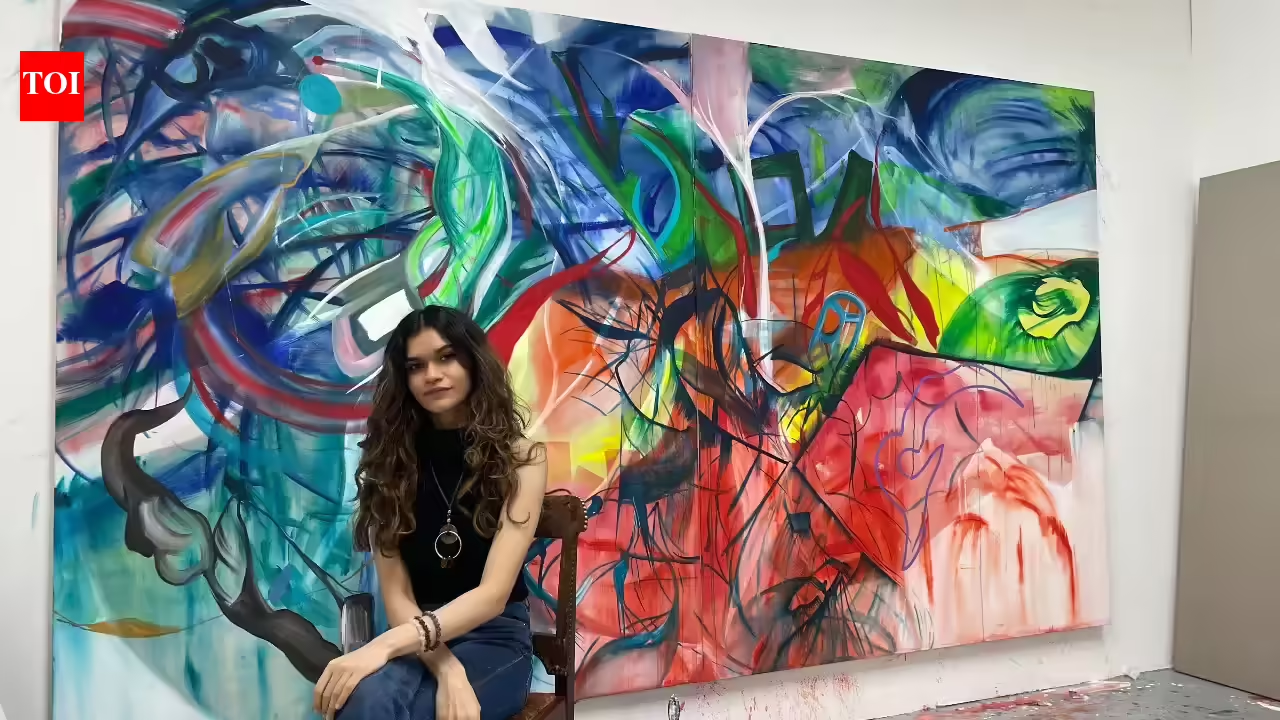
In a seamless interplay of abstraction and surrealism, the artworks of Mannat Gandotra, an artist based in London emerge as a dynamic system that is fluid, multi-layered, and ever-evolving. Incorporating the underlying philosophy behind Ragamala painting without falling prey to any preconceived frameworks, her artworks function as gateways to both conflict and change. In a detailed interview with Etimes Lifestyle, she shares insights into her spontaneous approach to painting, the concept of “madness” as a heightened form of consciousness rather than chaos, and the diverse reception her artworks receive from international audiences.How would you describe your art style to someone seeing your work for the first time?I would describe the paintings as sitting within abstraction, they have a surrealist logic in terms of automatism, if we are to place them within a category. But they are more like systems than images, operating like internal and external ecosystems—almost like a soundscape or a language that is unfolding and that I’m exploring. So there is a sense of dichotomy and dualism within the paintings. Each canvas feels self-contained and independent, just as the forms and colors feel like they are trying to be independent, almost like a droplet. They hold a complete universe within them, even microcosms, different internal worlds, or paintings within paintings. But at the same time, I would like to think that each painting extends beyond itself. It extends beyond the canvas, beyond the edges, so that the line in the painting is not only on the surface but inside it, sliding through, gliding through, going toward another dimension.You draw inspiration from traditional Ragamala painting while working within a contemporary abstract framework. How do you reconcile or reinterpret this cultural lineage in your work today?Ragamala feels more like a system of thinking and questioning about emotion, moods, time, and sensation through image, rather than its physics. I’m interested in absorbing and expanding on the essence and ethos it contains. Structural echoes might surface, but they aren’t protected. They’re interrupted or pushed off balance.I think of the miniatures as elegant amalgamations of these questions. They aren’t just visualisations of music, but rather their own musical mode. In that sense, I think ragamalas resist hierarchical structures themselves. My paintings also resist that. There isn’t always a fixed center or a dominant order in the paintings, or cerebral schemas that close doors rather than open them.I’m also drawn to Ragamala’s use of color and containment, its borders, and its fierce linearity. The miniature, by its very nature, asks you to stand still in front of it, to be fully absorbed by it. Even if it is not expansive in scale, it becomes expansive in our peripheral vision. It becomes a kind of portal through its architecture and complexity. It’s not something you can glance at and move on from.What inspires you the most when you start a new piece?It doesn’t begin with a preconceived idea. It begins more as a question, a sentence I’ve written, or a feeling—something that needs to be lingered on and that might continue. It often starts with a mark, a line, or a wash. The moment that happens, it becomes an ignition point. One stroke leads to another, and the painting begins to unfold from there. Much like improvised free jazz, one note sits on top of another, each one responding to what came before it.As the painting progresses, a lot of tension begins to build. There are disruptions and ruptures within it, and I’m trying to hold that tension or bring more of it into the work. Your recent exhibition, “Containers of Madness,” suggests an intense emotional and conceptual space. What does “madness” represent to you in the context of your art, and how did this body of work evolve?This madness is not disorder, but rather an intensity that doesn’t seek resolution in the conventional sense. It’s about an uncomfortable state, a lack of linear perception within the painting, and a resistance to stabilization or tonality within the work.So the madness is not just about the act of making, or about me. It exists within the painting itself, in what it entails. The forms and colors feel like they are trying to be independent, and the line, and the way all of these elements interact within the configuration of the canvas, become part of that condition.I’m also thinking about atonality and nature’s defiance of symmetry. Color combinations that aren’t meant to sit together are forced into proximity and made to coexist. Ultraviolet next to a vermillion red that doesn’t want to be there, but is. That kind of containment, of holding things together that resist one another, becomes important. It feels like a flowing river interrupted by rocks. The painting carries movement, but the forms create points of resistance within it, and that friction adds to the madness.Having exhibited across continents—from London to New York to Japan—how have different cultural audiences influenced your perspective, and do you find your work being interpreted differently in each context?The interpretations definitely shift depending on where the paintings are being seen. In London, there is often a more theoretical reading, a tendency to approach them through ideas and frameworks. In Japan, I’ve felt a stronger sensitivity towards the architecture of the painting, the movement of the line—whether it is fractured or precise—and the way it is constructed. In New York, the response feels more centered on the image as a whole, the immediate encounter with it.I find these differences interesting because they show that the paintings don’t sit within a singular narrative. They are also very much shaped by the viewer and their experience. But as an artist, that is not something I’m consciously making the paintings for.Do you have a favorite piece you’ve created so far? What makes it special to you?I don’t think I have a single favourite, but there are certain paintings that feel like turning points or boiling points within the practice. They feel difficult, like they ask something of me.One such painting is from the last year of my undergraduate, called The Sore Throat. I still have it hanging in my living room and I never wish to part with it. It has quietly haunted me and continues to push me to defy formulaic rhythm, introducing disruptions like speed bumps within the flow and atonality within the painting. It’s on unprimed canvas, where the surface itself becomes a colour. On paper, it might not seem like the most resolved painting, or even the one most associated with my work, but it still sits within that framework, just more skeletal and less flesh.