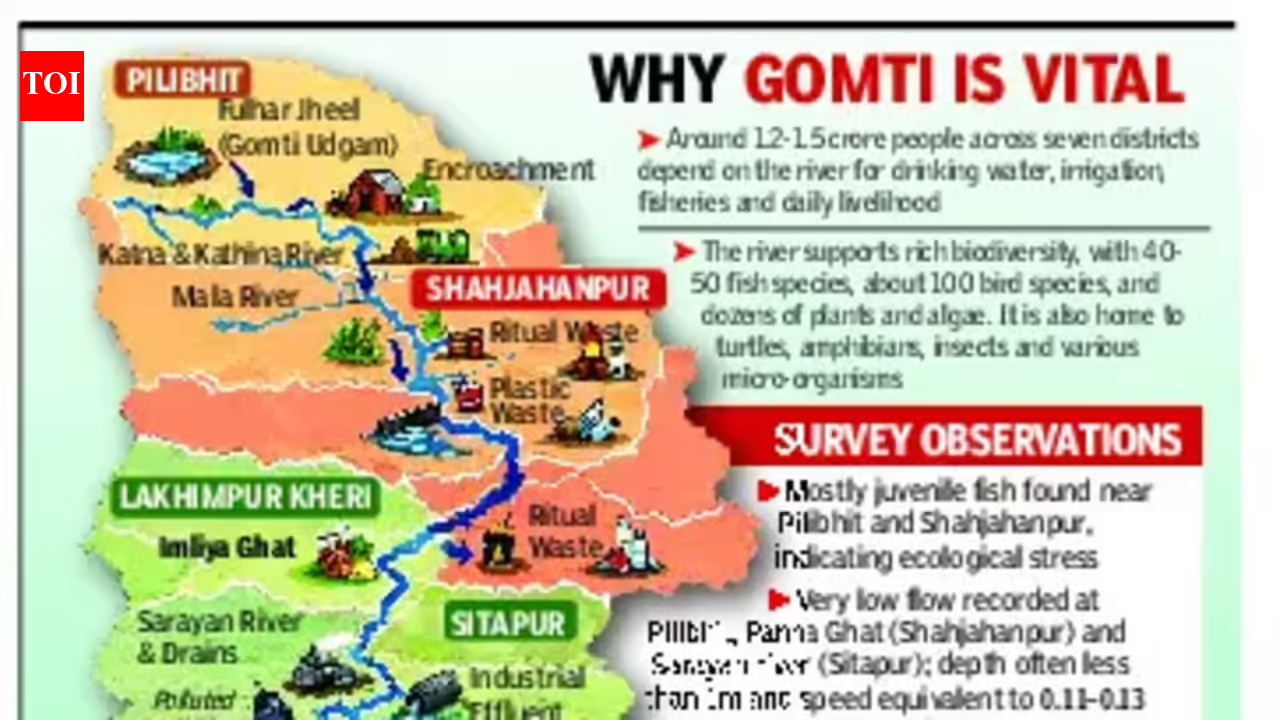
Lucknow: Gomti, the lifeline for 1.5 crore people and home to more than 200 species of flora and fauna, is slowly drying up due to multiple reasons, mostly caused by human activity and some natural factors, reveals a recent field survey by a team from Babasaheb Bhimrao Ambedkar University (BBAU).The survey covered the river’s origination point in Pilibhit and districts like Shahjahanpur, Lakhimpur Kheri, Sitapur and Hardoi through which it flows.In Pilibhit, about 15 km near the origin was found to be dry due to very low water at the source (Fulhar Jheel) and disruption of natural flow. The river’s flow was also slow across Pilibhit, Shahjahanpur, Lakhimpur Kheri and Sitapur.The river was found to be shallow and narrow at several stretches, leading to the spread of invasive plants like water hyacinth. Congress grass was also found in abundance along some banks, restricting natural vegetation growth.These conditions were seen at multiple locations, including near Fulhar Jheel (Madhotanda, Pilibhit), Triveni Ghat (Ghatampur), Panna Ghat (Shahjahanpur), Imliya Ghat (Lakhimpur Kheri) and stretches across Sitapur and Hardoi, where reduced flow and degraded banks have allowed invasive species to spread.Across these areas, clearing of natural vegetation, unprotected wetlands and encroachment through farming and construction along both banks were recorded, further weakening the river system.The survey also found that several tributaries of the Gomti are under stress. The Katna stream in Piparia Bhaja (Pilibhit) has become seasonal and remains almost dry or stagnant during non-monsoon months, while the Bhainsi river in Shahjahanpur often dries up in summer.The Kathina river near Sukatiya (Pilibhit-Lakhimpur Kheri stretch) shows reduced depth and slow flow due to encroachment and sand mining. Similarly, the Behta river in Hardoi has weakened flow due to land leveling for farming, indicating that many tributaries either carry very little water or face periodic drying.The survey further revealed that excessive groundwater abstractions near the river has caused irreversible damage to the baseflows resulting in loss of water in the river. There is a possibility of augmentation particularly at the Sharda canal bifurcation point in Puranpur (Madhotanda, Pilibhit) and through the Devipur minor near Fulhar Jheel. However, this water is not adequately returned during low-flow periods, reducing flow in downstream stretches across Lakhimpur Kheri, Sitapur and Hardoi.Pollution levels were found to be high at several locations along the Gomti. At Triveni Ghat (Ghatampur, Pilibhit) and Panna Ghat (Shahjahanpur), the river is polluted due to ritual waste, flowers, cloth and plastic dumping linked to religious activities.At Imliya Ghat (Lakhimpur Kheri), picnic and recreational waste, especially thermocol plates and single-use plastics, was observed along the banks.In Sitapur, the Sarayan river near Hargaon — a major tributary — is polluted by untreated wastewater from nearly 40 drains and discharge from a sugar mill, along with agricultural runoff, leading to algal growth.In Hardoi, the Sai river at Bhajehata showed fecal contamination due to open defecation.Across multiple stretches in Pilibhit, Shahjahanpur, Lakhimpur Kheri, Sitapur and Hardoi, domestic waste and plastic litter were also found along the riverbanks, largely due to poor waste management and low water flow, which reduces the river’s natural ability to clean itself.“Human behaviour, lack of coordination between authorities, and administrative negligence have all contributed to the present condition of the Gomti,” said Prof Venkatesh Dutta, head of the department of environmental science, who led the survey.He said the river can still be revived by ensuring minimum flow at the source at Fulhar Jheel. Researchers Rakesh Singh Kushwaha and Ankit Kumar added that at least 20 cusecs of water should be supplied from the Sharda canal system to sustain downstream flow.The team stressed protecting wetlands and natural drainage channels, removing encroachments and safeguarding riverbanks to support recovery. Prof Dutta said that low-cost, nature-based solutions can improve flow.“The condition of the Gomti is reversible, but only if timely and coordinated action is taken,” said researchers Komal Loshali, Pragati Sharma and Ayusma Yadav.