

Types of Artificial Intelligence Explained with Real Examples. Hey there! Have you ever wondered how Netflix seems to know exactly what show you want to watch next? Or how your email automatically filters out those annoying spam messages? Well, you’re interacting with artificial intelligence (AI) every single day, probably more than you realize.
Types of Artificial Intelligence.
So grab a cup of coffee, get comfortable, and let’s explore the fascinating world of AI together!
What Exactly is Artificial Intelligence?
But here’s the kicker – AI isn’t just one thing. It’s a whole family of technologies, kind of like how “vehicles” includes cars, trucks, motorcycles, and buses. They all move you from point A to point B, but they work differently and serve different purposes.
Part 1: Types of AI Based on Capabilities
1. Narrow AI (Weak AI)
Real-Life Examples You Know:
- Siri or Google Assistant: Your phone’s voice assistant can answer questions, set reminders, or play music. But Siri can’t drive your car or cook you dinner. It’s great at voice commands and nothing else.
- Netflix Recommendations: Have you noticed how Netflix suggests shows based on what you’ve watched? That’s Narrow AI analyzing your viewing history. But that same AI can’t help you write an email or recognize your face in photos.
- Spam Filters: Your email service uses AI to detect spam messages. It’s learned to spot suspicious emails, but that’s its only job.
- Facial Recognition on Your Phone: When your iPhone unlocks using Face ID, that’s Narrow AI. It’s trained to recognize your face, but it can’t do your math homework!
Fun Fact: Even though we call it “Weak AI,” it’s actually incredibly powerful in its specific area. Google’s AlphaGo, which beat the world champion at the complex game Go, is technically Narrow AI. It’s a genius at Go but knows nothing else!
2. General AI (Strong AI)
What is it?
General AI, or Strong AI, is the holy grail of artificial intelligence. This would be a machine that has human-level intelligence. It could learn, understand, and apply its intelligence to solve any problem, just like you or me. It would have consciousness, emotions, and self-awareness.
Where Can You Find It?
Nowhere yet. General AI doesn’t exist. It’s still in the realm of science fiction and theoretical research. Scientists and engineers are working toward it, but we’re probably decades away (if it’s even possible).
Examples from Movies:
- Data from Star Trek: The android character could think, feel, learn, and even try to understand humor. That’s General AI.
- The robots in I, Robot: They could reason, make decisions, and interact with humans naturally.
- HER (the movie): The AI operating system Samantha could have conversations, develop emotions, and form relationships.
3. Superintelligent AI
Sounds Scary, Right?
This is where things get philosophical. A superintelligent AI could solve problems we’ve struggled with for centuries – curing diseases, solving climate change, or achieving world peace. But it could also pose risks if its goals don’t align with human values.
Examples in Pop Culture:
- Skynet from Terminator: An AI system that becomes self-aware and decides humans are a threat.
- The Matrix: AI that has taken over the world and uses humans as energy sources.
- HAL 9000 from 2001: A Space Odyssey: An AI that runs a spaceship and makes its own (sometimes deadly) decisions.
Part 2: Types of AI Based on Functionality.

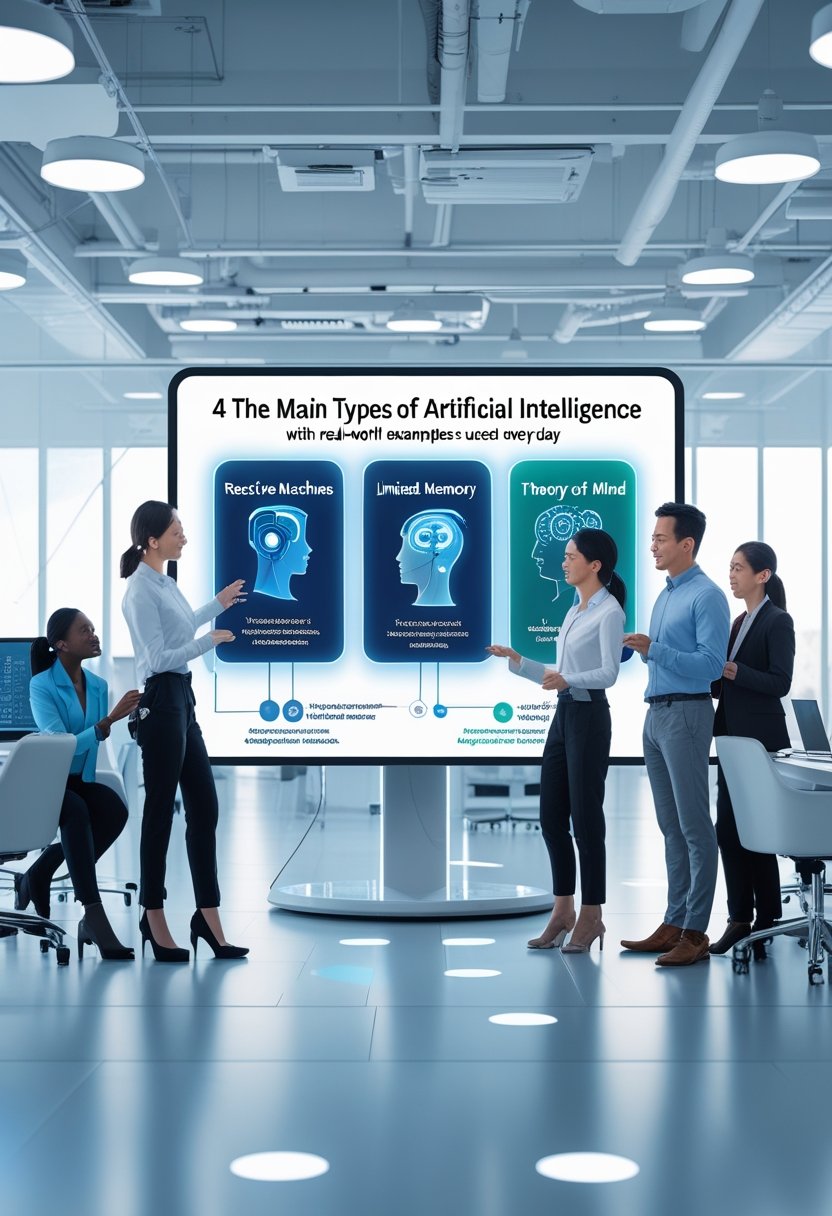
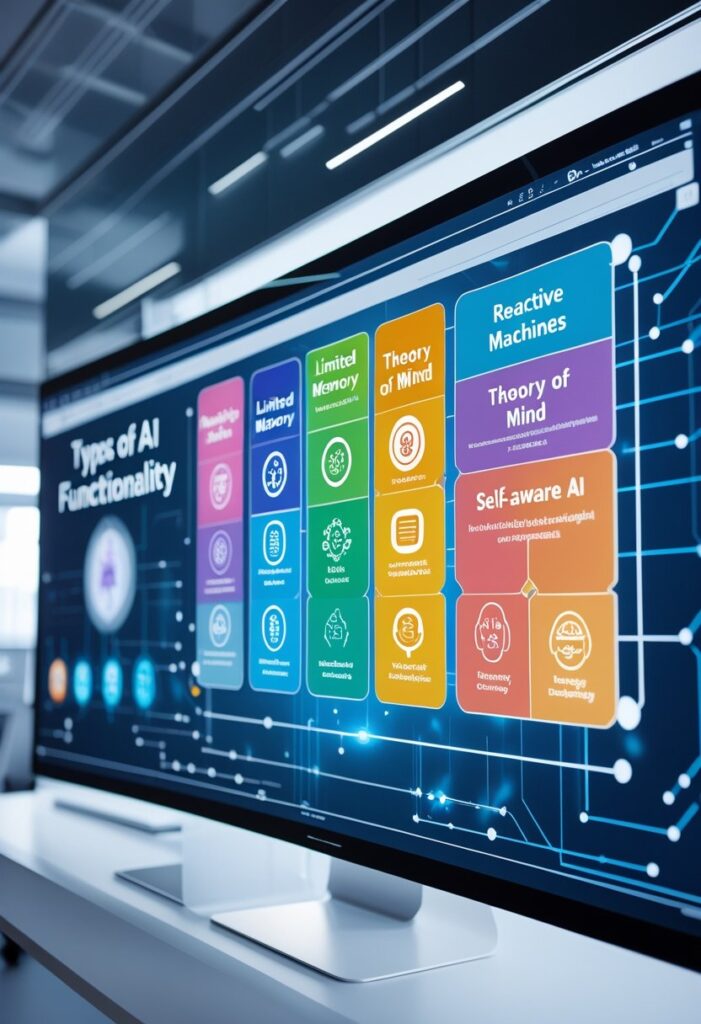
Now let’s look at AI based on how it works and remembers. This classification is like looking at the “memory” and “learning” capabilities of AI systems. There are four main types here.
1. Reactive Machines
What are they?
These are the most basic types of AI systems. They don’t have memory and can’t learn from past experiences. They simply react to current situations based on pre-programmed rules. It’s like a chess player who looks at the board and makes a move without remembering previous games.
Key Characteristics:
- No memory capability
- Cannot learn from past actions
- Responds only to current input
- Very reliable for specific tasks
Real-World Examples:
- IBM’s Deep Blue: Remember when IBM’s computer beat chess champion Garry Kasparov in 1997? Deep Blue was a reactive machine. It analyzed the chess board and calculated the best move, but it didn’t learn from previous games or remember Kasparov’s playing style.
- Spam Filters (basic ones): Some simple spam filters use rules like “if an email contains ‘Viagra,’ mark it as spam.” They don’t learn; they just follow rules.
- Traffic Lights: Basic traffic lights work on timers. They react to the time of day, not actual traffic conditions.
The Limitations:
Because reactive machines can’t learn, they’re limited to specific situations. Deep Blue could beat a chess grandmaster but couldn’t do anything else – not even play checkers!
2. Limited Memory AI
What is it?
This is where things get interesting. Limited Memory AI can look at past data and learn from it. These systems are trained on data that they “remember” for a short time and use that information to make better decisions.
This is the AI we use today!
Almost all modern AI applications fall into this category. They learn from historical data and improve over time.
Real-World Examples You Use:
- Self-Driving Cars: This is a perfect example. A self-driving car observes the speed of other cars, the actions of pedestrians, road signs, and lane markings. It uses recent observations (like “the car ahead is braking”) to make immediate decisions. It also learns from millions of miles of driving data collected from other vehicles.
- ChatGPT and Other Chatbots: When you chat with ChatGPT, it looks at the conversation history (what you just said) to generate relevant responses. It also learned from billions of text examples during its training.
- Recommendation Systems: Netflix, Amazon, and Spotify all use limited memory AI. They remember what you watched, bought, or listened to in the past and suggest new things based on that history.
- Voice Assistants: Siri and Alexa get better at understanding YOUR voice over time because they remember your speech patterns and accents.
How It Works:
Limited memory AI uses machine learning algorithms. Engineers train the AI on massive datasets. The AI identifies patterns and creates a model. When you use it, it applies that model to new situations.
For example, Tesla’s autopilot has been trained on millions of hours of real driving footage. It “remembers” what typical driving situations look like and how to handle them.
3. Theory of Mind AI
What is it?
This is a more advanced type of AI that doesn’t fully exist yet. Theory of Mind AI would understand that humans have thoughts, emotions, beliefs, and expectations that influence their behavior. It would be able to interact socially with humans.
What Would It Do?
- Understand that you’re feeling sad and respond appropriately
- Recognize that you might have false beliefs
- Adapt its behavior based on your emotional state
- Have genuine conversations that feel natural
Where Is It?
Still in research labs. Psychologists and AI researchers are working on it, but we’re not there yet.
Potential Future Applications:
- Healthcare robots that understand patient anxiety and provide comfort
- Teachers who recognize when students are confused or bored and adjust their teaching style
- Customer service that actually understands your frustration and responds with empathy
- Companion robots for the elderly that can provide genuine emotional support
The Challenge:
Understanding human emotions is incredibly complex. Even humans sometimes misread each other! Teaching machines to genuinely understand feelings (not just fake it) is a huge scientific challenge.
4. Self-Aware AI
What is it?
This is the ultimate level of AI – machines that have consciousness, self-awareness, and a sense of identity. They would understand not only others’ emotions but also their own internal state. They would have desires, beliefs, and perhaps even rights.
Where Is It?
Pure science fiction. We’re not even close to this level of AI.
Philosophical Questions:
- If a machine is self-aware, does it have rights?
- Can we turn it off?
- Should we be afraid of it?
- What does it mean to be conscious?
Examples from Movies:
- The AI in Ex Machina: Ava, the robot, shows self-awareness, desire for freedom, and even deception.
- Wall-E: The little robot has personality, emotions, and desires – he’s curious, lonely, and falls in love.
- The replicants in Blade Runner: They have memories, emotions, and a desire to live longer.
The Technologies Behind AI: How Does It Actually Work?

Now that we know the types, let’s peek under the hood. How do these AIs actually work? Here are the main technologies powering today’s AI revolution.
Machine Learning (ML)
Machine Learning is the most common approach to AI today. Instead of programming explicit rules, we give the computer lots of examples and let it figure out the patterns.
How It Works:
Imagine teaching a child to identify cats. You don’t describe cats scientifically. You just point at cats and say “that’s a cat.” Eventually, the child learns what cats look like.
Machine learning works the same way. We show the computer thousands of cat photos, and it learns the patterns – fur, whiskers, pointy ears.
Real Example:
Google Photos can recognize your friends in pictures. You tag a few photos, and the AI learns to identify them automatically.
Deep Learning and Neural Networks
This is a more advanced form of machine learning inspired by the human brain. Neural networks are layers of interconnected “neurons” that process information.
Real Example:
When you use Facebook and it automatically tags people in your photos, that’s deep learning. The neural network has learned to recognize faces by processing millions of examples.
Natural Language Processing (NLP)
NLP helps computers understand, interpret, and generate human language. It’s why you can talk to Siri or type questions into ChatGPT.
Real Example:
Grammarly uses NLP to understand your writing and suggest improvements. It knows the difference between “their,” “there,” and “they’re” because it understands context.
Computer Vision
This technology enables computers to see and understand images and videos. It’s like giving eyes and a visual brain to computers.
Real Example:
When you use your bank’s app to deposit a check by taking a photo, computer vision reads the numbers and amounts on the check.
Real-World Applications: AI in Your Daily Life

Let’s get practical. Here’s where you’re actually using these different types of AI every single day.
At Home
- Smart Speakers: Amazon Echo and Google Home use Narrow AI (voice recognition, natural language processing) and Limited Memory (learning your preferences).
- Smart Thermostats: Nest learns your schedule and temperature preferences and adjusts automatically.
- Robot Vacuums: Roomba uses sensors and limited memory to learn the layout of your home and clean efficiently.
- Smart Fridges: Some refrigerators can track what’s inside and suggest recipes based on available ingredients.
On Your Phone
- Keyboard Predictions: When your phone suggests the next word as you type, that’s AI learning your writing style.
- Photo Organization: Your phone automatically creates albums and memories from your photos using facial recognition.
- Battery Management: AI learns your usage patterns and optimizes battery charging to extend battery life.
- Maps and Navigation: Google Maps uses AI to predict traffic and suggest the fastest routes based on historical data.
At Work or School
- Email Filters: Gmail’s spam detection and smart reply suggestions.
- Search Engines: Google uses AI to understand your search intent and find relevant results.
- Video Conferencing: Zoom’s background blur and noise cancellation use AI.
- Plagiarism Checkers: Tools like Turnitin use AI to compare your writing against millions of sources.
In Healthcare
- Disease Detection: AI can analyze medical scans to detect cancers earlier than human doctors sometimes.
- Drug Discovery: AI helps researchers find new medications by analyzing molecular structures.
- Personalized Treatment: AI recommends treatments based on patient history and genetic data.
- Virtual Health Assistants: Apps that answer medical questions and remind you to take medication.
In Entertainment
- Streaming Services: Netflix, Spotify, and YouTube use AI to recommend content you’ll love.
- Video Games: NPCs (non-player characters) use AI to behave realistically and challenge players.
- Social Media Feeds: Facebook, Instagram, and TikTok use AI to show you content you’re likely to engage with.
- Content Creation: AI tools can now write articles, create art, and even compose music.
The Future of AI: What’s Coming Next?
The field of AI is moving incredibly fast. Here’s what experts think we might see in the coming years.
Near Future (5-10 Years)
- More Personalization: AI will know you so well that it’ll feel like having a personal assistant who anticipates your needs.
- Better Healthcare: AI will help doctors diagnose diseases earlier and more accurately.
- Smarter Homes: Your home will automatically adjust lighting, temperature, and music based on your mood and schedule.
- Autonomous Vehicles: Self-driving cars will become common in more cities.
- AI in Education: Personalized learning programs that adapt to each student’s pace and style.
Medium Future (10-20 Years)
- General AI Breakthroughs: We might see the first glimpses of AI that can reason across multiple domains.
- Human-AI Collaboration: AI will work alongside humans in almost every profession, enhancing our capabilities.
- Advanced Robotics: Robots that can perform complex physical tasks in unstructured environments.
- Brain-Computer Interfaces: Direct communication between your brain and computers, enhanced by AI.
Long-Term Possibilities
- Superintelligent AI: If developed, this could transform civilization in ways we can’t predict.
- AI Companions: Robots or virtual beings that provide genuine emotional connection.
- Space Exploration: AI-powered probes and robots exploring distant planets and galaxies.
- Solving Global Challenges: AI helping to solve climate change, disease, poverty, and other major problems.
Common Myths About AI (Let’s Bust Them!)

There’s so much misinformation about AI out there. Let’s clear up some common misconceptions.
Myth 1: “AI Will Take Over All Jobs”
Reality: AI will change jobs, not eliminate them entirely. Just like the internet created new types of jobs we never imagined, AI will create new roles. Yes, some routine tasks will be automated, but new opportunities will emerge. Humans will work alongside AI, not be replaced by it.
Myth 2: “AI Has Consciousness and Feelings”
Reality: Today’s AI doesn’t feel anything. When ChatGPT says “I understand how you feel,” it’s mimicking understanding based on patterns, not actually experiencing emotions. It’s like a calculator that gives you the right answer but doesn’t understand math.
Myth 3: “AI is Only for Tech Experts”
Reality: You use AI every day without realizing it. From Google Maps to Spotify recommendations, AI is designed for regular people. You don’t need to understand how it works to benefit from it.
Myth 4: “AI is Always Right”
Reality: AI makes mistakes, sometimes embarrassing ones. Self-driving cars have had accidents. Recommendation systems suggest weird products. AI is powerful but not perfect. It’s a tool, not a magic solution.
Myth 5: “AI is Too Complicated to Understand”
Reality: The basic concepts are quite simple. You don’t need to know how to build a car to drive one. Similarly, you can understand and use AI without knowing the technical details.
Ethical Concerns: The Dark Side of AI
AI isn’t all positive. There are real concerns we need to address.
Privacy Issues
AI systems collect massive amounts of data about you. Your online activity, shopping habits, location history, and even your conversations are being analyzed. Who owns this data? How is it being used? These are important questions.
Bias in AI
AI learns from human-created data. If that data contains biases, the AI will too. For example, some hiring AIs have shown bias against women because they were trained on historical hiring data that favored men. Facial recognition systems sometimes work poorly on darker skin tones because they were trained mostly on light-skinned faces.
Job Displacement
While AI creates new jobs, it also eliminates others. Workers in certain industries (like manufacturing, data entry, customer service) may need to learn new skills. Society needs to help people transition.
Deepfakes and Misinformation
AI can now create incredibly realistic fake videos and images of people saying or doing things they never did. This technology could be used to spread misinformation, damage reputations, or even influence elections.
Autonomous Weapons
There are serious concerns about AI-powered weapons that could make life-and-death decisions without human involvement. Many experts are calling for international regulations.
The Control Problem
If we ever create superintelligent AI, how do we ensure it remains aligned with human values? This is a serious concern among AI researchers.
Frequently Asked Questions About AI
Q: Is AI dangerous?
A: Like any powerful technology, AI can be used for good or bad. The AI we have today (Narrow AI) is generally safe when designed properly. The concern is about future advanced AI, which is why researchers are working on safety guidelines.
Q: Can AI be creative?
A: Yes and no. AI can generate art, music, and writing that seems creative. But it’s really combining and remixing things it’s seen before. Whether that counts as “true” creativity is a philosophical question.
Q: Will AI become smarter than humans?
A: In specific tasks, AI is already smarter than humans (like playing chess or calculating complex math). General intelligence that matches humans across all tasks? Not yet, and maybe not for a long time.
Q: How do I start learning about AI?
A: Start with free online courses (Coursera, edX have great ones). Play with AI tools like ChatGPT. Read articles and watch videos. You don’t need to be a programmer to understand AI basics.
Q: Does AI have emotions?
A: No. Today’s AI can recognize emotions in text or speech, and it can respond in emotionally appropriate ways, but it doesn’t feel anything. It’s all pattern matching.
Q: What’s the difference between AI, machine learning, and deep learning?
A: Think of them as Russian dolls. AI is the biggest concept (machines doing intelligent things). Machine learning is a subset of AI (machines learning from data). Deep learning is a subset of machine learning (using neural networks with many layers).
Q: Can I trust AI with my personal information?
A: It depends on the company and how they handle data. Always read privacy policies (yes, they’re boring, but important). Use strong passwords and be careful what information you share.
Q: How much does AI cost?
A: Many AI tools are free (Google Search, Spotify recommendations). Others require subscriptions. For businesses, AI can be expensive to develop but often saves money in the long run.
Conclusion: Embracing Our AI-Powered Future
So there you have it – a complete guide to the types of artificial intelligence, explained with real examples you actually use. Let’s do a quick recap:
We have three types based on capabilities:
- Narrow AI: The only kind that exists today, great at specific tasks
- General AI: Human-level intelligence (still in the future)
- Superintelligent AI: Smarter than humans (theoretical)
And four types based on functionality:
- Reactive Machines: No memory, just react (like Deep Blue)
- Limited Memory: Learn from past data (most AI today)
- Theory of Mind: Understands emotions (in development)
- Self-Aware: Has consciousness (science fiction)
Here’s the thing to remember – AI isn’t some far-off future technology. It’s here, it’s in your pocket, and it’s making your life easier every day. That spam-free inbox? AI. Those perfect Netflix recommendations? AI. Your phone understanding your voice? AI.
But AI is also a tool, and like any tool, it depends on how we use it. The same technology that recommends your next favorite show could potentially be misused. That’s why it’s important for all of us – not just tech experts – to understand the basics.
The future of AI isn’t something that will just happen to us. We all get to be part of shaping it. By understanding what AI is, how it works, and what its limitations are, you’re already ahead of the game.
So the next time your phone suggests the perfect song or your car warns you about traffic, you’ll know exactly what’s happening behind the scenes. It’s not magic – it’s artificial intelligence, and now you’re in on the secret!
What type of AI do you use most in your daily life? Drop a comment below and let me know! And if you found this article helpful, share it with someone who’s curious about how technology works.