
Discover how Voice Recognition (Voice & NLP in ERP) and Natural Language Processing (NLP) are revolutionizing Enterprise Resource Planning (ERP). This 7000-word guide explores use cases, benefits, implementation strategies, and the future of conversational ERP.
The Dawn of a New ERP Era
For decades, Enterprise Resource Planning (ERP) systems have been the central nervous system of businesses, integrating everything from finance and supply chain to human resources and customer relations. Yet, for all their power, they have often been hampered by a critical bottleneck: the user interface. Complex menus, dense data fields, and a steep learning curve have meant that unlocking the full potential of an ERP required significant training and created a divide between the system and its users.
Today, we stand at the precipice of a fundamental shift. The convergence of mature Artificial Intelligence (AI) technologies, specifically Voice Recognition and Natural Language Processing (NLP), is transforming these monolithic systems from data repositories into intuitive, conversational partners. We are moving from a world of “point-and-click” to a world of “ask-and-tell.”
This article is a deep dive into this transformative integration. We will explore the core technologies, uncover practical use cases across every business function, weigh the immense benefits against the real-world challenges, and provide a blueprint for successful implementation. The future of ERP is not just automated; it is conversational, and it is here.
Deconstructing the Core Technologies
To understand the revolution, we must first understand the tools driving it. Voice and NLP are often used interchangeably, but they are distinct, complementary technologies.
What is Voice Recognition?
At its simplest, Voice Recognition (or Speech Recognition) is the technology that converts spoken language into text. It’s the foundational layer that allows a computer to “hear” you.
- How it Works: The process involves capturing audio via a microphone, digitizing it, and then breaking it down into phonemes (the distinct units of sound that distinguish one word from another in a particular language). Advanced algorithms and acoustic models then match these sound patterns to words and sentences in a vast vocabulary.
- Evolution: Early systems were speaker-dependent and required extensive training. Modern systems, powered by deep learning and neural networks, are speaker-independent, can handle diverse accents, and filter out background noise with remarkable accuracy. The proliferation of virtual assistants like Siri, Alexa, and Google Assistant has accelerated this maturity.
What is Natural Language Processing (NLP)?
If Voice Recognition is the “ears” of the system, NLP is the “brain.” NLP is a branch of AI that gives computers the ability to understand, interpret, and generate human language in a valuable way.
- Key Components:
- Natural Language Understanding (NLU): This is the hard part. NLU goes beyond literal word matching to grasp intent, context, sentiment, and nuance. It discerns that “What’s the forecast for Q4?” and “Show me projected sales for the last quarter” are essentially the same request.
- Natural Language Generation (NLG): This is the process of generating natural language text or speech from structured data. It’s what turns a database query result into a coherent sentence like, “The sales forecast for Q4 is $5.2 million, a 15% increase over the previous quarter.”
- How it Works: NLP models are trained on massive datasets of text and speech. They learn grammar, syntax, semantics, and even colloquialisms. Techniques like Named Entity Recognition (NER) identify and categorize key information (e.g., person names, dates, product codes), while sentiment analysis determines the emotional tone behind words.
The Symbiotic Relationship in an ERP Context
In an ERP system, these technologies work in concert:
- Voice Recognition captures the user’s spoken command: “Hey [ERP System], create a new purchase order for 50 units of component X from supplier Y.”
- NLP parses this command, identifying the intent (create a purchase order) and the entities (item: component X, quantity: 50, supplier: Y).
- The ERP’s backend logic executes the command, creating the PO in the database.
- NLG formulates a response, which is then delivered back to the user via text-to-speech: “Purchase order #45021 for 50 units of component X has been created and sent to supplier Y for approval.”
This seamless interaction masks a tremendous amount of complexity, delivering a simple, powerful user experience.
The Use Case Revolution: Voice & NLP Across the Enterprise
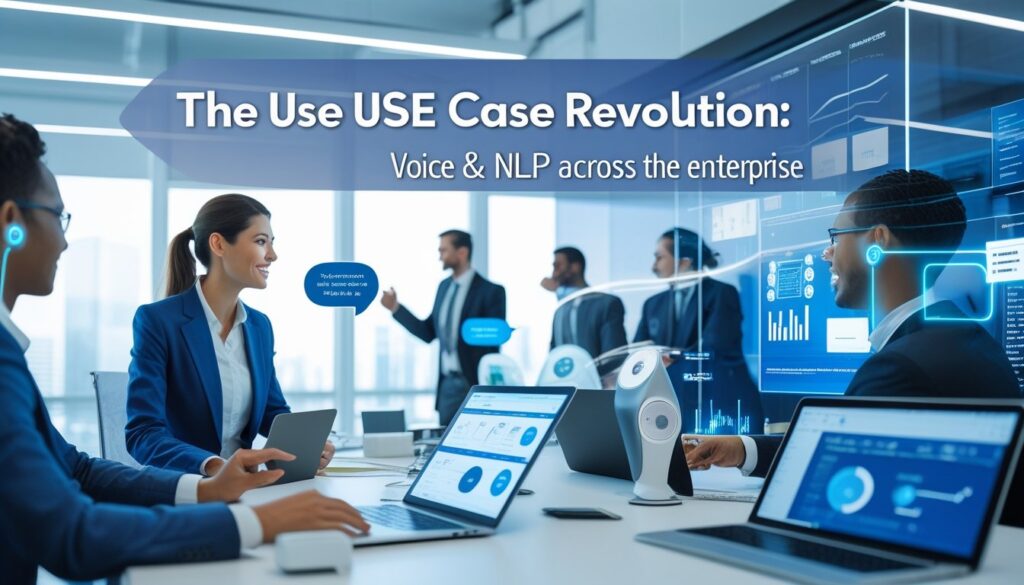
The true power of Voice and NLP is revealed in their practical application. Let’s explore how they are transforming core ERP modules.
Warehouse and Inventory Management: The Hands-Free Revolution
This is arguably the most mature and impactful application. In fast-paced warehouse environments, speed, accuracy, and safety are paramount.
- Voice-Directed Picking/Putting: Workers wear a headset and receive verbal instructions: “Pick 12 units of product A-245 from aisle 3, bin 7.” The worker confirms by speaking a check-digit or saying “Done.” This leaves their hands and eyes free, increasing picking speed by 15-35% and reducing errors by over 99% compared to paper-based systems.
- Inventory Counts: Auditing stock becomes vastly more efficient. An employee can walk the aisles and say, “I have 235 units of SKU B-112,” which is instantly logged in the ERP. This eliminates manual data entry and the errors that come with it.
- Goods Receipt and Putaway: Upon receiving a shipment, a worker can verbally confirm the received items against the purchase order in the ERP. The system can then immediately direct them to the optimal storage location.
Manufacturing and Shop Floor Control
On the factory floor, where grease, dirt, and safety gloves are the norm, touching a keyboard or screen is often impractical.
- Production Reporting: Operators can verbally report the start and completion of production orders, log units produced, and report scrap or downtime reasons in real-time. “Job 8472 started.” “Job 8472 completed, 495 units, 5 units scrap due to material defect.”
- Maintenance Requests: “Report a issue: Machine press #5 has an abnormal noise.” The NLP system creates a maintenance work order in the ERP, automatically tagging the asset and logging the description.
- Material Calls: “Request delivery of 100kg of resin to molding station 2.” This triggers a task for the material handler within the ERP system, streamlining the flow of materials.
Financial Management and Reporting
For financial controllers and CFOs, Voice and NLP turn the ERP into a powerful analytical assistant.
- Voice-Activated Queries and Reports: Instead of navigating complex report builders, a finance executive can simply ask, “What were our total expenses in the EMEA region last month?” or “Show me the aged accounts receivable report.” The NLP engine translates this into a database query and presents the results in a dashboard or reads out a summary.
- Expense Management: Employees can log expenses by speaking into their phone: “Add a travel expense for $45.50 for a taxi ride in London yesterday.” The system uses NLP to categorize the expense and populate the relevant fields.
- Invoice Processing: While often part of Robotic Process Automation (RPA), NLP can be used to “read” and understand incoming invoices (via OCR and NLP), extract key data, and pre-populate the accounts payable module, with voice commands used for verification and exception handling.
Human Resources and Talent Management
HR departments are burdened with administrative tasks. Voice and NLP can create a more efficient and engaging experience for both HR professionals and employees.
- Employee Self-Service: Employees can use voice commands to request time off, check their remaining leave balance, inquire about pay slips, or get answers to common HR policy questions. “How many vacation days do I have left?” “Request sick leave for today and tomorrow.”
- Recruitment and Onboarding: NLP can screen resumes by parsing text and matching skills and experience to job descriptions. For new hires, a voice-assisted guide can walk them through the onboarding process within the ERP’s HR module.
- HR Analytics: HR managers can ask complex, data-driven questions: “What is the average tenure of employees in the sales department?” or “Show me the headcount growth trend over the past five years.”
Procurement and Supply Chain Management
Managing a complex supply chain requires quick access to information and the ability to act swiftly.
- Supplier Inquiries: “What is the on-time delivery rate for supplier Gamma?” The ERP system provides the KPI instantly.
- Purchase Order Status: “What’s the status of purchase order #88901?” The system can check and respond: “PO #88901 was shipped yesterday and is expected to arrive on November 15th.”
- Inventory Alerts: The ERP can be configured to proactively alert managers via voice notifications on smart devices: “Alert: Safety stock for component Z-88 is below threshold.”
CRM and Sales Force Automation
For sales teams on the go, voice integration can be a game-changer for CRM data entry and access.
- Voice-to-Text Logging: After a client call, a salesperson can dictate their notes directly into the CRM module of the ERP. “Log activity for Acme Corp: Spoke with Jane Doe, discussed renewal, sent a quote for the premium package. Next follow-up in two weeks.”
- In-the-Moment Data Access: While driving to a meeting, a sales rep can ask, “What was the value of the last order from Beta Industries?” ensuring they are well-prepared.
Executive Dashboards and Decision Support
For C-level executives, time is the most valuable resource. Voice and NLP provide a direct line to business intelligence.
- Conversational Business Intelligence (BI): An executive can have a conversation with their ERP. “Compare our Q3 EBITDA this year to last year.” “What is our current cash flow position?” “Drill down into the sales figures for the new product launch in Asia.” This moves beyond static dashboards to dynamic, interactive exploration.
The Tangible Benefits: Why Your Business Needs This

The use cases paint a compelling picture, but the aggregate benefits are what drive ROI and competitive advantage.
- Unprecedented Operational Efficiency: Voice commands are significantly faster than manual data entry. Reducing the time to complete a task from 30 seconds of typing and clicking to 5 seconds of speaking compounds into thousands of saved hours annually.
- Radical Accuracy and Data Integrity: “Voice is the new barcode.” By eliminating manual keying, businesses see a dramatic reduction in transposition errors, mis-picks, and incorrect data entries, leading to cleaner data and more reliable reporting.
- Enhanced User Adoption and Lower Training Costs: A conversational interface is intuitive. The learning curve for complex ERP modules is flattened, as users can interact in their natural language. This increases user satisfaction and reduces resistance to the ERP system.
- True Hands-Free, Eyes-Free Operation: This is a critical benefit for warehouse, manufacturing, and field service roles. It improves safety by allowing workers to maintain focus on their physical environment and tasks.
- Real-Time Data Capture and Action: Information is logged the moment it is spoken, making the ERP a true real-time system. This enables faster decision-making, quicker response to issues, and improved supply chain visibility.
- Democratization of Data and Analytics: Non-technical users are no longer dependent on IT or data analysts to run complex reports. They can ask questions directly and get immediate answers, fostering a more data-driven culture across the organization.
The Implementation Challenge: A Strategic Blueprint
Integrating Voice and NLP into an ERP is a significant undertaking that requires careful planning. A failed implementation is often a result of poor strategy, not poor technology.
Prerequisites for Success
- A Stable and Well-Configured ERP: You cannot build a smart interface on top of a broken process. Your core ERP system must be optimized, with clean, structured data. “Garbage in, garbage out” is amplified with AI.
- Robust Connectivity Infrastructure: Voice and NLP processing, especially cloud-based, require reliable, low-latency network connectivity, particularly in warehouses and manufacturing plants where Wi-Fi dead zones can cripple the system.
- Executive Sponsorship and Clear Objectives: This is a strategic investment, not an IT experiment. Leadership must champion the project and tie it to specific business goals (e.g., “15% increase in picking efficiency,” “50% reduction in data entry errors”).
Choosing the Right Approach
- Off-the-Shelf Solutions: Many ERP vendors (like Oracle, SAP, Microsoft) and third-party specialists (like SymphonyAI, Körber) now offer pre-built voice and NLP capabilities for their platforms. This is typically faster to implement and has lower upfront cost.
- Custom-Built Solutions: Using AI platforms like Google Dialogflow, Amazon Lex, or Microsoft Azure Bot Service, companies can build a custom conversational interface tailored to their unique processes and terminology. This offers maximum flexibility but requires significant in-house AI expertise and development resources.
- Hybrid Approach: Start with an off-the-shelf solution for common tasks and build custom integrations for unique, high-value processes.
The 7-Step Implementation Plan
- Discovery and Process Mapping: Identify the highest-value, most repetitive, and most error-prone processes that are suitable for voice/NLP. Start with a pilot area, like a single warehouse or a specific shop floor process.
- Vendor and Technology Selection: Evaluate vendors based on their expertise in your industry, compatibility with your ERP, accuracy of their speech models (especially for specific accents and technical jargon), and total cost of ownership.
- Phased Pilot Program: “Think big, start small, scale fast.” Run a controlled pilot with a small, engaged group of users. The goal is to test the technology, refine the voice dialogs, and measure the ROI in a real-world setting.
- Customization and Training: This is where the magic happens. The NLP model must be trained on your company’s specific lexicon—product codes, supplier names, internal jargon, and common phrases. This “domain tuning” is critical for high accuracy.
- Change Management and User Training: Communicate the “why” clearly. Emphasize how this technology will make employees’ jobs easier and safer, not replace them. Provide extensive hands-on training and super-users for support.
- Integration and Deployment: Work closely with your IT team and vendor to integrate the voice solution deeply with your ERP’s APIs and data structures. Ensure security protocols are in place.
- Monitoring, Feedback, and Continuous Improvement: Go-live is not the end. Continuously monitor system performance, accuracy rates, and user feedback. Use this data to further refine the voice dialogs and expand the system’s capabilities.
Overcoming Common Challenges
- Ambient Noise: Invest in high-quality, noise-canceling microphones and ensure the speech recognition engine is trained for your specific environment.
- Accents and Dialects: Test the system with a diverse group of speakers during the pilot phase. Most modern systems are highly adaptable, but this may require additional tuning.
- Security and Privacy: Voice data is sensitive. Ensure the solution complies with data protection regulations (like GDPR). Implement authentication, such as voice biometrics, for sensitive transactions.
- User Resistance: Involve users from the beginning. Co-creation and addressing their feedback directly is the best way to ensure adoption.
The Future: Where Do We Go From Here?
The integration of Voice and NLP in ERP is still in its early stages. The future points towards even more profound integration and intelligence.
- Predictive and Prescriptive Analytics: The ERP will evolve from a system that answers questions to one that offers proactive advice. “Based on current sales velocity and supplier lead times, I recommend you increase the reorder point for component X by 20% to avoid a stock-out in 4 weeks.”
- Multimodal Interactions: The future interface will seamlessly blend voice, touch, gesture, and even augmented reality (AR). A warehouse worker might use AR glasses to see a picking path while using voice to confirm the pick.
- Advanced Sentiment Analysis for CRM: NLP will analyze the tone and sentiment of customer emails and call logs entered into the CRM, automatically flagging at-risk accounts or identifying upsell opportunities based on customer satisfaction.
- Hyper-Personalization: The ERP will learn individual user preferences and patterns, tailoring its interactions and the information it proactively surfaces.
- The Truly Cognitive ERP: The ultimate goal is an ERP that doesn’t just process transactions but understands the business context, learns from outcomes, and autonomously optimizes operations. It becomes a strategic partner in running the business.
Speaking the Language of Business

The integration of Voice Recognition and Natural Language Processing is not merely a feature upgrade for ERP systems; it is a paradigm shift. It represents the final step in humanizing technology, breaking down the barriers that have long existed between complex enterprise software and the people who use it every day.
By transforming the ERP from a system of record into a system of conversation, businesses can unlock unprecedented levels of efficiency, accuracy, and insight. The benefits are tangible and transformative, from the warehouse floor to the executive boardroom.
The journey to a conversational enterprise requires careful strategy, a focus on people and processes, and a commitment to continuous improvement. But for those who embark on this journey, the reward is a more agile, intelligent, and responsive organization, fully equipped to compete in the data-driven economy of the 21st century. The question is no longer if you should integrate Voice and NLP into your ERP, but how soon you can start. The future of business is conversational, and it’s waiting for your command.