
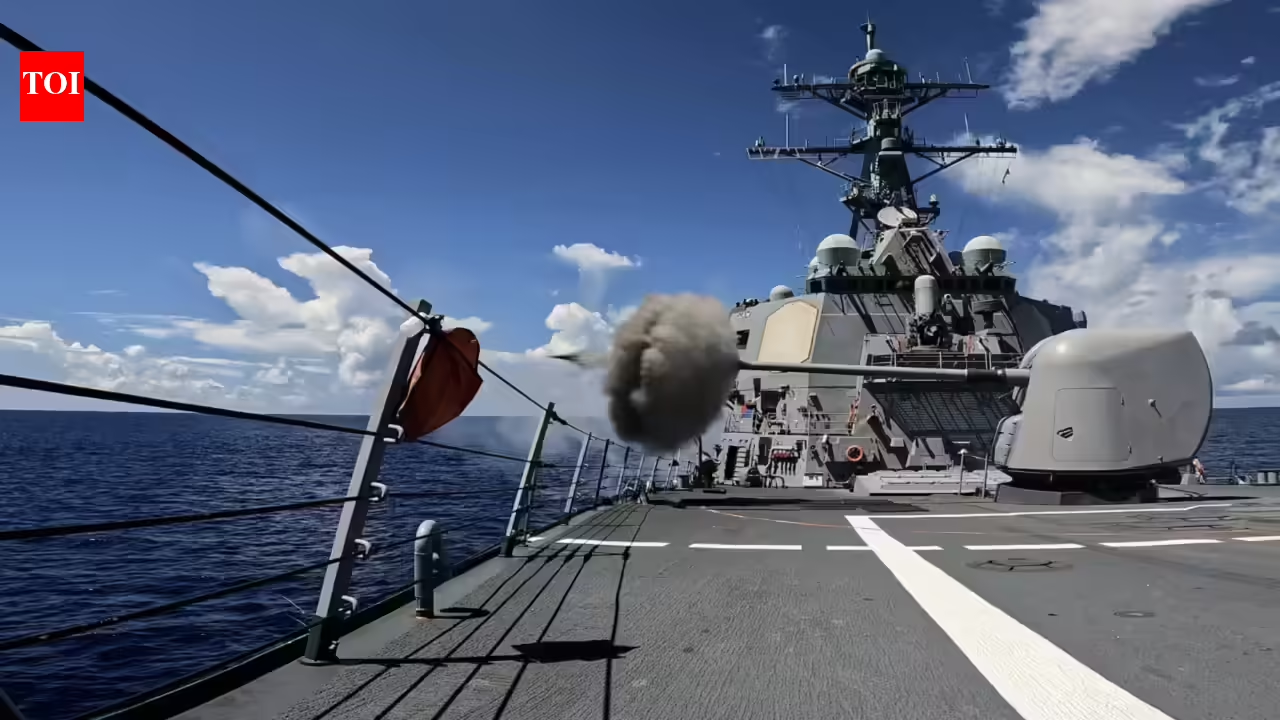
On the 45th day of the intensifying West Asia conflict, the United States Navy (USN) has announced its intention to impose a naval blockade on the Strait of Hormuz.This strategically vital chokepoint, just 34km wide at its narrowest, has dominated global headlines since the conflict’s outbreak earlier this year. Nearly 20% of global oil and gas demand passes through this narrow waterway and its closure has put the global energy market in a dire strait.After peace talks between Iran and the US failed to deliver results, US President Trump decided to blockade Iranian ports and the strait to exert pressure on Tehran.At the forefront of this operation will be the US Navy’s reliable stalwart: the Arleigh Burke-class guided-missile destroyers.These multi-mission behemoths have shouldered the heaviest burdens of American naval power since the lead ship, USS Arleigh Burke (DDG-51), was commissioned in 1991.This class of vessels ranks as the second most potent surface combatant in the US fleet, trailing only the Ticonderoga-class cruisers (which are gradually being phased out). These 9,200-ton vessels blend stealth, speed (exceeding 30 knots), and firepower into a versatile platform.On Saturday, the United States Central Command (Cent Com) deployed two ships of this class — the USS Frank E. Peterson and the USS Michael Murphy — to the Strait of Hormuz.
Backbone of the US Navy
The Arleigh Burke-class forms the undisputed backbone of the US Navy’s surface fleet. Of the 92 ships ordered since the program’s inception, 74 are currently active, with 18 more under construction or in testing phases—pushing toward a total of nearly 100 by decade’s end.This makes it not only the single largest class of major surface combatants in service anywhere on the planet (eclipsing China’s Type 052D destroyers at around 30 units) but also the longest production run of any US warship class in history.
Why will Arleigh Burke-class be the enforcer
In a navy that displaces more tonnage than the next 10 fleets combined —boasting 11 nuclear-powered aircraft carriers, 22 Ticonderoga cruisers, 66 Virginia- and Los Angeles-class submarines, and over 20 Littoral Combat Ships (LCS) — the Burkes provide the flexible muscle for everything from humanitarian aid to high-intensity warfare.Executing a blockade against Iran demands a vessel that excels in presence, persistence, and punch.The enforcer must project deterrence through sheer visibility, dart in to board and inspect blockade-runners (like oil tankers masquerading as neutral), withstand salvos from Iranian Revolutionary Guard Corps (IRGC) craft, and neutralize escalatory threats from air, sea, or subsurface. Littoral Combat Ships, optimized for near-shore skirmishes, fall short with their lighter armament and vulnerability to heavier foes.Cruisers, while powerful, are fewer in number and prioritized for fleet air defense.Aircraft carriers like the USS Abraham Lincoln in the Arabian Sea can’t venture too close to Iranian waters — within range of hypersonic missiles like the Fattah-1 — risking $13 billion assets. Carriers excel at long-range power projection but rely on Burke escorts for layered defense: surface-to-air missiles against jets, anti-submarine torpedoes for Kilo-class subs, and close-in weapons for speedboats.Thus, the Arleigh Burke’s balanced capabilities make it the blockade’s perfect spearhead.
What makes? Arleigh Burke-class destroyers great
This class of destroyers are armed with 96 Vertical Launching Systems (VLS), one of the highest for this class of ships.A VLS cell allows a ship to fire a missile vertically into the air, providing both an offensive and a defensive umbrella.These VLS cells can be armed with cruise missiles to take on surface targets or surface to air missiles to take on aerial threats. This system allows the weapon to be fired in any direction, meaning the ship need not turn towards the enemy during the firing phase.The ship is also armed with anti-submarine missiles and lightweight torpedoes to tackle sub-surface threats. This class of ships is also being equipped with the High Energy Laser with Integrated Optical-dazzler and Surveillance (HELIOS) laser system to take down drones.It can also carry as many as two MH-60R helicopters for anti-submarine warfare. Indian Navy also operates this type of helicopters.This class of destroyers has seen considerable combat experience in the West Asian theatre. Ships of this class have been involved in operations firing land attack cruise missiles at targets in Iraq and Syria. This class of vessels has also been intercepting Houthi drones and missiles fired at ships in the Bab El Mandeb as well as on Israel by Houthi rebels.The ships have also been part of exercises with India and have taken part in the Milan series of exercises. The USS Pinckney was scheduled to take part in Exercise Milan and the International Fleet Review held off Vishakhapatnam in February this year, but backed out as it was part of the buildup for Operation Epic Fury. In a way, this proves that when the US Navy wants to show presence in either war or peace, the Arleigh Burke-class of destroyers is what it turns to.