


There is a moment, at the end of Damien Chazelle’s 2018 movie First Manwhen Neil Armstrong (played with quiet restraint by Ryan Gosling) stands alone on the Moon. He takes out a small bracelet that belonged to his daughter, Karen, who died at the age of two, and lets it fall into a crater. It is a fictional scene, debated for its historical accuracy, but emotionally it is undeniable. It is a moment which possibly has brought people again and again to watch the film, just to reach that ending 20-minute sequence, aided by an unforgettable music score by Justin Hurwitz, in which Gosling reaches the farthest mankind had reached, steps on the moon as the first man, with his broken heart which possibly finds some peace. That gesture of leaving the bracelet on Moon says what Armstrong doesn’t in words in the film: that even at the farthest point a human can reach, grief travels with you.

If Armstrong’s fictional act was about letting go, Wiseman’s real one was about holding on.
This week, reality, unexpectedly and almost impossible, echoed that fiction. During the historic Artemis II mission, as astronauts flew further from Earth than any humans before, they paused. Not for a technical check. Not for a scientific observation. But for memory. In that vast silence between Earth and the Moon, his Canadian teammate, Jeremy Hansen, requested that a small, unnamed lunar crater be called “Carroll,” in honor of Carroll Taylor Wiseman, the late wife of mission commander Reid Wiseman. There wasn’t a single eyes without tears in Orion or at the command center, and now possibly, the whole world. The crater may have been small but the gesture was not. Even at the farthest point of space exploration, and on the darkest side of the Moon, love prevailed. Kindness won.
Carroll Taylor Wiseman died in 2020 after a long battle with cancer, leaving behind her husband and their two daughters. It is easy to be distracted by the scale of the moment. Artemis II is a milestone. A return to deep space after more than half a century, a mission that broke distance records set during Apollo 13. But what has been imprinted on people’s minds (and hearts) is not the distance traveled, or even the images of the Moon’s far side – it is that brief, fragile human interruption: a name of a loved one lost spoken into the void.A crater, after all, is just an absence – a hollow formed by impact. Naming it after someone you love is an act of filling that emptiness with meaning. Over here, the real and the imagined gestures had the same instinct. Love.In First ManArmstrong’s gesture is solitary. The Moon becomes a private mourning ground, a place where grief can be finally, quietly laid to rest. It is cinema’s way of making interiority visible. What happened aboard Artemis II was something else. It was communal. The suggestion to name the crater in memory of his wife did not come from Wiseman, but his Canadian crewmate, Jeremy Hansen. He was the one who spoke to Mission Control about “a loved one” they had lost, before proposing the name. The moment reportedly moved the crew to tears; they embraced in zero gravity, a floating knot of shared emotion.If Armstrong’s fictional act was about letting go, Wiseman’s real one was about holding on. The difference matters because cinema often imagines grief as something that seeks closure: a final act, a symbolic release. But in life, grief is rarely resolved. It is carried, reinterpreted, folded into new contexts. It becomes part of the self that continues.
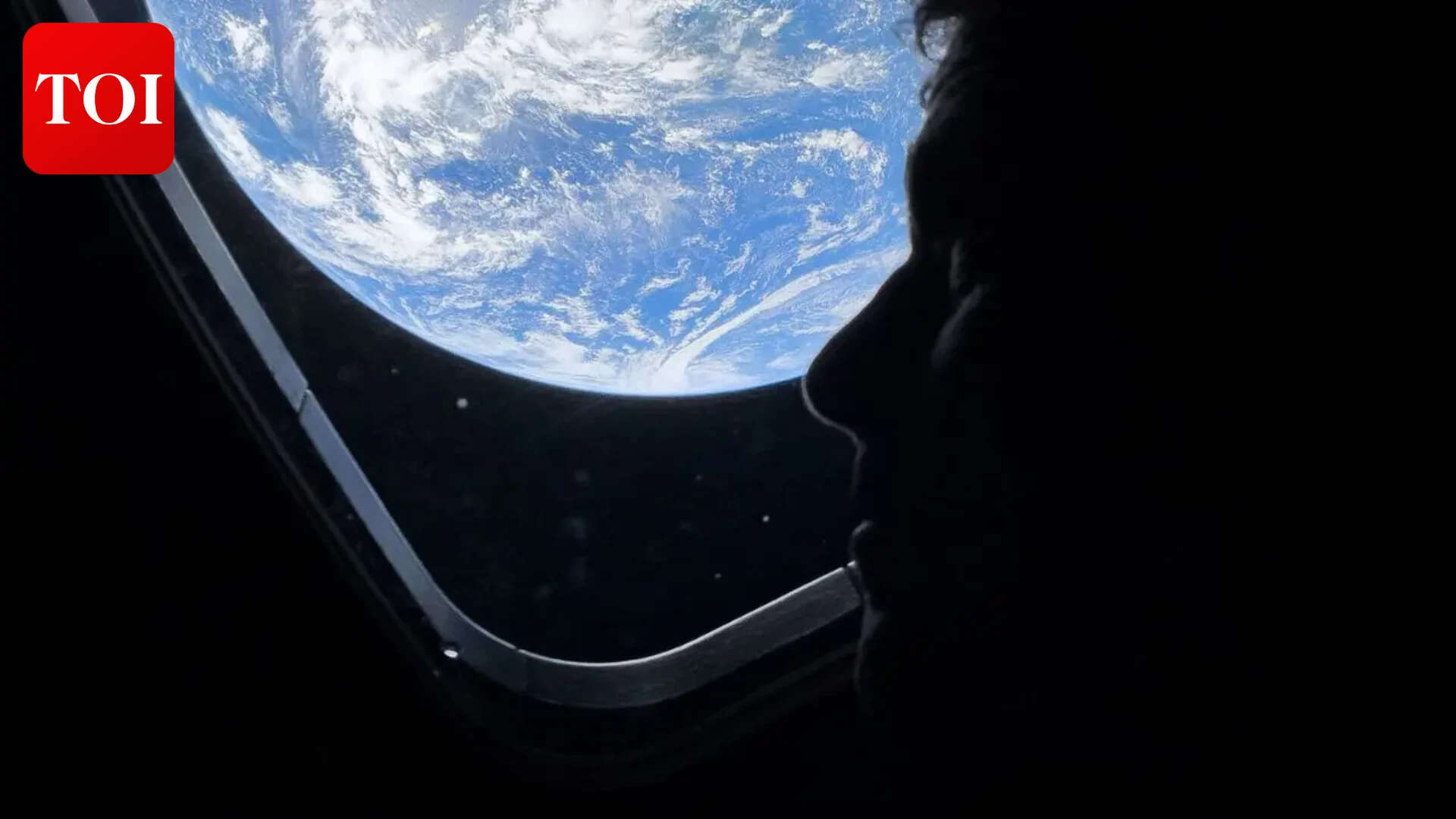
Commander Reid Wiseman looking out through Orion’s window. His crewmate Jeremy Hansen named a crater on the Moon to honor Reid’s late wife, Carroll WisemanPC: Flickr
Love, scaled to the size of the universe
There is something almost disorienting about the contrast. On one hand, the Artemis II crew was engaged in one of humanity’s most advanced technological feats – navigating a spacecraft across hundreds of thousands of miles, operating within the cold precision of orbital mechanics. On the other hand, in the middle of that, they were doing something ancient and deeply human: remembering someone they loved.Carroll Taylor Wiseman was not a public figure in the conventional sense. She was a nurse, someone who spent her life caring for others. She died at 46. There is no reason, in the logic of history or science, for her name to exist on the Moon. And yet, it does.Space exploration, for all its rhetoric of progress, has always been intertwined with the private lives of people involved with it. The Apollo missions were filled with quiet personal rituals: photographs tucked into suits, small tokens carried across impossible distances. Even NASA acknowledges that astronauts often bring mementos, because they want to remind people that they are not just representatives of humanity, but individuals with attachments.What this crater-sized gesture by the Artemis II crew revealed is that these attachments are not incidental to the mission. They are what make the mission meaningful. As someone said on social media: “No matter how far we may travel, the people we love stay with us.”