
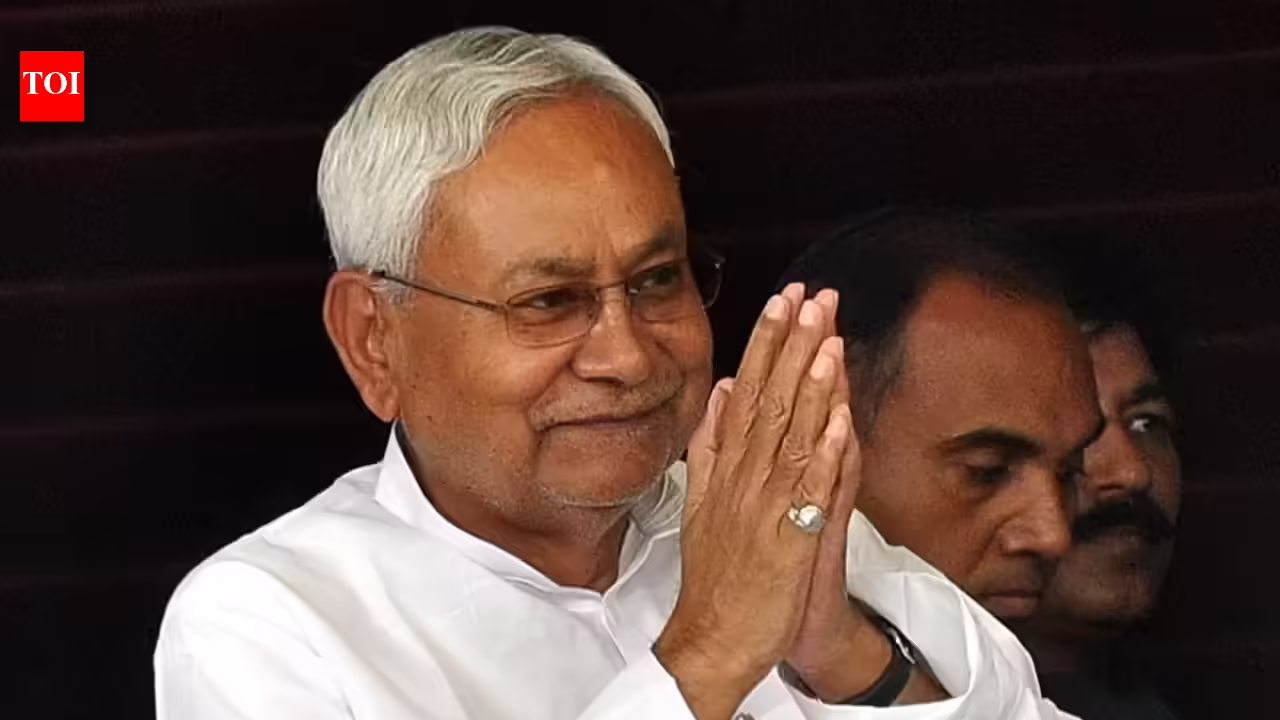
NEW DELHI: Janata Dal (United) supremo Nitish Kumar on Tuesday tendered his resignation as the chief minister of Bihar, setting the state towards a new era of politics. BJP’s Samrat Choudhary is all set to take the oath as the next CM.With Lalu Yadav out of active politics and Nitish Kumar now in Rajya Sabha, this also marks the end of the long-running political lineage that revolved around the ideals of Jay Prakash Narayan, Karpoori Thakur, and Lohia after over three decades.Now, Bharatiya Janata Party – which for long played the role of second fiddle to Nitish’s JD(U) – is set to take the center stage with Samrat Chaudhary as their new CM pick.End of an eraAfter the Sampoorn Kranti movement during the Emergency, the socialist ideology seeped deep into the state. JP took many youth leaders under his wings, many of whom later became the bigwigs of Bihar.Additionally, this was also an era of Karpoori Thakur, during which a new grammar of power emerged, where caste was not hidden beneath euphemisms but spoken of as politics of representation.
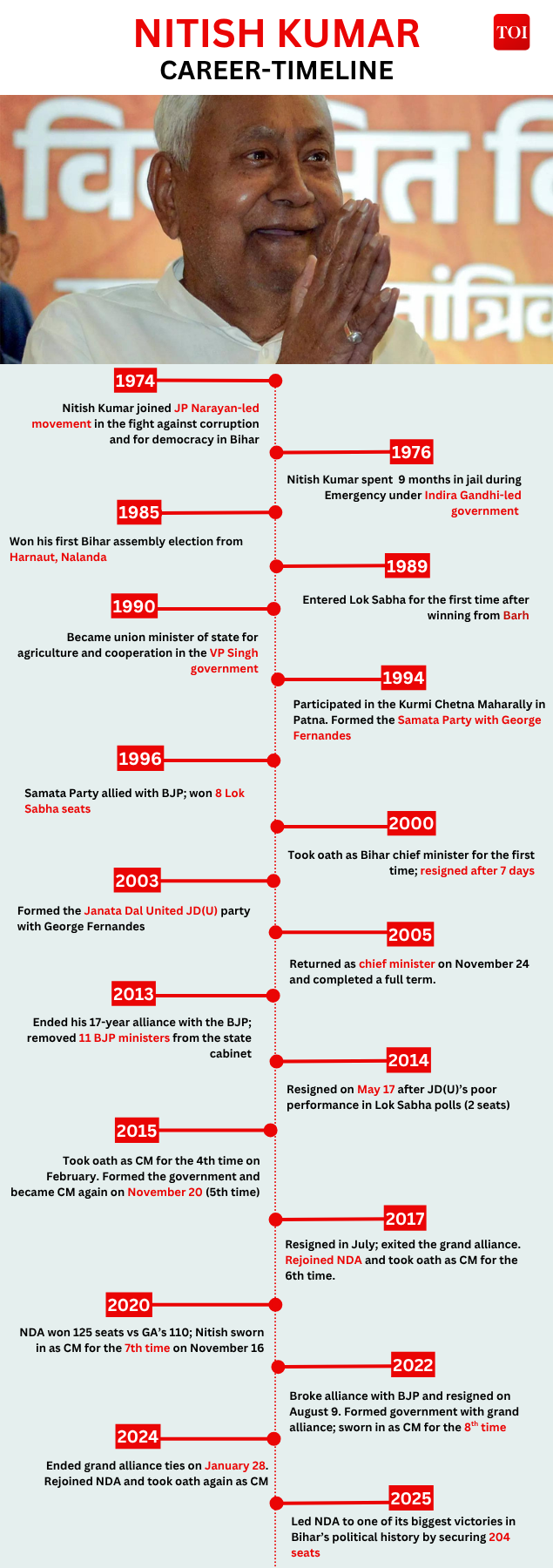
The fine-tuning of these ideologies led to the rise of two of the tallest leaders of the state – Lalu and Nitish – who cemented the vision of samajik nyay on which Bihar’s identity politics rests.Lalu, the popular leader known for jests, ruled for over 15 years. After his decline, Nitish, known as Sushasan Babu, ruled the next 21 years, which came to an end on Tuesday.Rise of BJP in BiharHowever, Nitish’s exit plan seems to have been made long ago. After the National Democratic Alliance’s overwhelming victory in last year’s assembly elections and the BJP’s extraordinary performance, rumors began to swirl that Nitish might step down from the top job, making way for the BJP in a state that was under its control yet out of reach.The rumors proved right when Nitish, on one fateful day, announced his decision to leave the top post in Bihar for a Rajya Sabha seat to fulfill his personal wish of serving in all four legislative bodies — the Bihar Legislative Assembly, Bihar Legislative Council, Lok Sabha and Rajya Sabha.Although many had anticipated this move amid speculation about his deteriorating health, Nitish’s sudden announcement still surprised many who expected a smoother transition plan.JD(U) sans NitishNitish Kumar remained the only star of his party for decades. Despite never securing an outright majority on its own, his “Sushasan Babu” image kept JD(U) at the center of Bihar politics. Nitish’s decision not only ends the political lineage of JP Narayan, Ram Manohar Lohia and Karpoori Thakur but also throws his party into uncharted waters, with no clear roadmap for the future.The party failed to build a strong second line of leadership. Leaders such as Sanjay Jha, Lalan Singh and Vijay Choudhary are present, but none commands a mass connect comparable to Nitish.
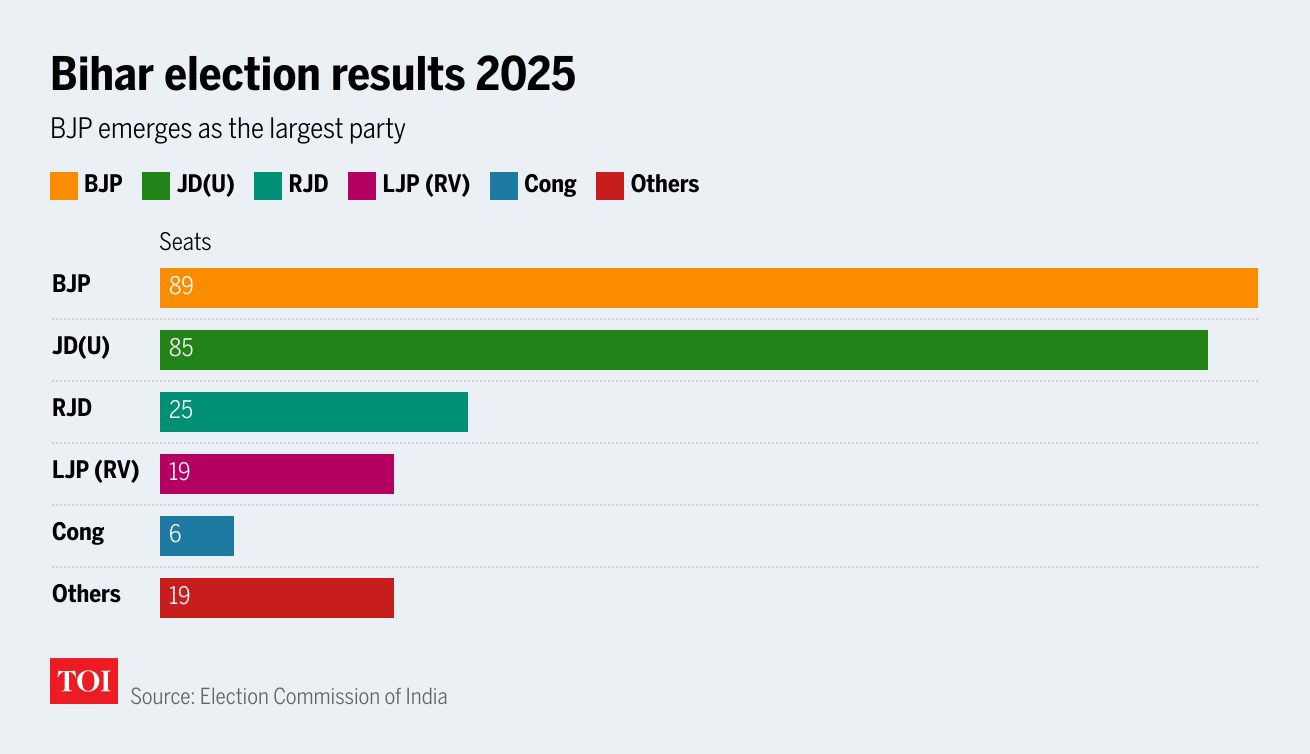
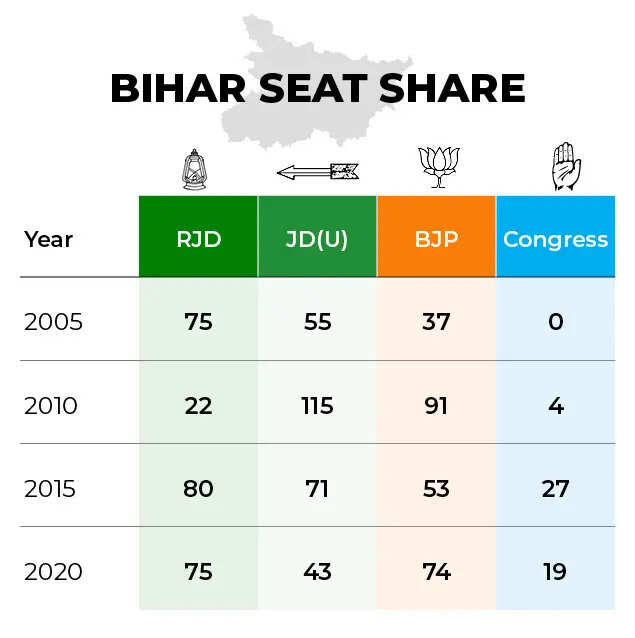
Political analysts believe there is also a possibility that JD(U) could merge with its ally BJP in the coming days, though such a move may not find unanimous support within the party.“There is also a possibility that BJP and JD(U) may merge in the future, though not everyone in JD(U) will accept such a merger. Several leaders may resist it. Some leaders within the party may move to RJD, while others may join BJP,” political analyst Kumar Vijay told The Times of India.“Earlier, JD(U) workers even voted for BJP candidates because they believed Nitish Kumar would ultimately remain chief minister. But now many hardcore workers may refuse to support BJP in the future,” he added.End of road for JD(U)The dynamic between JD(U) and BJP shifted in the last assembly elections, where the BJP emerged as the “elder brother”. In the 2025 polls, the BJP became the single largest party with 89 seats and a 20.45% vote share, while JD(U) secured 85 seats with 19.61%.Following the emphatic victory, the BJP began to look less like a coalition partner and more like a contender for the driver’s seat. It secured a larger share in the council of ministers, and Nitish Kumar also had to part with the home portfolio.According to PTI, party sources admitted there were misgivings among cadres over the role played by Sanjay Jha and some other close aides of Nitish in recent developments.“Yesterday, when the chief minister visited the JD(U) office in Delhi, many party workers insisted that even after he stepped down, the top post should not be given to the BJP. The visuals have been flashed by all media outlets and are, to an extent, reflective of the sentiment prevailing in the party here,” he said.“In Nishant (Nitish Kumar’s son, who recently joined the party), we have a young leader capable enough of stepping into his father’s shoes. We, however, are also aware that our leader is unlikely to push for his son. But, at least, we must insist on all the benefits that the BJP is currently enjoying, which include posts like two deputy CMs, the Speaker of the Assembly, and the crucial Home portfolio,” they added.“The BJP, on its part, has been acting with swagger. Just look at the alacrity with which they nominated Harivansh Narayan Singh to the Rajya Sabha, days after we denied him a third consecutive term,” JD(U) sources said.
JD(U) workers have also put up posters across Patna urging Nitish Kumar’s son Nishant to take up the chief ministerial post.The posters, put up by “Nitish sevaks”, called on Nishant Kumar to step into active politics, describing him as a “youth leader” and urging him to “come out of the shadows”.“We do not need a bulldozer, nor riots or unrest in Bihar. We need a young jansevak… it is time for him to come out of the shadow,” the posters read.What happens to Nitish Kumar’s EBC vote bank?Over the years, Nitish positioned himself as a key leader of the Extremely Backward Classes (EBC), which form a significant portion of Bihar’s population.He consciously built this support base by drawing on the legacy of Karpoori Thakur and focusing on economically weaker sections.With his exit, questions arise over who will inherit this vote bank. According to analyst Kumar Vijay, no single party appears well-placed to consolidate the non-Yadav OBC and EBC votes.“If Tejashwi Yadav had strong leadership credentials, that vote bank could have shifted to RJD. But the biggest tragedy in Bihar today is the lack of strong political leadership. Congress doesn’t have it, RJD doesn’t have it either. Despite being a politically mature state, Bihar is facing a serious leadership crisis,” Vijay said.“Upendra Kushwaha has lost credibility. Tejashwi Yadav has not emerged as a grassroots leader. LJP too has become more of a dramatic political outfit,” he added.For Bihar, Nitish Kumar’s move to the Rajya Sabha marks the end of a long political chapter defined by his leadership, shifting alliances and ‘Sushasan’ governance model. Months ahead will determine how both JD(U) and the state’s politics evolve beyond him.