
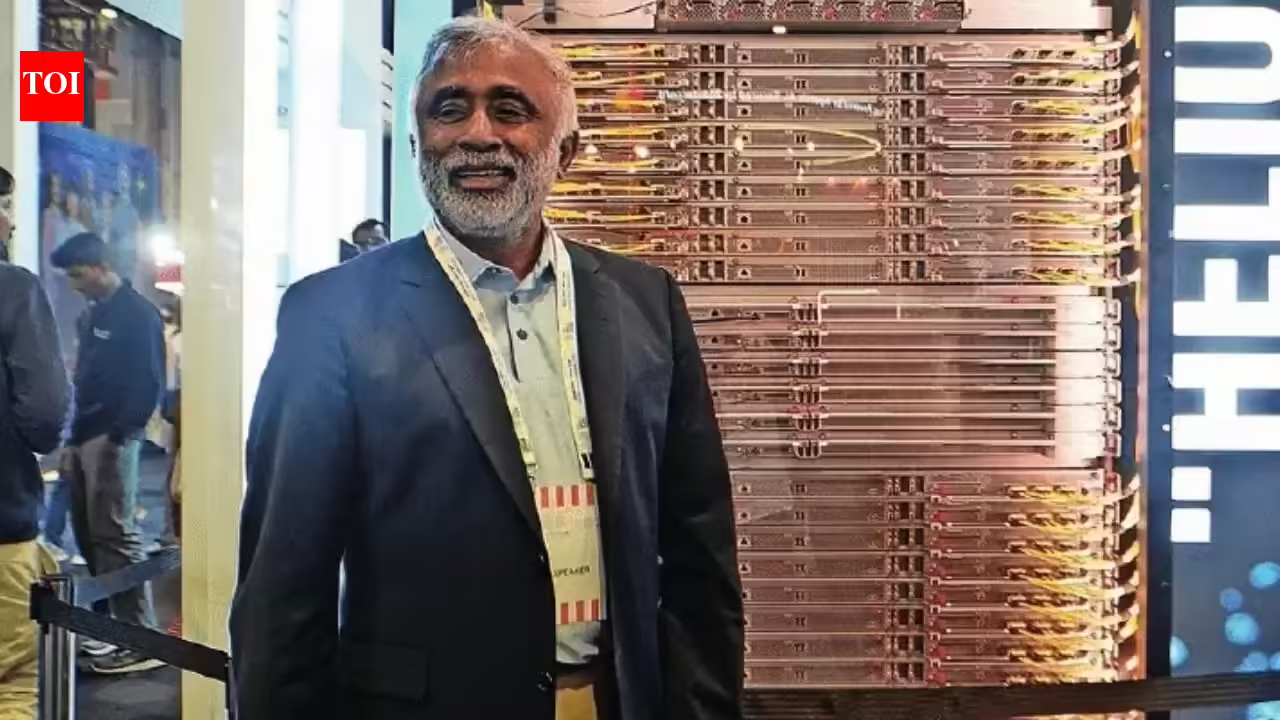
Thomas Zacharia has over the last few decades helped reshape the global computing landscape – including, improbably, the fortunes of a company he does not work for. Zacharia, senior VP of strategic technical partnerships and public policy at AMD and based in Austin, Texas, is one of the more consequential figures in the story of how AI moved from academic curiosity to industrial force. That story begins not in Silicon Valley, but in Kerala.Zachariah grew up moving. His father worked in Kerala’s public health engineering department and was transferred every two or three years, meaning the young Thomas cycled through a series of schools – in places like Cochin and Kottayam – accumulating what he describes as a “remarkable” education by attrition. He did his pre-degree at Maharaja’s College in Cochin, and his Bachelor’s from what is now NITK Surathkal. “My parents’ confidence in me getting an admission elsewhere was not high,” he said. “They said, you better take that.”After graduating, he joined his grandfather’s construction business, only to conclude, with what he admits was the arrogance of youth, that it was not quite large enough for both himself and his father. America, he decided, would be a suitable alternative. He arrived for a Master’s degree, returned briefly, and then — partly at the gentle insistence of a new wife who saw a PhD as a convenient excuse to extend an international honeymoon — enrolled at Clarkson University. He finished his PhD in 1987. “I liter-ally never thought we would stay in the US,” he said.Life in the USHe was wrong. A postdoctoral position at Oak Ridge National Laboratory in Tennessee, assumed to be a two-year interlude, stretched into a 35-year career. Oak Ridge is one of America’s most storied institutions – the site of uranium enrichment during the Manhattan Project, home to the first continuously operated nuclear reactor, birthplace of nuclear medicine and nuclear submarines. “Every day I walked into that laboratory I knew I was doing something to change the world,” Zacharia said.The laboratory eventually made him its director, and it was in that role, around 2009, that Zacharia made the decision that would, in retrospect, do as much for Nvidia’s trajectory as anything the company itself engineered. Oak Ridge was planning its next-generation supercomputer, a machine that would need to be roughly ten times more powerful than its predecessor, the Jaguar system, while consuming broadly the same amount of energy. The problem was that traditional, CPU-only architectures could no longer deliver the required performance without demanding prohibitive amounts of electricity.The answer, Zacharia concluded, lay in graphics processing units. GPUs had been designed for rendering video games, moving data in a fundamentally different – and, for certain types of computation, far more efficient – manner than conventional processors. Zacharia reached out to Jensen Huang, Nvidia’s founder and chief executive, and persuaded him to commit the company’s GPU technology to something that had never been tried at this scale: a scientific supercomputer. “We were the first at Oak Ridge,” Zacharia said during our interview. “I convinced Jensen to do GPUs as you see it now.” He paused, waving off the detail with characteristic understatement. “You can go Google it.”The result was Titan, unveiled in 2012, which combined more than 18,000 Nvidia Tesla GPU accelerators with AMD Opteron CPUs to become the world’s fastest supercomputer – delivering more than 27 petaflops of peak performance at a fraction of the energy cost a pure CPU architecture would have required.By choosing Nvidia GPUs for a flagship US department of energy system, Oak Ridge provided the kind of high-profile, high-stakes validation that no marketing campaign could purchase. It proved that GPUs were not merely for gaming but were essential for complex scientific simulation – and, as would become apparent, for artificial intelligence.The partnership deepened. In 2018, Oak Ridge unveiled Summit, a successor featuring nearly 28,000 Nvidia Tesla V100 GPUs and IBM Power9 processors, which became at its launch the world’s fastest and smartest supercomputer. Jensen Huang appeared at the unveiling ceremony. Thomas Zacharia, as Oak Ridge director, was on the stage.AMD’s rack-scale AI platformHe is careful, these days, not to dwell too long on Nvidia when he is talking on AMD’s behalf. “I like to keep it more about our products,” he said.The transition to AMD came in March 2024, and in a role that involves helping govts and major institutions build their own AI infrastructure.His reasons for the move echo the language he used when explaining why he stayed at Oak Ridge for so long. “AMD offers the same opportunity in this pivotal moment,” he said. The conviction was reinforced when he saw the company’s chair & CEO Lisa Su making a personal commitment to Frontier, the supercomputer at Oak Ridge which in 2022 became the world’s first to break the exascale barrier – performing more than a quintillion calculations per second. “It was a good business decision. And that’s why, to me, AMD is a very intelligent, interesting company.”It was the Helios rack, though, that was drawing the crowds at the AI Summit in New Delhi in Feb. A rack-scale AI platform built around AMD’s Instinct MI450 Series GPUs, Helios is designed to deliver 2.9 exaflops of AI compute – nearly three times the performance of the Frontier supercomputer – within a single rack drawing 220 kilowatts of power. Each rack contains 72 tightly interconnected GPUs, enabling both the large-scale training runs that teach AI models and the inference workloads that serve billions of users. Zacharia’s enthusiasm for the numbers is almost childlike. “It still blows me away,” he said. “2.9 exaflops of AI compute in a single rack at 220 kilowatts. That is a dramatic improvement in energy efficiency.”