


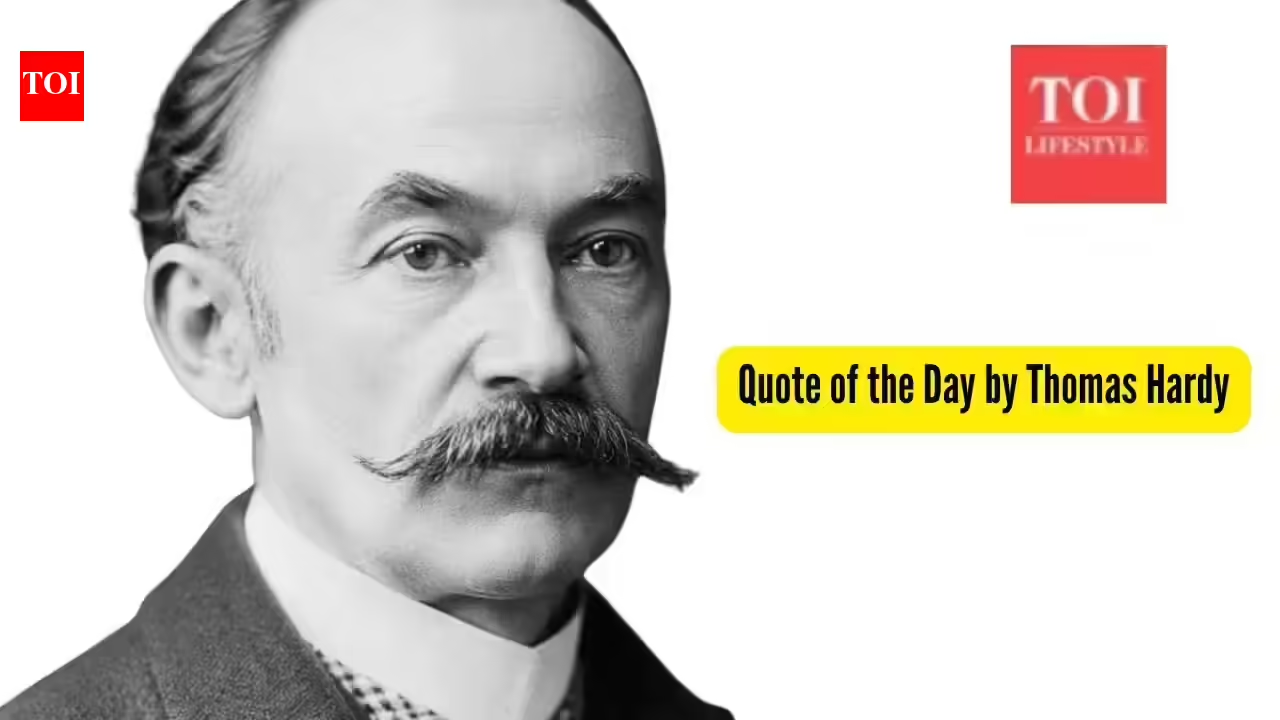
Thomas Hardy (1840–1928) is one of the most important writers in English literature. He lived during the Victorian and modern periods. Hardy was born in the small village of Higher Bockhampton in Dorset, England. He grew up in a simple family that had a big impact on his imagination and artistic taste. His father worked as a stonemason and builder, and his mother was well-read and taught him to love books and telling stories. Hardy’s literary identity would later be shaped by this mix of living in the country and being curious about ideas.Hardy started out as an architect and moved to London in his early twenties to work in that field. He loved writing, but architecture gave him discipline and a sense of structure. While he was in London, he learned about the literary and cultural trends of the time, but he still felt very connected to his rural roots. Hardy eventually gave up architecture to focus solely on writing. This choice led to an incredible body of work that includes novels, short stories, and poems.Hardy’s early books, like Desperate Remedies (1871) and Under the Greenwood Tree (1872), show how he tried out different styles and ways of telling stories. But it was with books like Far from the Madding Crowd (1874) that he really started to get a lot of attention. This book introduced readers to Wessex, a made-up area that is a mix of real and made-up parts of rural southwest England. Wessex was the setting for most of his major novels, and it was more than just a backdrop; it was almost a character in its own right, shaping the lives and fates of the people who lived there.The Return of the Native (1878), The Mayor of Casterbridge (1886), Tess of the d’Urbervilles (1891), and Jude the Obscure (1895) are some of Hardy’s most famous books. These works frequently exhibit a tragic tone and an examination of human suffering. Hardy was very interested in the things that control people’s lives, like fate, chance, social norms, and the universe’s indifferent workings. His characters often have to deal with things they can’t control, which usually leads to bad and unavoidable outcomes.Hardy’s writing style is characterized by a combination of realism and a strong sense of determinism. He depicts life with unwavering honesty, frequently emphasizing the severe realities encountered by individuals, especially those from lower socioeconomic strata. His works are also philosophical in that they suggest that people are affected by things they can’t fully understand or control. This view puts him in line with naturalist writers, but Hardy’s work is still very poetic and symbolic. Hardy’s language is another thing that makes his style unique. He mixes rich, descriptive prose with parts of the local dialect to capture the rhythms and textures of rural speech. His descriptions of nature are especially powerful, showing both his training as an architect and his strong emotional connection to the countryside. Hardy’s landscapes aren’t just pretty; they often reflect how his characters are feeling and reinforce the themes of being alone, fighting, and having to do something.Hardy’s work has had a huge impact on literature. He questioned the moral norms of Victorian society, especially in novels like Tess of the d’Urbervilles and Jude the Obscure, which deal with topics like sex, marriage, religion, and social injustice. People didn’t like these works when they first came out because they thought they were immoral. Hardy stopped writing novels after the bad reviews of Jude the Obscure and instead focused on poetry for the rest of his career. Hardy was a successful poet, and his books Wessex Poems (1898) and Poems of the Past and the Present (1901) are two of his most famous works. His poems often deal with the same themes as his novels, like time, memory, loss, and the passage of life, but in a more personal and lyrical way. Many critics now think that Hardy was one of the best English poets of the early 1900s. They point out how he influenced later writers like Robert Frost and W. H. Auden. Hardy’s legacy is not only in his own works, but also in how he helped the novel change over time. Quote of the DayThe above quote makes a deeper point about how men and women are often shown to understand the world, especially when it comes to feelings or relationships. The statement means that a woman can see the truth from a distance, whether it’s emotionally, intuitively, or mentally. A man, on the other hand, may not see those same truths even when they are right in front of him. “Distance” here doesn’t just mean being far away; it can also mean being far away emotionally or mentally. The phrase “a man cannot see close” implies a limitation, possibly indicating a tendency to overlook subtle emotional cues, ignore underlying tensions, or focus exclusively on the overt and concrete. He might not fully understand something even when it’s right in front of him, like a relationship that isn’t working, feelings that are hidden, or things that aren’t said. This isn’t a criticism of men as individuals; it’s more of a comment on how people thought about gender roles and expectations in Hardy’s time.The quote also talks about the idea of being smart with your feelings. A lot of classical literature shows that women are more emotionally aware and sensitive to small things. They notice little things, like changes in mood, tone, or behavior, that can mean a lot more. Men, on the other hand, are often shown to be more practical or focused on the outside world, which can mean they don’t pay as much attention to their feelings. The idea of experience versus observation gives the idea more depth. A woman who “sees from a distance” might be able to objectively understand a situation without being affected by her ego, pride, or direct involvement. A man who can’t “see close” may not be able to see things as they really are because he is too involved or too sure of his own point of view. In this way, the quote is more about how you see than things about gender. Being far away from something can help you see it more clearly, while being close can make you blind.A lot of Hardy’s work is about relationships, so this could be seen that way too. In his stories, the woman usually knows more about how the relationship makes her feel than the man does. She might see problems coming, sense changes happening, or know truths long before they become clear. But the man might not find out until it’s too late. In today’s world, this quote should not be seen as an absolute or universal truth about men and women. It doesn’t show what Hardy thought about things; it shows what people thought about literature and culture at the time. Today, we might think of it in a broader way: some people are better at figuring things out and picking up on things, while others rely more on direct evidence and might miss small details.The quote is about the difference between what you think and what you see right away. This means that being close to something doesn’t always give you insight, and that understanding often depends on being sensitive, aware, and able to see beyond the surface.