



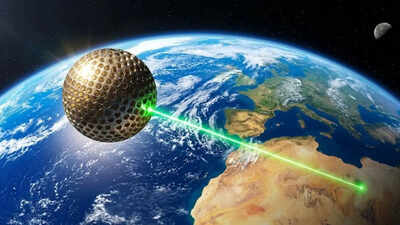
For almost 50 years, a brass and aluminum sphere weighing 900 pounds has circled our planet. NASA launched LAGEOS, the Laser Geodynamics Satellite, in 1976. Unlike other satellites, it doesn’t rely on batteries or sensors. Despite this, it has become one of the most valuable tools for Earth science research. This satellite reflects lasers from the ground with millimeter-level accuracy. As a result, scientists can track tectonic plate movements and slight changes in Earth’s rotation. Built to withstand almost anything, LAGEOS offers stability that modern electronic satellites can’t provide. As reported by NASAits straightforward design allows it to track the planet’s physical dynamics for millions of years to come.
NASA’s disco ball in space: Mapping Earth’s crust
The LAGEOS satellite acts like a large 60-centimetre mirror, bouncing laser beams sent from Earth back to their origin. When scientists measure how long these laser beams take to travel to the satellite and return, they can determine exactly where a station sits on Earth’s surface. This ongoing tracking showed that Earth’s crust is not one solid piece; it’s made up of many moving plates. According to NASALAGEOS was groundbreaking because it helped in tracking these tectonic shifts all around the world. It confirmed continents aren’t just standing still-they’re rifting and colliding into each other right now.
How LAGEOS tracks global shifts
LAGEOS, a dense and solid sphere, moves along a very stable and predictable orbit. Scientists rely on it to observe changes in Earth’s geodynamic processes. For instance, the satellite monitors shifts in Earth’s mass from melting ice sheets and monitors polar motion on its axis. Such precise measurements play a crucial role in defining the International Terrestrial Reference Frame (ITRF). This framework underpins every GPS and navigation system we use today.
LAGEOS avoids atmospheric drag
LAGEOS is built to last an incredibly long time. According to NASA, it has 426 cube-corner retroreflectors, which are special mirrors that send light back to its source. Since it contains no electronics that might break down and orbits high above Earth at 3,700 miles (6,000 kilometres), it avoids atmospheric drag. Due to this stable orbit, NASA believes the satellite won’t re-enter Earth’s atmosphere for another 8.4 million years. This makes LAGEOS one of the most permanent landmarks humans have ever made.
NASA’s message to the future
LAGEOS became like a time capsule because of its durability. Inside this satellite, NASA placed a stainless-steel plaque. It has three maps of Earth. The first map shows how the continents looked 268 million years ago when they formed the supercontinent Pangea. Then there’s a map showing Earth as it was in 1976. Finally, the third map predicts what the continents might look like 8.4 million years in the future. Therefore, even if all human records disappear, this satellite can still record the evolution of our planet’s geological changes over time.