


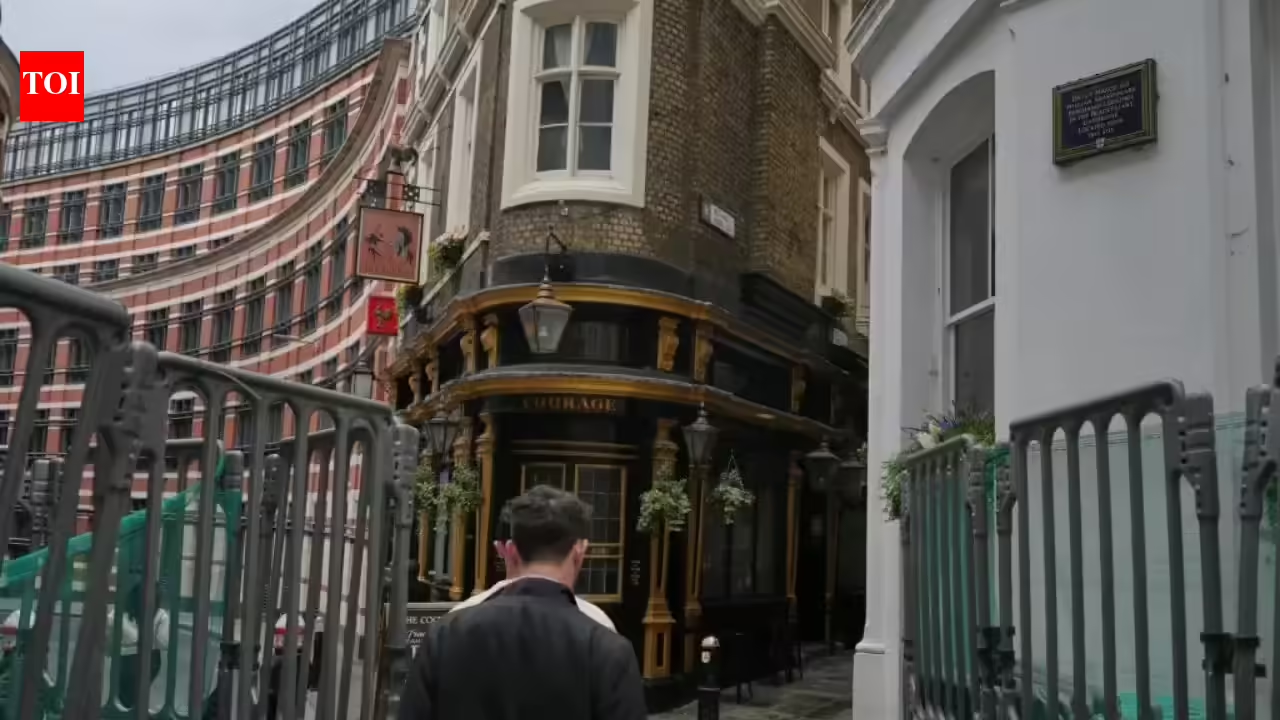
For centuries, William Shakespeare’s life in London has carried a strange gap that historians could never fully close. People knew he traveled between Stratford-upon-Avon and the capital. They knew he worked in theaters and built his career in the city’s busy artistic world. Yet one detail always stayed uncertain: where exactly did he live in London? That question has lingered for around 400 years. Now, experts say they may finally have an answer. A newly studied set of historical documents points to a property in Blackfriars, London, according to Discover Britain. It sits close to where Shakespeare reportedly worked. The discovery is being described as important, even surprising, because it connects his professional life with a physical home that had been lost in time.
Shakespeare’s London property mystery and hidden private life in the capital
Shakespeare’s connection with London has always been clear, but his private life there has remained partly hidden. Records confirm he owned property in the city, yet the exact location was never firmly identified. Over time, the details faded into uncertainty.Historians had only fragments to work with. Old references, partial documents, and later assumptions built up a general idea that he stayed somewhere in central London. Still, nothing concrete emerged for centuries. The property itself seemed to disappear from the historical record.According to Discover Britain and BBC reports, experts often believed he returned to Stratford-upon-Avon for most of his later years. That idea shaped how people imagined his life. A London home existed in theory, but not in certainty.
Hidden floor plan reveals possible Shakespeare residence in London
The discovery reportedly comes from Shakespeare scholar Professor Lucy Munro. She was working on a separate research project when she came across unexpected archival material. Among the documents was a detailed floor plan linked to a property in the Blackfriars area of London.At first, it did not appear significant. But as she studied it further, the structure began to match known references connected to Shakespeare. The layout showed an L-shaped building near a gatehouse, which experts now believe may have been part of his residence.The location also fits known historical clues. It sits near the Blackfriars Theatre, where Shakespeare is believed to have been active during his career in London. This proximity has led researchers to suggest he may have spent more time living in the city than previously thought.
What the house might have been like
The property itself is described as modest but notable. It was not a grand mansion, but it was still considered relatively substantial for its time. According to experts, the building may have been large enough to be divided into separate living spaces.This detail is important because it suggests the house had flexibility in use. It may have housed more than one occupant at different times, or even been adapted as needs changed. The L-shaped design also hints at an unusual structure, possibly extending over or around existing buildings.Professor Munro reportedly described it as a practical London residence rather than a luxury estate. Still, its size and location would have made it valuable in the early 1600s.
How location may have influenced Shakespeare’s work
One of the most interesting aspects of the discovery is its proximity to Shakespeare’s professional environment. The Blackfriars Theater was nearby, and he is known to have been associated with it later in his career.Experts suggest this connection may not be accidental. Living close to a major theater would have made collaboration easier. Actors, writers, and theater managers would have been within walking distance. This would have been ideal for someone as active in the theater world as Shakespeare. There is even speculation that parts of his later works might have been written while he stayed at this property. Although this cannot be confirmed, it is considered a possibility by some researchers.
Sold after his death and lost again in time
Another key detail comes from records showing that Shakespeare’s granddaughter sold the property in 1665 as reported by BBC. This was nearly 50 years after he died in 1616. The timing places the sale just one year before the Great Fire of London in 1666, which destroyed large areas of the city.After that point, the original structure and surrounding streets were heavily altered or lost entirely. This may explain why the house’s exact location remained uncertain for so long. Over time, only general markers remained, including a plaque on St Andrew’s Hill that suggests Shakespeare owned property nearby. The new findings appear to sharpen that vague location into something more precise.