



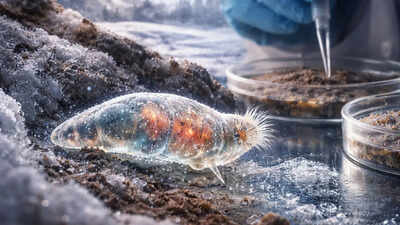
Bringing a prehistoric being back to life may seem like something out of science fiction, but scientists have done exactly that. Researchers have managed to revive a tiny creature that has been encased in permafrost in the Arctic region for about 24,000 years. This scientific achievement has captured worldwide attention as it raises questions about survival, time, and even biological limitations. The creature, called a bdelloid rotifer, was discovered buried beneath the icy ground in Siberia and resurrected in laboratory settings. Even more astonishingly, the creature did not just manage to live; it started multiplying. According to the study “A living bdelloid rotifer from 24,000-year-old Arctic permafrost” published in Current Biology, scientists confirmed that the organism successfully revived and reproduced after being frozen for thousands of years.
Siberian permafrost yields 24,000-year-old freshwater organism
The discovery took place in samples of permafrost obtained from northeastern Siberia. The scientists drilled holes deep into the ground, where the soil had been permanently frozen for many years. The age of the soil was determined using radiocarbon dating and was estimated to be about 24,000 years.The revived organism belonged to a class known as bdelloid rotifers. They are microscopic animals that usually live in freshwater habitats.
Survival through cryptobiosis in extreme frozen conditions
Another fascinating feature about this discovery is that of cryptobiosis, which is when the metabolism of an organism virtually comes to a halt, enabling it to survive in harsh environments like cold temperatures, dehydration, and even an absence of oxygen. The reason why the organism was able to live for thousands of years lies here.
How scientists revived a 24,000-year-old multicellular organism
During the revitalisation process, the permafrost samples were thawed out very slowly in a lab setting. Once the conditions were suitable, the rotifer slowly came back to life.In addition, the rotifer started reproducing by way of parthenogenesis, which is sexual reproduction without the help of males. This showed that it was not just alive but functionally alive.This was one of the most convincing cases proving that multicellular creatures could survive for a really long time in suspended animation.
Bdelloid rotifers and their unique biological resilience
It is well understood that bdelloid rotifers are extremely hardy creatures. They are capable of enduring harsh environments such as being exposed to radiation, dehydration, and freezing.They have adopted techniques of repairing themselves and becoming normal when the environment around them becomes favourable. They are regarded as the toughest creatures in the world. That is why they are ideal subjects for studying the stresses of nature.
Implications for cryobiology and future scientific research
Besides being relevant in terms of learning more about prehistoric life forms, the finding has applications in another area known as cryobiology. Studying rotifers’ ability to withstand freezing will help scientists find better ways of cryopreserving different body parts, including cells and tissues.It is also possible that the knowledge gained in this respect may contribute to future research aimed at studying biology in space.
What this discovery reveals about the limits of life on Earth
This event raises some previous notions about the limits of life since it shows the potential longevity of life given ideal conditions.It poses the question of whether there would be another kind of life that could survive under extremely harsh conditions, such as ice burial, maybe even on another planet.More than anything else, however, it is the implications of the event that raise eyebrows, for it shows us where to draw the line for the definition of life.
Final insights
The resurrection of the bdelloid rotifer after such an extensive period is more than a fascinating scientific story; it is actually an important milestone in learning about the ability of living things to survive in harsh environments and dormant states.By coming alive in the lab from the Arctic soil where it had been frozen for over 24,000 years, this little creature has challenged the scientific world’s imagination about what is possible.