

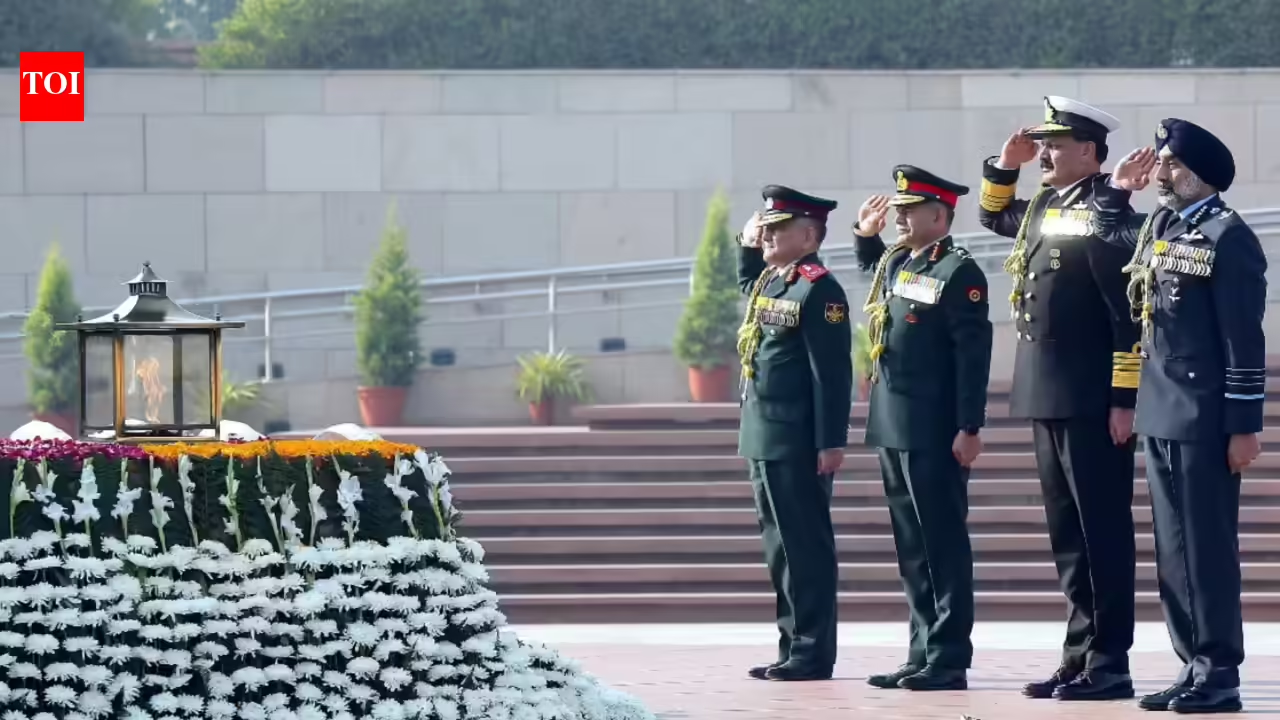
The Indian armed forces seem to be on the verge of a massive change. Chief of Defense Staff (CDS) General Anil Chauhan, at the second edition of Ran Samvad, announced that the discussions amongst the armed forces on the formation of theater commands is over. CDS Chauhan stated, “I should be able to complete the report of operation Tiranga, that is the name of the discussion and formulation of theater commands, in a week or so”. Although the CDS did say that some minor issues are yet to be ironed out.General Chauhan, who was slated for retirement on 30th September last year, received an extension till 30th May. The CDS, at an event in Pune in January had stated that the effort to finish the discussions within the armed forces will be completed before the end of May.Once drafted the theater command proposal will be sent to the Ministry of Defense and then it will be taken over by the Prime Minister chaired Cabinet Committee on Security (CCS). Once cleared, theatreisation will become the biggest defense reform in independent India’s history.
What are integrated theater commands
An integrated theater command will be a single command headquarters which will have all the elements of all three services reporting to one single commander. Three separate theater commands are to be raised. Each of these theaters is expected to look after distinct areas. These three commands will, respectively, look after Pakistan front, Chinese front and the Maritime domain. Currently, the three services are divided into seventeen operational and functional commands.The theater command that will look after the Pakistan frontier is likely to be located in Jaipur and will be headed by an army officer. The integrated theater command responsible for the China front will be located in Lucknow, it is said that this command is headed by an air force officer. The command looking after the maritime front is likely to be located in Thiruvananthapuram and will be headed by a naval officer.
Advantage of theater commands
The aim of the integrated theater commands will be to improve the combat effectiveness of the three services. By integrating the capabilities of the services into a single command the services will fight in a more cohesive manner. Working under a single commander, will reduce the decision cycle and hence provide a faster response time for any contingency. Another advantage of joint commands is that resources can be allocated and pooled in a more efficient manner, thereby maximizing resources and their effect. This move will also reduce duplication in logistics.