

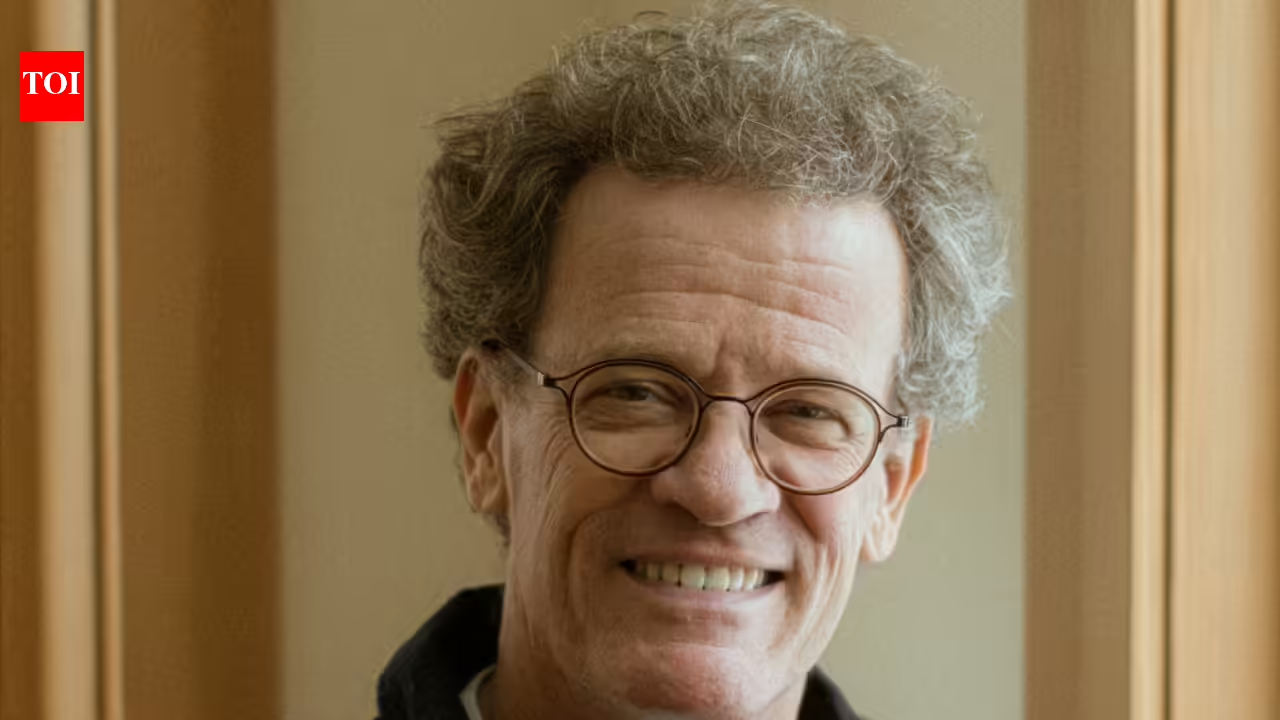
After nearly a decade, Booker Prize-winning ‘Life of Pi’ author Yann Martel returns with a novel, ‘Son of Nobody’, that reimagines the Trojan War through the eyes of a soldier. Against the backdrop of fresh wars, the Canadian writer talks to Sharmila Ganesan Ram about the enduring questions of the Greek epic, and its resonance with the GitaYou won the Booker in 2002, a moment you once said felt like “being in the arms of a beautiful woman”. How do you look back at it?Did I say that? I don’t remember. At any rate, I won’t be glib or cynical: I loved it. It was a wonderful validation of a book that I thought no one would read. I mean, it’s about religion and zoos, with neither subject being treated with irony or disdain. The Booker meant my book met more readers than it might have otherwise. I look back on those crazy days when I was touring and signing a million copies of the book with great fondness.‘Life of Pi’ was shaped by your early travels in India. When did you first come here, and how have you seen India evolve since?I’ve been four times to India, twice in the mid-1990s on extended backpacking trips, both north and south, from Kashmir to Kanyakumari, as they say, then on briefer trips later. Have I seen India evolve? Well, who hasn’t? The country is now an economic giant. But that has come at a cost — to the environment, for example. And the slide towards soft (and not-so-soft) authoritarianism, similar to Turkey, is very concerning. Corruption and injustice may well kill the golden egg. What attracted me to India, and continues to attract me, is the imaginative dynamism of the country, which you see in its literature, music, architecture, pop culture, religions, and in every aspect of its society. There’s something kaleidoscopic about India, in ways both negative and positive. As I’ve said before, in India, you find all of life in one place at one time.Your new novel revisits the Trojan War. Why does that story endure?The Trojan War happens to be in ‘The Iliad’, which was literally the first book written in the West, and one of the foundational texts of western consciousness. Most wars come and go, but this one has endured in the popular imagination for a number of reasons. Though it’s called a war, it was mostly a siege, implying a lot of waiting around—and waiting around is a very modern experience. We’re always waiting for Godot, waiting for our flight, waiting to see the doctor, waiting for a green light, waiting, waiting, waiting—and waiting is very trying. It is the incubator of gnawing fear, wild ideas, and pent-up resentment. The Greeks, or rather Homer, made something of that waiting. While waiting, they talked. And in these conversations, they asked themselves questions that still resonate today: Why are we fighting? What is our purpose here? What is the meaning of it all?You can see the beginnings of Greek philosophy in these questions, and they’re questions that we still ask today. In that, the Trojan War has very much the same set-up as the Bhagavad Gita: there is a war between the Pandavas and the Kauravas, but we don’t actually see Arjuna fighting that war. Rather, while waiting and fretting for a battle to start, he seeks advice from his chariot driver, the god Krishna. They talk, and from that talk comes wise words. It’s all so very Greek!In a time of fresh wars, is it the theme of violence that still resonates?All wars are violent, ripping the body apart and spraying the landscape with blood. In fact, wars have gotten worse in that sense. Whereas in Homer, nearly every victim is named and given a brief obituary in which we find out where he was from, what he did, whom he loved, and who loved him, now wars are so devastating that we only get numbers. But that’s not it. The Trojan War is still relevant because of its ambient nihilism. There were no winners in the Trojan War. The Trojans were annihilated, their city completely destroyed, with only a tiny number of survivors escaping with their lives. But did the Greeks, therefore, win the war? Not really. The Trojan War was a Pyrrhic victory before the term was invented. Ten years of war with nothing to show for it, but the return of one man’s wife. And then a disastrous return home to a country on the brink of collapse into the Greek Dark Ages. Agamemnon, the supreme commander, assassinated not long after his return. What victory is that? It’s no victory at all. A war in which there are no real victors is very much with us today. We should ask ourselves the same questions the Greeks asked themselves then about the Trojan War. Are we not perhaps on the brink of our very own Dark Ages?The title ‘Son of Nobody’ suggests anonymity and erasure. Why are you drawn to marginal figures?It was a working title that stuck. There’s an irony to it. Psoas of Midea’s nickname (‘Son of Nobody’) might well reflect a low social standing, nevertheless he fights on and ends up being the star of a Trojan War epic, The Psoad. I write on marginal figures because I’m a child of the ideals of democracy, in which everyone matters. I have no interest in—or admiration for—the Elon Musks of this world, to name only one famous billionaire among the multitude of unknown billionaires who are, collectively, destroying our civil societies, with untold consequences. I stand with the ordinary man, woman, and child who is just trying to get by.In today’s divided world, what kind of story might Pi tell?The same that he tells in ‘Life of Pi’, that it’s best to embrace than to push away, that there’s nothing wrong with being different, that to judge is to invite judgment, that you can’t love by hating. To exclude the other is to mistreat not only that other but oneself by diminishing one’s humanity. A true Hindu does not exclude a Muslim, for example, nor does a true Muslim exclude a Jew, and so on, round and round. The more you let go, the more you will receive, while the more you exclude, the less you will have.