

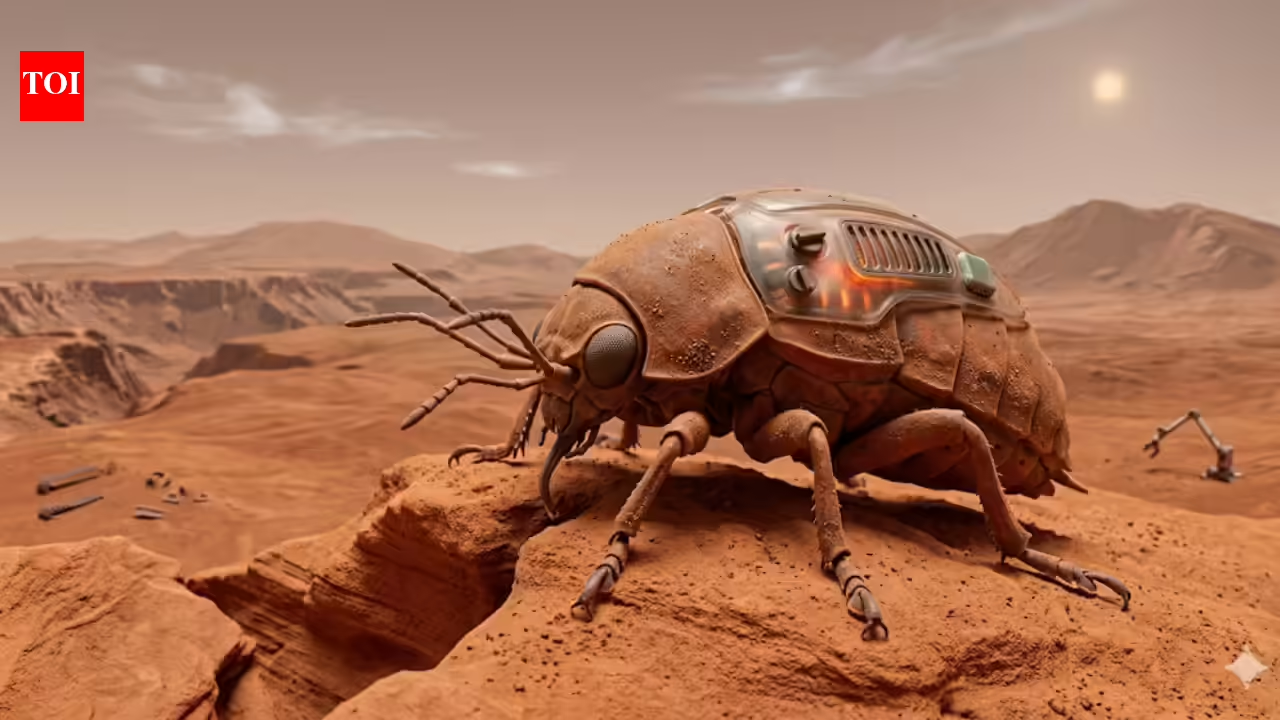
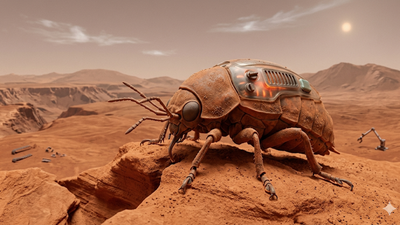
In the recent few days, the discovery of “winged insects” and life forms similar to predators in images from NASA’s rovers on Mars has intrigued scientists as well as confused them in equal measure. It is certainly an interesting idea to see insects flitting about the planet’s surface or even seeing lizard-like creatures hiding amid the dust. But although there have been cases where scientists have seen such life forms in the images captured by the rovers, the scientific world at large is being more skeptical about it. This is because, despite extensive research, Mars still ranks among the most studied planets in our solar system.
NASA Mars rover images: Claims of insect and predator life
The recent claims largely stem from interpretations of images captured by NASA’s Mars rovers, particularly the Curiosity rover. An entomologist, William Romoser, analyzed publicly available rover images and suggested they show insect-like and reptile-like forms on Mars.He’s in’Evidence of Extant Insect-Like Organisms on Mars” + Supplemental Material‘ argued that certain shapes resemble organisms with “wings, wing flexion” and structured legs, adding that “there has been and still is life on Mars.”Romoser even presented his observations at a meeting of the Entomological Society of America, suggesting that some forms appear to be in motion or interacting with their surroundings. These claims have resurfaced with renewed attention as more high-resolution images from Mars become publicly accessible, allowing independent researchers to examine them in detail.
Scientific explanation: Why experts disagree
However, despite the thrill involved, most scientists reject these notions completely. The main problem here involves a psychological concept known as pareidolia where humans are inclined to discern familiar figures such as animals and faces from random objects.Scientists believe that rather than being actual bugs or lizards, these shapes are rocks formed after millions of years due to winds, dust, and other erosional processes on the planet’s surface. Indeed, as experts say, finding “suggestive shapes in NASA photos” does not equate to signs of life.In planetary science, this concept is known as pareidolia, and it poses great challenges for researchers studying surface images of planets.Additionally, no traces of insectoid life forms or animals have been discovered through NASA missions. Indeed, the current missions on the Red Planet target the discovery of microbial life forms in its history.
What NASA research actually reveals about life on Mars
Despite the lack of confirmation of the insect theory, NASA’s studies have delivered some impressive results. For example, the Perseverance rover has found “Cheyava Falls,” which can be an indication of “possible indicator of ancient life.”According to NASA scientists, such findings are indicative of chemical reactions that could support microbial life on the planet billions of years ago, although alternative theories exist.Furthermore, rovers have discovered organic materials and geological formations created using the water elements required for the development of life forms. However, based on scientific studies, all these findings fail to prove that life thrives on Mars.It is true that the scientific community believes that no proof of any insects or predators or life forms exists on Mars.
The bigger picture: Curiosity, caution, and the search for truth
The idea of flying insects on the Red Planet may seem fascinating; however, any scientific research should always go according to evidence rather than interpretation only.Still, there is an element of humanity in these theories: the hope that life exists somewhere else and is not confined to our planet. Mars can actually be considered one of the best candidates where the existence of primitive microorganisms will help change the perception of life in the universe drastically.In the meantime, Mars continues to keep its mysteries a secret, and although the picture may cause much surprise, the reality of the situation should be proved by science.