


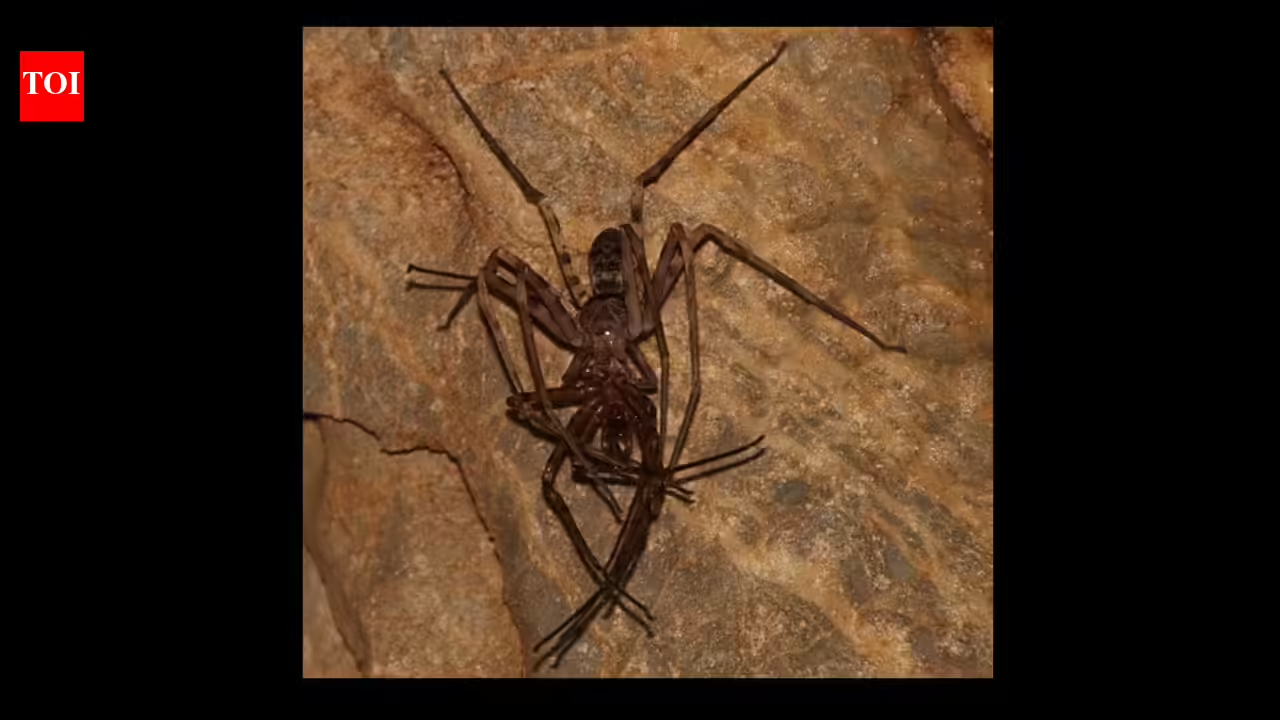
In the year 2001, there was a discovery that could have been straight out of a science fiction movie. It was a spider that had a leg span measuring up to a terrifying 11.8 inches (30 cm). The giant huntsman spider was discovered in a cave deep within the country of Laos. This gigantic creature has broken several records and still holds the title of being one of the largest spiders known in terms of leg span. But behind this horrifying-looking creature, there is a lot more to learn.
Discovery of the giant huntsman spider
The giant huntsman spider was initially discovered in 2001 by Peter Jäger, a German arachnologist, while conducting research in Laos under the title “May gen. n. (Araneae: Sparassidae): A Unique Lineage from Southern Africa Supported by Morphological and MolecularFeatures.” It was officially discovered in 2001 and reported in scientific literature in 2001/2002. Based on Jäger’s discovery, the spider:“Is the largest huntsman spider so far known.”The discovery of this spider was made in a cave setting in the Khammouane area, underscoring the extent to which subterranean ecology is yet unknown to us.
Size, appearance, and unique traits
The characteristic feature of Heteropoda maxima is its unusually large legs that extend up to 30 centimeters in span (11.8 inches). Unlike heavy spiders, such as tarantulas, Heteropoda maxima is characterized by a flat body structure and long legs extended to the side, which enables the spider to move rapidly.As Jäger mentions in his scientific paper:“Legs are laterigrade, spreading sideways, characteristic for huntsman spiders and allowing fast locomotion.”The feature mentioned above proves to be very helpful for cave habitat since speed plays an important role there. Although being such a big creature, this spider poses no danger to humans.
Habitat, behavior, and scientific importance
This particular spider mainly inhabits caves, and its habitat directly affects its behavior and physiological characteristics. Caves can make animals develop specific features, and the giant huntsman spider is no exception. In particular, this arachnid has adapted to life in caves thanks to its light body color and unusually long limbs.This particular finding will have far-reaching consequences not only for the field of biology but also for the study of diversity in general, as evidenced by the following quote from the Senckenberg Research Institute:“Finds like Heteropoda maxima show how even larger and conspicuous species can still remain undiscovered in distant regions.”
Why was the spider’s discovery so crucial?
The giant huntsman spider continues to fascinate people even after many years since its discovery. It shows that no matter what modern science has managed to achieve, nature keeps secrets waiting to be discovered. For scientists, the spider acts as a reminder of the significance of taxonomy and field research. For common people, it demonstrates just how diverse nature really is.Although at first sight, this animal may seem scary because of its size, in reality, it is only a representation of the complexity of nature and not something to be scared of. The discovery of the giant huntsman spider in 2001 became one of the greatest achievements in arachnology.