


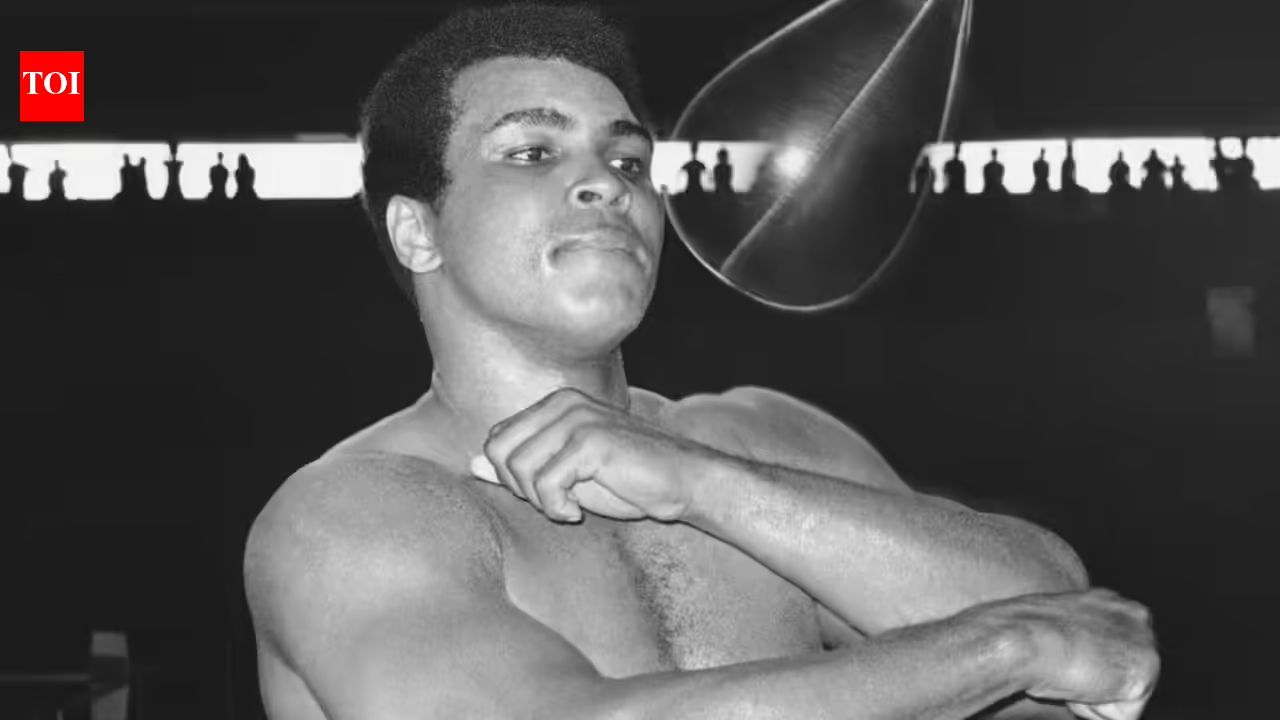
“He who is not courageous enough to take risks will accomplish nothing in life.”That line from Muhammad Ali, one of the greatest heavyweight boxers in history, comes from a career where he repeatedly chose difficult paths over safe ones, both inside the ring and outside it.Across his life, whether it was taking on opponents he was expected to lose to, or making decisions that cost him his title and years of his career, Ali kept putting himself in positions where the outcome was uncertain, and that is what gives weight to what he said.
Where that idea began
Ali was born Cassius Marcellus Clay Jr. on January 17, 1942, in Louisville, Kentucky, and grew up in a country that was still shaped by segregation. His father painted signs and billboards, his mother worked as a domestic, and nothing about his early life suggested he would become one of the most recognizable athletes in the world. Boxing came into his life almost by accident. At 12, after his bicycle was stolen, he told a local policeman, Joe Martin, that he wanted to “whup” whoever had taken it. Martin, who also trained young fighters, told him to learn how to fight first. That was the starting point. Within a few years, he had moved through the amateur ranks, and by 1960, he was in Rome, winning an Olympic gold medal in the light heavyweight division. That win did not feel like a risk at the time, but it was the first step into a career where he would keep putting himself in positions where failure was very real.
The first big gamble
The moment that defined him early came in 1964 against Sonny Liston. Liston was the heavyweight champion and one of the most feared fighters of that era. Clay, as he was still known then, was seen as too young, too unproven, and too outspoken. He didn’t fight like most heavyweights either. His hands were low, his movement was constant, and he relied on speed rather than brute force. Before the fight, he made bold predictions, wrote rhymes, and told anyone who would listen that he was going to win. That alone was a risk. If he lost, all of that confidence would have turned into ridicule. Instead, Liston did not come out for the seventh round, and Clay became world champion. Within days, he announced he had joined the Nation of Islam and changed his name to Muhammad Ali, a decision that carried consequences far beyond boxing. It was not popular at the time, and it immediately shifted how he was viewed in the United States.
The risk that cost him everything for a while
The clearest example of what Ali meant by that quote came in 1967. At the height of his career, with the heavyweight title in his hands, he refused to be drafted into the US Army during the Vietnam War. He cited his religious beliefs and opposition to the war. The cost was immediate.He was stripped of his title and lost his boxing license, sidelining him for more than three years during what should have been the peak of his career between the ages of 25 and 29, time most fighters simply cannot afford to lose. Muhammad Ali understood the full cost of that decision. It was never a symbolic stand; it put his career, income and public standing on the line, and at the time it brought intense criticism across the United States. In the years that followed, however, that choice became as central to his legacy as anything he achieved inside the ring.
Coming back and doing it again
Ali returned to boxing in 1970, and almost immediately, he was back in the kind of fights that carried real stakes. In 1971, he fought Joe Frazier in what was called the “Fight of the Century.” He lost after 15 rounds, the first defeat of his professional career. He didn’t step away from that. He kept fighting. In 1974, he faced George Foreman in Zaire. Foreman was younger, stronger, and had been knocking opponents out with ease. Again, Ali was not the favourite. That fight became the “Rumble in the Jungle.” Instead of trying to outfight Foreman directly, Ali leaned on the ropes, absorbed pressure, and waited. It was a deliberate risk. He allowed himself to take punishment, trusting that Foreman would tire. In the eighth round, he knocked him out and reclaimed the heavyweight title. A year later, he fought Frazier again in the “Thrilla in Manila,” one of the most physically demanding fights ever seen. After 14 rounds, Frazier’s corner stopped it. Ali had won, but both men were pushed to their limits.
The later years and what remained
Muhammad Ali retired with a professional record of 56 wins and 5 losses, including 37 knockouts, leaving behind one of the most dominant careers in boxing history. He made history by becoming the first fighter to win the heavyweight title three times, reclaiming it in 1978 after defeating Leon Spinks, a moment that reinforced his reputation for resilience as much as skill.In the 1980s, Ali was diagnosed with Parkinson’s disease, a condition that gradually affected his movement and speech. Over time, it began to take away the physical precision that had once defined him in the ring, reshaping how the world saw a man who had once been untouchable in motion.Even as his health declined, he remained visible in public life, choosing presence over retreat. One of the most enduring images of his later years came at the 1996 Atlanta Olympics, where he lit the Olympic flame. His hands trembled as he held the torch, but the moment carried a quiet weight that made explanation unnecessary.In 2005, he was honored with the Presidential Medal of Freedom, a recognition of his influence far beyond sport. He died on June 3, 2016, in Scottsdale, Arizona, at the age of 74, leaving behind not just records and titles, but a legacy shaped equally by his achievements, his struggles, and his presence in the world long after he stopped fighting.
What that quote means in real terms
When Ali said, “He who is not courageous enough to take risks will accomplish nothing in life,” he was not talking about taking chances for the sake of it. He was talking about moments where staying where you are is easier, but moving forward matters more. In his case, it meant stepping into fights he was expected to lose, speaking in ways that made him a target, and making decisions that cost him years of his career. There is a pattern there. The outcome was not always guaranteed. In some cases, the immediate result was negative. But the decision to act did not depend on that.
How that applies outside sport
What Muhammad Ali said about risk works the same way outside boxing because the principle is simple: nothing moves forward unless something uncertain is accepted first, and that shift from what is known into what is not yet clear is where progress usually begins, even if it feels uncomfortable at the time. Risk, in that sense, is the price of growth, even when it does not look like it in the moment, because staying inside what feels familiar can slowly turn into stagnation, and that is where the comparison with nature becomes useful, since organisms that do not adapt or move toward new conditions eventually fall behind or disappear, even though staying still might seem safer at first. The same pattern shows up in everyday life, where choosing only what is predictable can quietly limit how far someone can go, while stepping into something uncertain, even in small ways, creates space for movement, learning, and improvement over time. In practical terms, that can take different forms depending on the situation, whether it is choosing a career path that is less predictable, starting a project without knowing how it will develop, or making a decision that goes against what others expect, because each of those moments involves moving forward without complete certainty. That is also why this idea is not about acting without thought or taking unnecessary risks, because the kind of risk Ali spoke about was tied to something specific, whether it was a goal, a belief, or a direction he had already chosen, and that is what separates it from being reckless. Applying this principle means practicing what can be called calculated audacity, where a person accepts temporary discomfort, possible failure, or even criticism in exchange for the chance to move toward something better, whether that is an entrepreneur starting a business, an artist putting out work that feels personal, or someone setting clear boundaries in their own life. When there is no direction, risk becomes random and often unproductive, but when there is a clear sense of where someone wants to go, taking that risk becomes necessary, because without it, very little changes and most things worth doing never really begin.
What often gets missed in that idea
The main obstacle to taking risks is the fear of failure, but what Muhammad Ali points toward is a different way of understanding it, where failure is not treated as an end point but as “intellectual capital,” data that informs the next attempt.Once that shift happens, risk stops being a single high-stakes moment and becomes a series of experiments, where each step adds something, even if the result is not immediately successful, and that is usually where real progress begins to build.Those who accomplish the most are rarely the ones who never failed, but the ones who were willing to keep experimenting when others stepped back, and over time that difference becomes clear in how far each person is able to go.A life without risk tends to remain within what is already known, but once uncertainty is accepted and acted upon, the direction changes, and that is where something meaningful begins to take shape.