


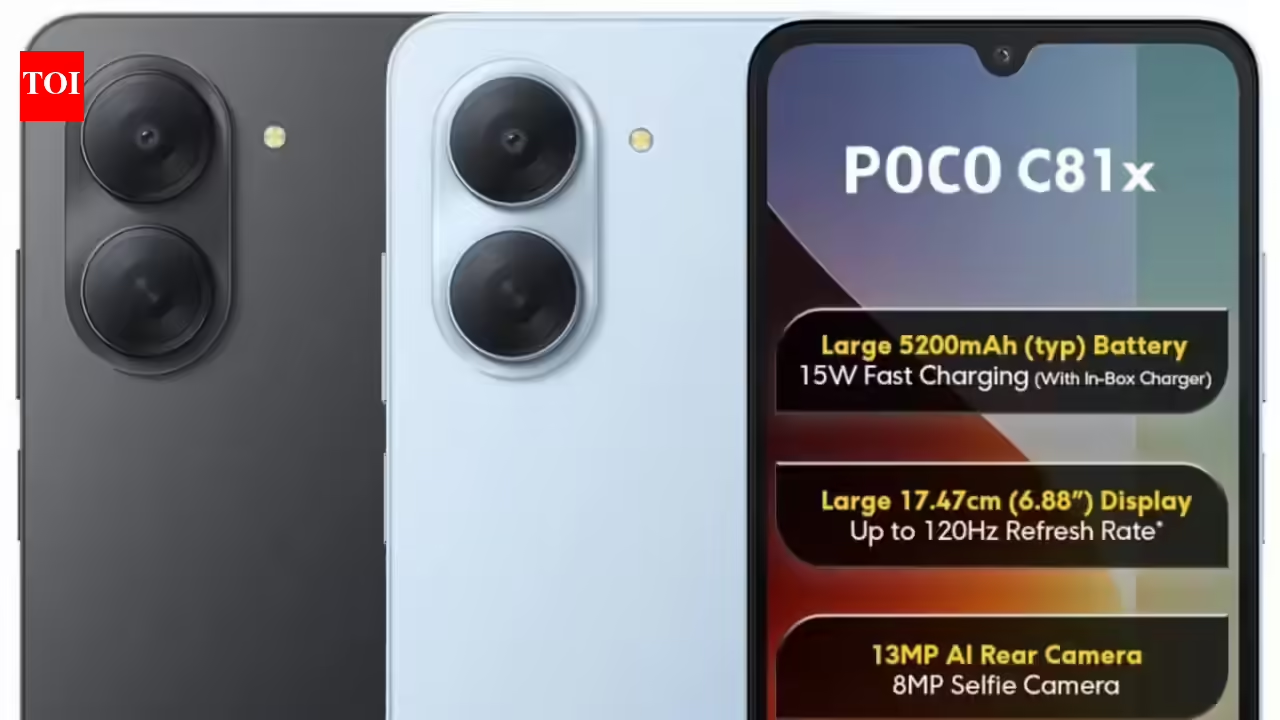
POCO has built a reputation for delivering feature-packed smartphones at competitive prices, and its latest entries—the POCO C81 and POCO C81X—continue that tradition in the budget-to-midrange segment. At first glance, the two devices appear nearly identical, sharing the same processor, camera setup, connectivity options, and battery configurations. Both are powered by the UNISOC T7250 chipset, paired with 3GB/4GB RAM and 64GB storage, expandable up to 2TB, making them versatile for everyday use. They also feature a 13MP rear camera, 8MP front camera, and a large 5200mAh/6300mAh battery with 15W fast charging, ensuring reliable performance for casual users.Where the differences emerge is in software and display certifications. The POCO C81 runs on Android 16 with HyperOS 3, offering the latest software experience and extended support, while the C81X ships with Android 15 and HyperOS 2. On the display front, the C81 adds extra TÜV Rhineland certifications for low blue light, circadian friendliness, and flicker-free viewing, making it more eye-friendly compared to the C81X’s standard panel. Design-wise, the C81 is slightly slimmer but heavier, whereas the C81X is lighter with a marginally thicker build.Together, these subtle differences position the POCO C81 as the more future-proof and user-friendly option, while the C81X remains a solid, slightly lighter alternative for those who prioritize simplicity.
| Feature | POCO C81 | POCO C81X | ||||||
| display | 6.9‑inch HD+ IPS LCD (1600 × 720), 120Hz refresh rate, 240Hz touch sampling, TÜV Rhineland Low Blue Light, Circadian Friendly, Flicker Free certified, DC dimming | 6.88‑inch HD+ IPS LCD (1600 × 720), 120Hz refresh rate, 240Hz touch sampling | ||||||
| Processor & GPU | UNISOC T7250 Octa‑Core (12nm), Mali‑G57 MP1 GPU | UNISOC T7250 Octa‑Core (12nm), Mali‑G57 MP1 GPU | ||||||
| RAM & Storage | 3GB / 4GB LPDDR4X RAM, 64GB UFS 2.2 storage, expandable up to 2TB via microSD | 3GB / 4GB LPDDR4X RAM, 64GB UFS 2.2 storage, expandable up to 2TB via microSD | ||||||
| software | Android 16 with Xiaomi HyperOS 3 | Android 15 with Xiaomi HyperOS 2 | ||||||
| SIM & Connectivity | Dual SIM (nano + nano + microSD), Dual 4G VoLTE, Wi‑Fi 802.11 ac (2.4GHz/5GHz), Bluetooth 5.2, GPS | GLONASS | Galileo | BDS (B1C), USB Type‑C | Dual SIM (nano + nano + microSD), Dual 4G VoLTE, Wi‑Fi 802.11 ac (2.4GHz/5GHz), Bluetooth 5.2, GPS | GLONASS | Galileo | BDS (B1C), USB Type‑C |
| Rear Camera | 13MP f/2.2 + secondary sensor, LED flash | 13MP f/2.2 + secondary sensor, LED flash | ||||||
| Front Camera | 8MP f/2.0 | 8MP f/2.0 | ||||||
| audio | 3.5mm jack, FM Radio, bottom‑ported speaker | 3.5mm jack, FM Radio, bottom‑ported speaker | ||||||
| Security | Side‑mounted fingerprint scanner | Side‑mounted fingerprint scanner | ||||||
| Dimensions & Weight | 171.56×79.47×8.15mm; 208g | 171.79×79.77×8.26mm; 193g | ||||||
| Durability | IP52 dust & splash resistant | IP52 dust & splash resistant | ||||||
| battery | 5200mAh (A7) / 6300mAh (A7 Pro), 15W fast charging | 5200mAh (A7) / 6300mAh (A7 Pro), 15W fast charging |