


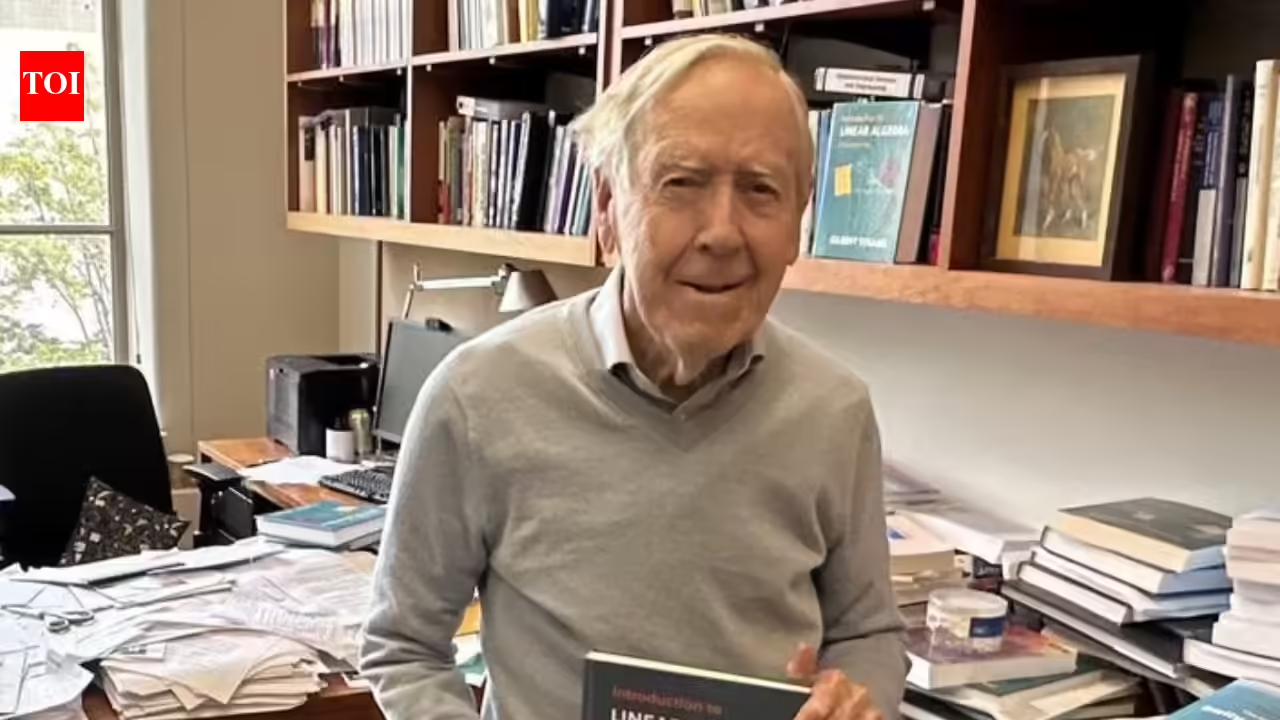

For more than six decades, Gilbert Strang stood at a chalkboard at the Massachusetts Institute of Technology. He taught linear algebra, a subject many students find abstract and difficult to grasp at first. What began as an undergraduate classroom course gradually grew into a global learning resource. Through MIT OpenCourseWare, Strang shared his lectures, notes, and problem sets online for free. Millions of learners around the world gained access to the mathematical foundations behind modern technologies, including artificial intelligence. His course is now among the most widely viewed university-level mathematics resources available online.
A lifetime of teaching the maths behind AI to generations
Strang joined MIT’s faculty in 1962 and taught for more than six decades before retiring in 2023, making his academic career one of the longest in the institute’s history. Over that time, he taught thousands of students in person and many more remotely. His flagship course, 18.06 Linear Algebra, became a cornerstone of MIT’s undergraduate curriculum.Beyond the classroom, his textbooks, particularly Introduction to Linear Algebra, have been adopted by universities worldwide. These works have helped standardize how the subject is taught across engineering, computer science, and mathematics programs.
Opening the classroom to the world
In 2002, MIT launched OpenCourseWare, an initiative to publish course materials online for free. While some educators were cautious about sharing their lectures publicly, Strang supported the idea from the outset.He recorded and released his full course, including lecture videos, assignments, exams, and detailed solutions. This decision transformed a traditional university course into a global educational resource that anyone with an internet connection could access.Linear algebra forms a core part of the mathematics used in machine learning, neural networks, data science, and computer graphics. Concepts such as matrices, vectors, eigenvalues, and singular value decomposition are essential tools in these fields.Strang’s approach made these ideas more accessible by focusing on intuition and real examples before introducing formal abstraction. While linear algebra is only one component of artificial intelligence, alongside probability, calculus, and optimization, it remains a foundational layer in how modern systems process data.
A different way of teaching mathematics
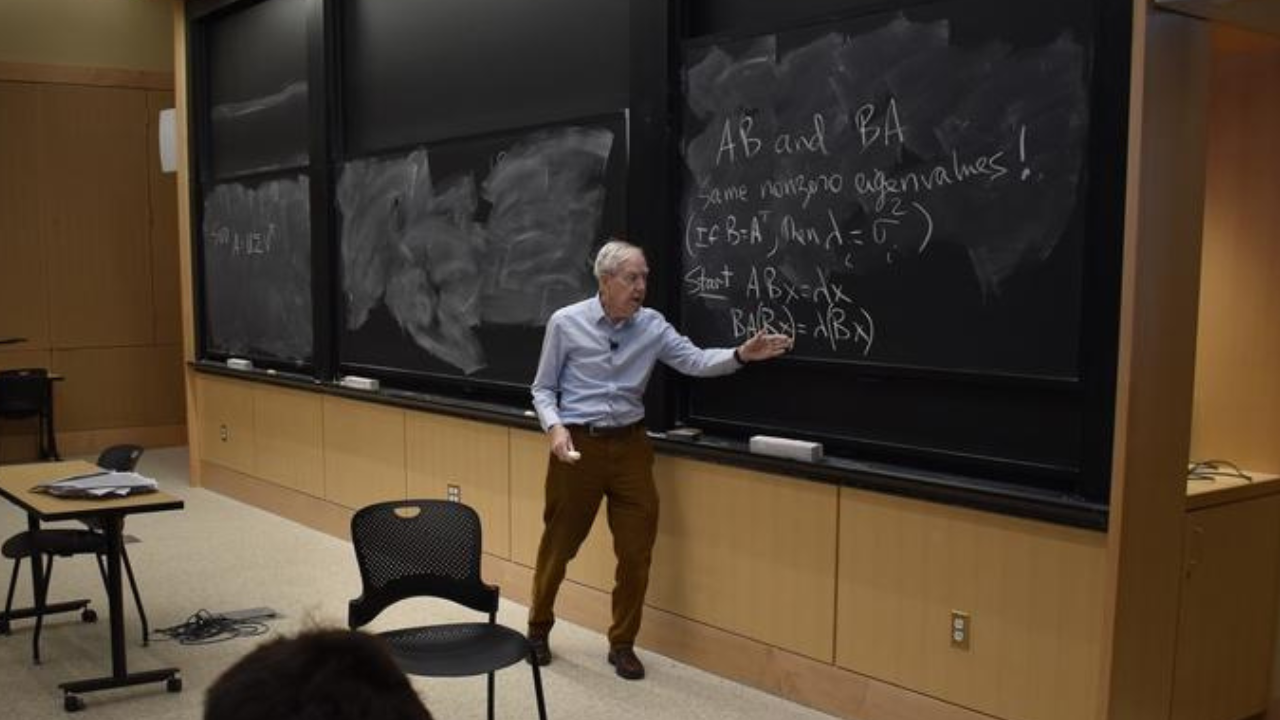
Strang’s teaching style stood out for its clarity and accessibility. Instead of beginning with abstract theory, he started with concrete examples, helping students build intuition before moving to more formal concepts.He also emphasized communication and understanding in the classroom. He avoided dismissive language such as “obvious” and encouraged questions by pausing to check whether students were following along. His approach treated beginners with the same level of respect as advanced learners.
A global classroom without borders
Over the years, Strang’s lectures have reached millions of viewers online. His course is frequently recommended in university programs, online learning communities, and pathways for machine learning and programming.In some cases, instructors at other institutions have supplemented or replaced their own lectures with his videos, reflecting their clarity and depth. This level of adoption is rare for a single professor’s course.Strang’s decision to share his work freely aligns with a broader shift toward open education. MIT OpenCourseWare became a model for similar initiatives worldwide and demonstrated that high-quality academic content could be made accessible without cost.Even after his retirement from classroom teaching, his lectures continue to serve as a reference point for learners globally, particularly those entering fields connected to data and artificial intelligence.Rather than building a personal brand, Strong focused on teaching itself. His contribution lies in the sustained effort to make complex ideas understandable to generations of students.Today, his lectures remain available online, unchanged, accessible, and widely used. They represent a simple but powerful legacy, a lifetime of teaching shared openly with the world.