


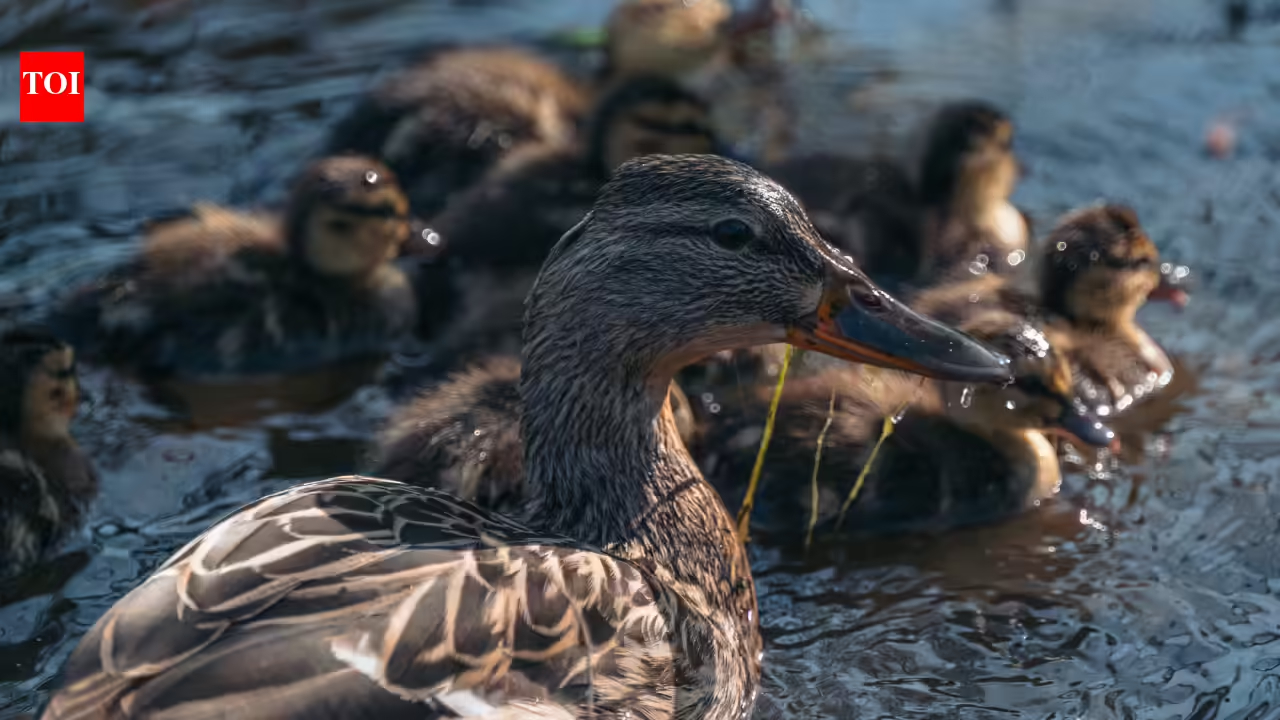
The large brood of ducklings acting like a single family is, in fact, a highly developed survival strategy used by ducks, which includes brood mixing, crèching, predator avoidance, and energy conservation. Although this is common among other species such as mallard ducks and other water birds, multiple broods unite under the supervision of only one or two mother ducks, thus creating a large family of ducks. This strategy makes sure that there are higher chances of survival, avoids predators, and conserves energy since all mother ducks are able to look out for predators at one go.
Giant duckling parade are a clever survival strategy, not a single family
The image of ducks with a long line of ducklings following them is an idyllic portrayal of the perfect family unit. In fact, in most cases, these parades consist of ducklings from various broods. The strategy of brood amalgamation enables the little birds to have increased security in numbers.As reported by Canadian Journal of Zoologysome water bird species like the mallard are often seen creating mixed groups that include “ducklings from various mothers that may congregate under a single female.” This kind of practice is also referred to as crèching and can be observed in other species of animals that form mixed nurseries.This activity is not merely a family gathering but a survival tactic employed by the ducks.
Brood amalgamation and crèching behavior in ducks
The process of brood amalgamation involves the combination of several broods of ducklings under one roof. The phenomenon can be either voluntary or arise in situations where ducklings from other broods join an existing group after being lost from their mothers.Studies carried out on goldeneye ducks and named ‘Cooperation, Conflict, and Crèching Behavior in Goldeneye Ducks‘ indicate that the behavior is common in areas with higher rates of predation. With the increased number of eyes, the ducklings can detect any dangers and alert others in case of threats.Sometimes, a leading female duck, who could be a more experienced mother duck, assumes responsibility for guiding the group toward food sources. It can be a burden but the advantages far outweigh the disadvantages.
Predator avoidance and safety in numbers
One of the reasons why ducks form large parades of ducklings is for the sake of protection from predators. There are many species of animals that prey on ducks, such as hawks, fish, and other mammals. Without being in a flock, a duckling is highly vulnerable and susceptible to attacks.In the case of a larger flock, the probability that any single duckling will be picked up by the predator is lowered; this is called the dilution effect in ecology. Furthermore, the motion of the whole flock confuses the predator, hence making it difficult to catch the ducklings.Several ecological studies have been conducted in relation to this issue by the Royal Society.
Shared parental effort and energy efficiency
A final benefit of this system of duckling raising is the way that adults share parenting duties. At first glance, it might be surprising that a parent would have to look after so many ducklings, but when viewed in context, it actually makes sense.Sometimes, several females will stay around to help guard the flock. In other situations, there will only be one lead female, yet she will be less stressed knowing that the group shares information and is collectively aware of any danger. By doing this, duck parents manage to save their energy.Studies conducted on bird behavior indicate that this is an efficient approach in situations where resources are scarce and risks abound.
What this behavior reveals about evolution and adaptation
The emergence of such behavior among giant ducklings illustrates how the process of natural selection affects the behavior of animals in relation to certain environmental challenges.Ducks that opted for group behavior as a solution strategy are still alive today and have passed the genes associated with such behavior to their offspring.This kind of behavior is observed in numerous species, including penguins, various other mammals, and some fish species. Grouping together is something all animals can engage in, and such behavior always leads to some benefits for all participants, regardless of kinship.Understanding such strategies allows specialists to ensure better protection of birds, especially when they live in environments affected by human intervention.Despite looking nice, giant duckling parades are actually a good illustration of how nature operates with the help of adaptation mechanisms. This kind of behavior is not just connected with maternal instinct, but represents an opportunity for self-defense.