


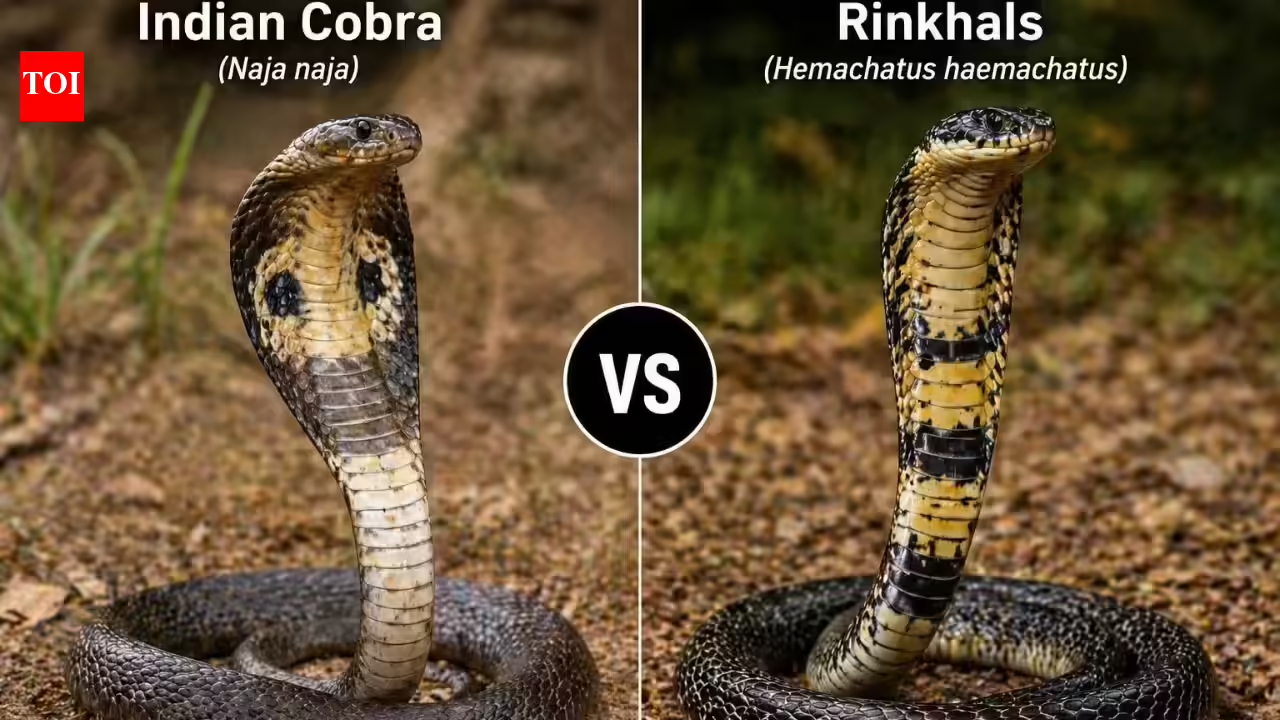
Cobras are considered to be among the most recognized venomous snakes in the world. Their ability to stand tall and create a hood around their necks. For this reason, these two species have been a subject of interest both within and outside the scientific community.Two of the species that tend to share similarities in many respects include the Indian cobra, referred to scientifically as Naja naja, and the rinkhals, which is called Hemachatus haemachatus.Despite appearing to be very alike in many aspects, particularly when it comes to their posture, there are a number of characteristics which distinguish these two snakes.
Where Indian Cobra and Rinkhals live
These two species are found in distinct regions, which contribute significantly to their behavioral traits and patterns of survival.The Indian cobra lives in most parts of the Indian sub-continent. They have been reported in India, Pakistan, Sri Lanka, Bangladesh, and Nepal, among other places, as well as known for being able to survive in all kinds of habitats, including forests, savannas, marshes, and even areas close to human settlements.The Indian cobra can live in termite hills, rocks, dense bushes, and abandoned burrows. Due to its adaptation, it is common to find it in contact with humans, particularly in agricultural settings.In contrast, the rinkhals is indigenous to southern Africa, in countries like South Africa, Zimbabwe, and Botswana. Its preferred environment is the open grassland and marshes around water bodies.Unlike the Indian cobra, which can be found anywhere without any restrictions to geographical boundaries, the rinkhals prefers areas with a lot of moisture, since that is what favors the presence of its favorite food.
Indian Cobra vs Rinkhals: Differences in size and appearance
Both of the species show typical cobra-like postures; however, they vary from each other in physical characteristics.The length of the Indian cobra varies from one to 1 to 1.5 metres; some specimens may be longer than others. One of the most distinctive features of this cobra is the spectacle-like mark present on its hood when it expands.In terms of size and weight, the rinkhals is bulkier and stronger; Its size equals or is slightly greater than that of the Indian cobra. Unlike the Indian cobra, the rinkhals lacks a spectacle-like mark on its hood; instead, it has dark skin covered with one or more light bands on its neck.Another difference is in the texture of the scales. While the Indian cobra has smooth scales, the rinkhals has keeled scales.
Venom and snakebite risk of the Indian Cobra and Rinkhals
These two species are both poisonous and dangerous, but their venoms have some differences in their effects.The Indian cobra is known for containing powerful neurotoxins and cardiotoxins that have an impact on the nervous system and may cause suffocation and paralysis if not treated quickly. It also belongs to the category of the “big four” snakes responsible for the most snakebites in India.The rinkhals, on the other hand, is venomous and has similar venomous characteristics as those of the Indian cobra; however, the rinkhals’ venom has an additional impact on the tissues of the organism. It should be noted that the rinkhals possesses the unique property of being able to spit venom at any danger towards it, namely into the eyes.It is characteristic that both snakes rarely attack people without reason and only if they are provoked or in danger.
Indian Cobra and Rinkhals: Hunting behavior and diet
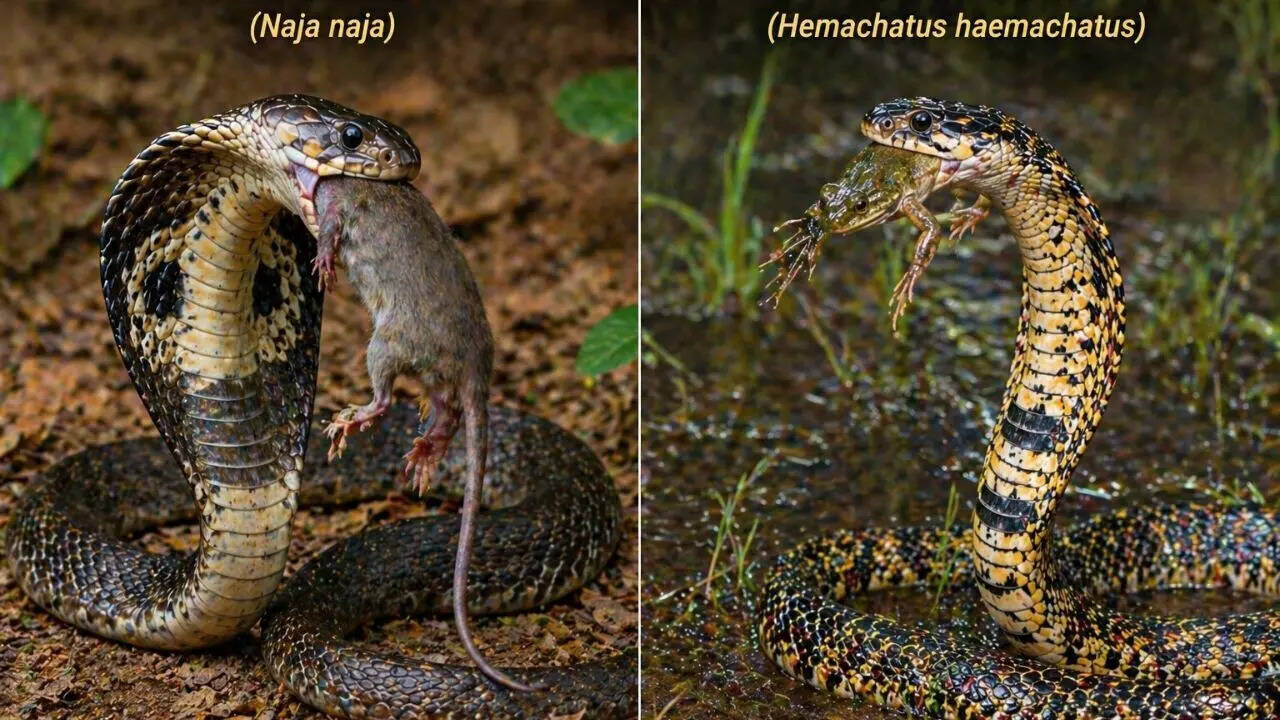
PC:AI-Generated
The Indian cobra and rinkhals are both meat-eating animals that depend on venom to hunt their prey.The Indian cobra’s diet includes rodents, frogs, lizards, and small birds. It is usually viewed as helpful in farming regions since it aids in controlling rodent populations.The rinkhals’ diet includes small mammals, amphibians, and reptiles, but it especially eats frogs and toads, which explains why it favors wetlands.Both snakes attack their prey, inject venom into them, and wait until the prey becomes weakened before eating them.
Defensive posture and behavior of both the snakes
One of the most famous traits about the cobra is its defensive posture, and both species show this behavior when they feel threatened.The Indian cobra will elevate its head and spread out its hood as an initial warning sign. This might be coupled with some hissing. However, if it feels threatened enough, it will attack, although it usually prefers to flee from a predator.In addition to elevating its body and flaring out a hood-like shape, the rinkhals is more complex in defense as it has the ability to shoot venom at the threat while playing dead by lying on its back.
Classification and reproduction differences in the Indian cobra and rinkhals
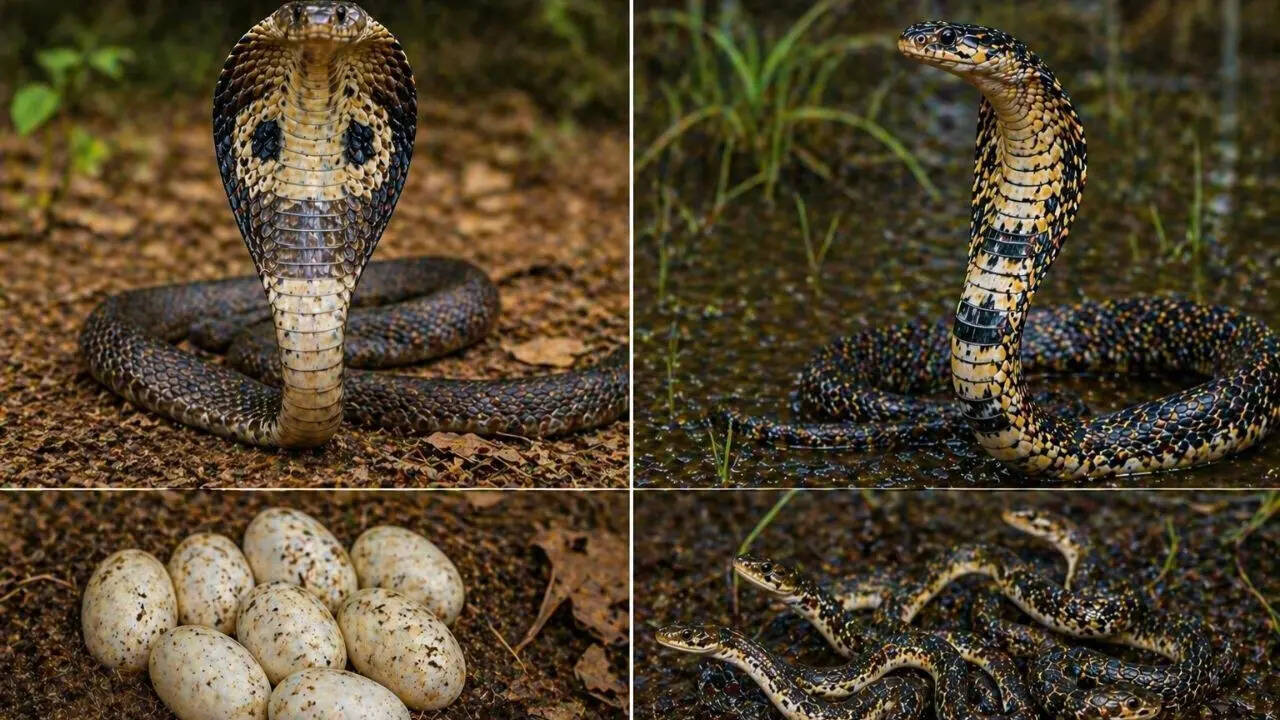
PC: AI-Generated
One significant difference between these snakes is that the Indian cobra is classified under the genus Naja, making it a genuine cobra, while the rinkhals snake is placed under the genus Hemachatus, and thus it does not belong to the cobra group, despite its appearance being somewhat like that of a cobra. Another important difference is in reproduction. The Indian cobra lays eggs, while the rinkhals gives birth to live young, which is relatively uncommon among cobra-like snakes.
Cultural and ecological importance
The Indian cobra is highly regarded in the South Asian region and has been connected to various religious and mythological aspects. This snake is mostly linked to cultures that relate to Lord Shiva.While the rinkhals does not have the same cultural role, this snake is renowned in its habitat for its special defense mechanism.Both snakes help to maintain ecological balance by regulating the population of small animals in their environment.