


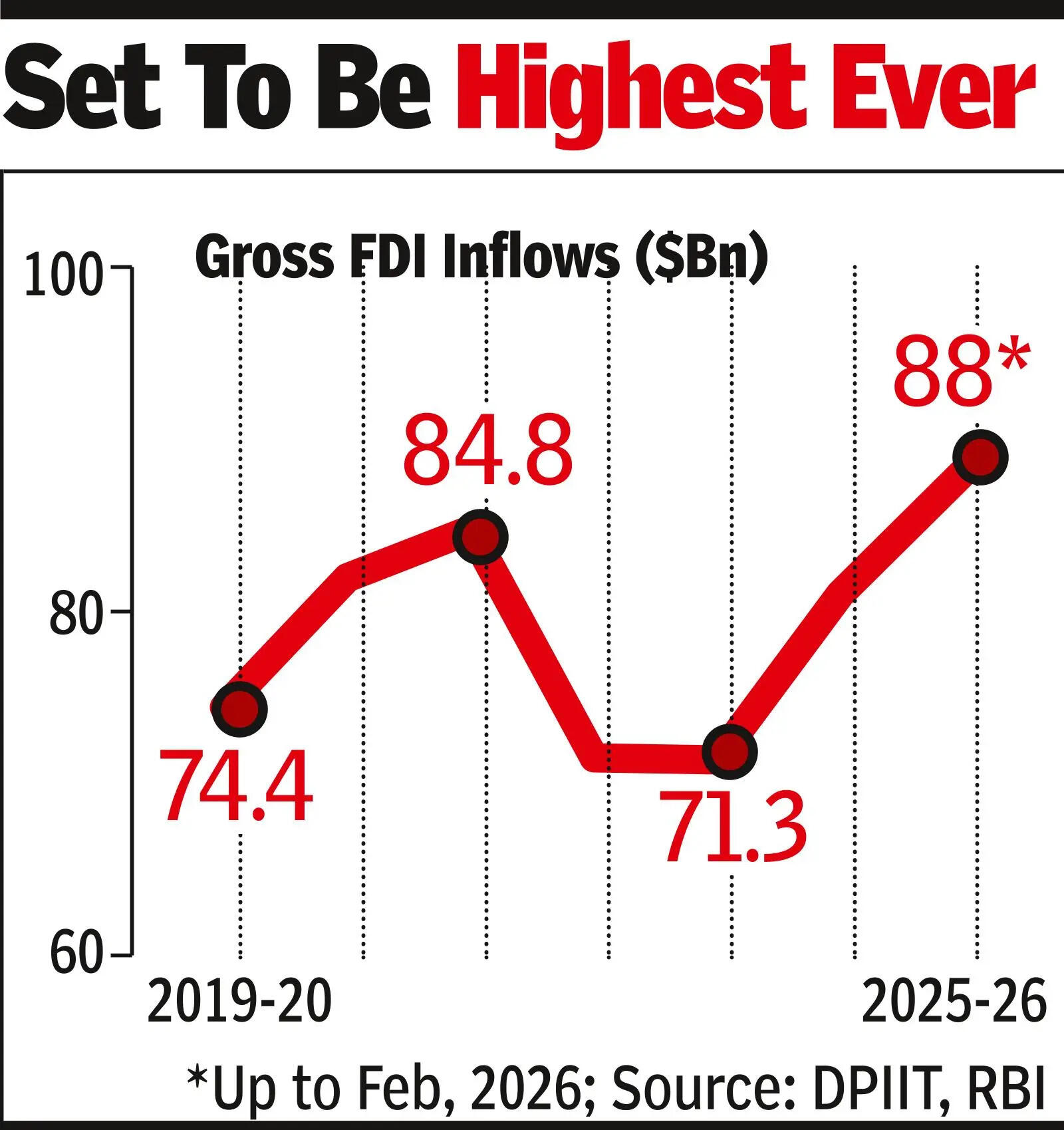
NEW DELHI: India’s foreign direct investment (FDI) inflows may have crossed the $90 billion mark for the first time in 2025-26, secretary at department of promotion of industry and internal trade (DPIIT) Amardeep Singh Bhatia told reporters Thursday, while seeking to highlight that greater outreach to investors has borne fruit, with free trade agreements (FTAs) set to provide further impetus to trade and investment inflows.Another official said that gross FDI till Feb 2026 was $88.3 billion, nearly 10% higher than $80.6 billion in 2024-25. This also helped blunt some of the impact of higher outward investment and repatriation from the country, with net FDI in first 11 months of the last fiscal year pegged at $6.2 billion, compared with $959 million in entire 2024-25.Besides, the proposed changes in the rules governing FDI from countries sharing land borders with India are soon going to be notified by the department of economic affairs (DEA).
“It is under process. The DEA will have to do their internal consultations and discussions with our agencies and then they will come up with the notification,” an official said.While DPIIT’s Press Note 2 (2026) last month announced the changes, the DEA must amend the Foreign Exchange Management Act (Non-debt Instruments) through a notification to give a legal basis to the announcement, added the official.This latest note changed the earlier rule of April 2020 (Press Note 3) that had made govt approval mandatory for all FDI from neighboring countries sharing land borders with India – China, Pakistan, Bangladesh, Nepal, Myanmar, Bhutan and Afghanistan. Earlier, these curbs were put to prevent opportunistic takeovers of Indian companies due to eroded valuations during the Covid pandemic shock.Besides, the Invest India, which is the national investment promotion and facilitation agency, said it has facilitated projects worth over $6.1 billion in 2025-26, which are expected to generate more than 31,000 jobs across 14 states.Approximately 42% of total investment value has come from European countries, reinforcing India-Europe economic linkages. The US, Japan, South Korea and Australia also remained key contributors, while emerging participation from Brazil, New Zealand and Canada highlighted diversification in investment sources.“Restructuring of Invest India has yielded dividends. Right from the first contact with the investor to maturing that lead, (the process) has sped up. Interactions taking place at all levels of the govt have also increased,” said Bhatia.Chemicals, pharmaceuticals, biotechnology, and food processing sectors account for about 65% of these grounded investments, driven by high-value projects. Emerging sectors such as electronics system design and manufacturing, aerospace and defense, and auto/EV have recorded significant activity.