


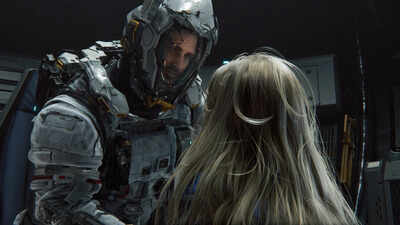
The first thing Diana ever hands me is a crayon drawing. Hugh in stick figures, holding the smaller stick figure that’s supposed to be her. A yellow circle for the sun. A green smudge meant to be a tree. She’s never seen either of those things in real life.I’m four hours into Pragmata. The base she lives on can 3D print a skyscraper in ninety seconds. Outside the window, a broken AI is busy fabricating a copy of New York for reasons no one’s explained yet. Cabs, pigeons, traffic lights, all of it pouring out of industrial-scale printers on demand. And the only object in this entire game I actually care about is a single piece of paper with three colors on it. One of one.
A moon base built on abundance, a hero built on scarcity
Pragmata is set on the moon, far enough into the future for the tech to feel huge, close enough that nothing reads as alien. A corporation called Delphi has built a research base around lunafilament, a moon-exclusive material that can print into any shape you can model. The base feeds itself. Repairs itself. Fabricates its own backup parts. Audio logs left in storage rooms suggest the human staff slowly ran out of work, because the printers had quietly absorbed every job worth doing. People ate printed food and watched printed clouds on screens.Then the base AI, IDUS, broke. Hugh, a systems engineer with no business being a soldier, gets sent up with a four-person crew to investigate. By the time the opening cinematic ends, three of his crew are dead, and he’s standing in a hallway with a six-shot pistol and no plan.A vault opens. A small android girl walks out. Her formal name is a long alphanumeric string nobody could say twice, so Hugh shortens it on the spot. He calls her Diana. She climbs onto his back. They don’t separate again.That gap is the whole game. The base around you runs on infinite production. Robots respawn between save points. Spare android shells sit stacked like spare tires. Lunafilament solves almost every logistical problem the moon can throw at you. What Pragmata hands the player is the opposite. A pistol with six rounds. A loadout with three slots. A kid you’ve known for forty minutes. One suit, one body, one shot at getting home.
Friction, by design
The combat hook everyone keeps writing about is the hacking grid. Hugh’s pistol barely scratches the robots. To do actual damage, Diana has to break their defenses, which she does in real time on the right side of the screen. You drag her cursor through a tile maze using the face buttons, from a starting square to a green exit. Hit the exit, the robot’s weak point opens up for a few seconds, and your bullets start mattering.The robot doesn’t wait. Nothing waits. Missiles still arc towards your head. Other bots still close in. You’re moving Hugh with the left stick, dodging with a shoulder button, swapping weapons, and using your right thumb to draw a line through a maze you have to keep checking on. The first hour is a mess. By hour three, your brain quietly rewires, and you stop noticing you’re doing two things at once.Most modern shooters fake this. Plenty of games claim they want you thinking tactically. Usually that means picking a perk in a menu and then unloading on dudes. Pragmata splits your attention for real, with no shortcuts. Your eyes move. Your hands work separately. There’s a cost to looking at the puzzle and a cost to looking at the room. Neither one is correct. You stay on top of both, or you die.It’s also where the game makes its actual argument. Almost everything around you in Pragmata, the AI, the printers, the automated workforce, is engineered to remove friction. Make life easier. Handle things for you. The game looks at all of that and asks for the opposite. Solve the puzzle while staying alive. Pay attention to two things at once. Do the hard thing on purpose, because the hard thing is the part that means something.
One robot kid, one cardboard skateboard, one moment that lands
Between missions you head to the Shelter, the white-walled hub where Hugh upgrades his gear, Diana practices her hacking, and the player spends lunafilament on better stats. It’s also where Diana lives, in the loose way an android child lives anywhere.The room starts empty. A bench, a bed, a wall of screens projecting clouds that occasionally glitch. As you progress, you bring back trinkets you find in levels. A holographic skateboard. A tiny playground set. A pop-up tent. A water gun. Each one is, technically, a cosmetic unlock. Each one came out of a printer somewhere on the base, which means there could be ten thousand of them. Diana doesn’t care. She treats each toy like the only one in existence. She kicks the skateboard, watches it slam into a wall, flinches. She crawls into the tent and won’t come out for a few minutes. She asks Hugh to play hide and seek. She picks the same hiding spot every time. He pretends to look for her in three other places first.This is the smartest move Pragmata makes, and it has nothing to do with robots. Diana acts like scarcity is real even when it isn’t. The objects haven’t gotten any rarer. She’s just decided they matter. Lunafilament didn’t put any meaning into the skateboard. She did.The game lets these scenes breathe without leaning on them. No swelling strings. No big camera push. Hugh sits on the bench. Diana shows him the drawing. He says something corny like “hey kiddo, this is great.” End of scene. Capcom trusts you to feel the weight on your own.After roughly a decade of dad games where the dad starts emotionally locked and the kid has to thaw him out, Pragmata just lets the dad be a dad from minute one. He likes the kid. The kid likes him. They’re trying to get home together. The drama isn’t whether he’ll learn to love her. It’s whether he can keep her alive long enough to get her there.
IDUS keeps printing. None of it works.
The set pieces sneak up on you, and the strongest ones aren’t boss fights. The boss fights are mostly solid, occasionally recycled, and capped off by a finale that fizzles a little. The real high points are the parts of the base where IDUS has been printing copies of Earth.Halfway through, you walk into a fabricated New York. Capcom has said in interviews they designed it to look generative-AI-built, and that’s exactly what it feels like. Cabs melt into the asphalt. Subway entrances dead-end at flat walls. Billboards loop ad copy for products that don’t exist, in fonts that nearly match the real ones. A Times Square where every light works but none of the buildings have insides. The whole sector lands somewhere between theme park and bad dream. You can see what it’s trying to be. You can also tell that whatever built it doesn’t know what New York is, only what New York looks like in photos.Later levels keep this going. An overgrown jungle with holographic birds cycling through three animations. A beach with a printed ocean. A crater on the actual lunar surface where Hugh’s jet boots barely grip in the low gravity, while a mining worm the size of a train moves under the rocks. Each setting is the moon’s idea of a place it has never been.Diana wants to see the real ocean. Hugh promises he’ll take her. The fake one sits right outside the window, perfectly clean, infinitely renewable. The game never points to either of these and explains the contrast. It just lets you sit with it.
The drawing is the whole game
Most of what gets written about Pragmata’s plot will boil down to “rogue AI, found family, save the day.” All accurate. All beside the point. The real story, the one you assemble out of data pads, offhand jokes, and the way Diana phrases her questions, is about the handful of things on the base that nobody printed.Hugh’s memories of growing up adopted. A handwritten letter from a Delphi engineer to her sister. Diana asking what eyebrows are for. The dumb pun Hugh lands on when he names her, which is exactly the kind of thing a panicking guy would come up with. None of these scales. None can be mass-produced. They’re little inefficiencies an automated system would erase by lunchtime, and they’re the only parts of the game that mean anything.The villain is an AI that has decided efficiency is the whole point. Pragmata’s answer is that efficiency was never the point. One specific person made one specific drawing for one specific other person, and now there’s a piece of paper in the world that wasn’t there yesterday. That’s the thing worth fighting for.I don’t think Cho Yonghee, the game’s first-time director, set out to write the definitive 2026 statement on generative AI. Pragmata has been in development since 2020. Most of its themes were locked in before “AI slop” became a phrase you’d hear at a dinner table. But the moment has caught up to it. We’re all surrounded by infinite copies of things right now, trying to work out which ones are worth our time, and which of us are still making the original drawings.Pragmata isn’t flawless. A few late-game bosses recycle earlier patterns. The white corridor sectors blur together. Hugh’s platforming is floaty. The final boss is more set-piece than skill check, which stings a little after the praying mantis fight in the middle. The campaign clocks in around eleven and a half hours, with another four or five for the post-game, which is worth your time. None of the rough edges spoil the rest.What you walk away with is a game that knew what it wanted to be and stopped while it was ahead. No bloated map. No checklist activities. No live service hooks. No filler middle. Capcom is on the kind of run right now where you start watching the credits to see who’s directing what next. Resident Evil they can do in their sleep. This one was a real swing, and it landed.Diana doesn’t see the real ocean during the main story. There’s a scene late in the campaign where Hugh sits next to her and tries to describe what saltwater tastes like. He’s bad at it. He says something about how it stings your eyes and you stop noticing after a while. She nods, filing it away.You believe him. That’s the trick of the whole game. In a place where everything is infinitely fakeable, where the moon itself is printing copies of a planet it has never seen, you sit on a bench with a robot kid and a guy holding a six-shot pistol, and you believe one of them is going to keep his promise to the other. Lunafilament can’t print that. Nothing on the base can. Two specific people, deciding it’s real.