



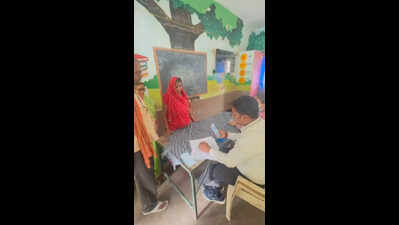
Lucknow: To strengthen transparency and curb impersonation in polls, the Uttar Pradesh State Election Commission formally introduced the facial recognition system in local body elections on Tuesday.This is the first time in India that such a technology is being tested as a pilot project during the ongoing bypolls for the nagar panchayat president in Katra (Shahjahanpur) and the Fazilnagar nagar panchayat in Kushinagar, marking a landmark moment in the state’s election management process.The system was deployed in 55 polling booths covering 31 wards to verify the identities of 50,257 registered voters.
Drawing from the data and field insights, the SEC intends to implement an enhanced version of the system across nearly 2.2 lakh polling booths in the upcoming local body elections.Designed to function in real time, the system tracks voter turnout at polling booths and acts as a safeguard against multiple voting and identity fraud.Explaining how the system works, officials said that when voters arrive at the polling booth, their photograph is captured and matched in real time with both local booth records and a central server. This process helps immediately verify if a voter has already cast a vote elsewhere.If a match is found, the system displays detailed information, including the voter’s name and the exact time the earlier vote was recorded.Officials said it took over eight months for the system to move from concept to execution. The tendering process began in July 2025, hardware was supplied by December, and subsequent months were devoted to software testing, revalidation and multiple rounds of artificial field trials.A key strength of FRS lies in its ability to clearly distinguish between “re-attempt” voting and “tender voting.”A re-attempt occurs when the same individual tries to vote again after already casting a ballot. In such cases, the system flags the voter and shows visual evidence — photographs and timestamps — on the digital dashboard. This often leads to immediate resolution, as presiding officer can demonstrate, on the spot, when and where the initial vote was recorded.Tender voting addresses a more sensitive scenario. A tender vote takes place when a legitimate voter arrives at the polling booth only to discover that someone else has already voted. If a voter insists they have not voted, his vote is accepted as a tender vote and sealed separately in an envelope, according to norms.According to SEC officials, tender votes are meant only for verification purposes and are not counted as valid votes.“When confronted with visual proof from the system, individuals attempting fraudulent voting often withdraw quietly, reinforcing the system’s deterrent effect,” an official said.Beyond fraud prevention, the system also captures nuanced voter behavior. It records cases of ‘refused voters’ — individuals who enter the booth and have their photo taken but choose not to cast a vote.Such voters cannot return to vote as the system will flag them as duplicates.Talking to TOI, state election commissioner Raj Pratap Singh acknowledged that, as a pilot, the system was operating at an “acceptable threshold.”“The probability of errors or mismatches has been estimated at less than 1%, and in many cases even below 0.05%. Data collected during this pilot phase will now be analyzed to improve system efficiency by another 15%-20%,” he said.“One persistent challenge has been voter list de-duplication. Frequent migration and re-registration often result in duplicate entries across different blocks, making accurate voter databases difficult to maintain. The system can eventually become a powerful tool in addressing this long-standing issue,” Singh added.