


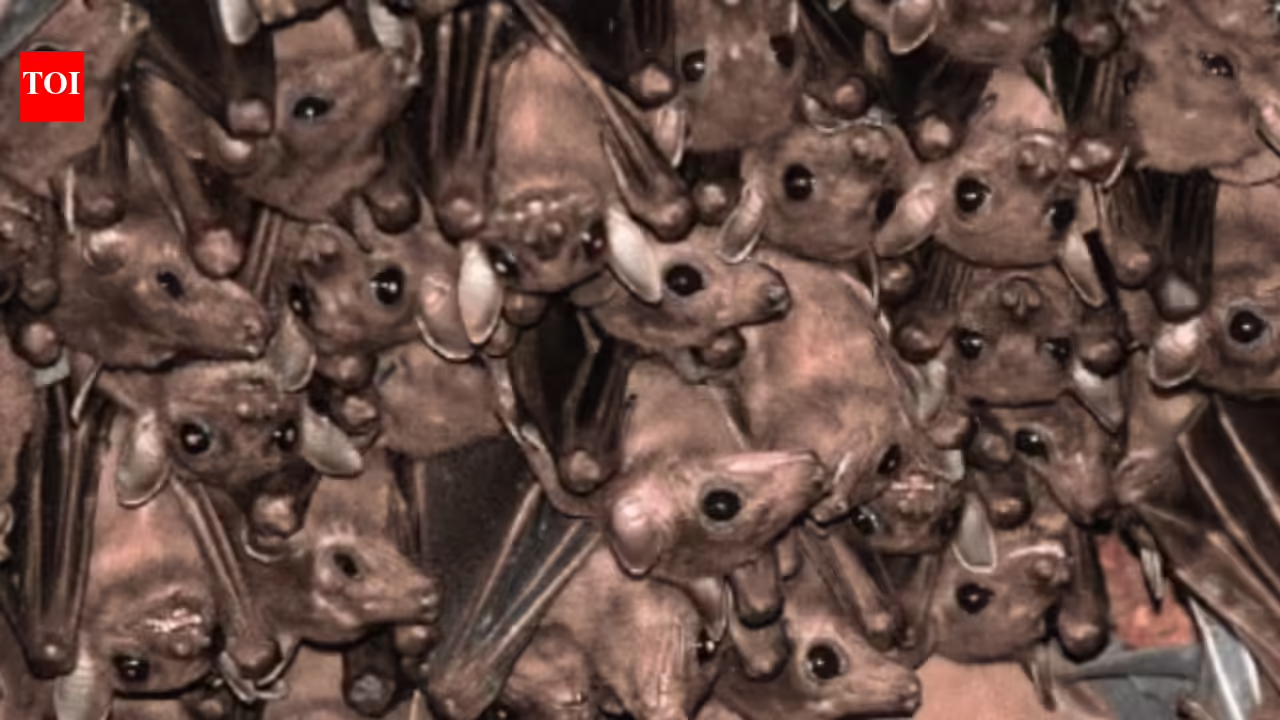
NEW DELHI: India’s bats, which are key to pollination, pest control and forest regeneration, remain widely understudied and increasingly threatened by human-driven change, according to a national assessment taking place after two decades.The report, State of India’s Bats (2024-2025), by Nature Conservation Foundation, Bat Conservation International, WWF and Center For Wildlife Studies, shares insights of over 30 researchers from 27 institutions.India is home to at least 135 species of bats, making them the country’s most diverse mammal group. Yet, the report highlights a striking gap: Fewer than 50 dedicated bat researchers currently work nationwide.
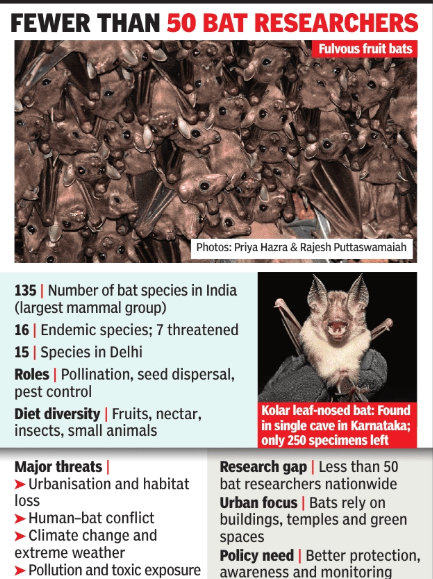
Of the 135 species, 16 are endemic, while seven are officially threatened, and data on many more remain sketchy. The previous assessment had recorded 120 species.The findings underline the bats’ immense ecological value. They feed on fruit, nectar, pollen, insects and even small vertebrates, enabling them to act as seed dispersers, pollinators and natural pest controllers. This makes them crucial for agriculture and forest health. However, scientists warn that these benefits are poorly quantified, limiting their use in driving conservation policy and public awareness.The report identifies rapid urbanisation, loss of habitat and climate change as the biggest threats to bats. Expanding cities and infrastructure, and changes in land use are destroying their roosting sites, such as caves, trees, temples and old buildings. Increasing human-bat conflict, often driven by fear and misinformation — especially after the Covid-19 pandemic — has worsened the situation.Delhi has 15 species of bats, the highest among all Union territories. The report notes that bats in urban landscapes, including cities like Delhi, often depend on monuments, old structures and green pockets, making them vulnerable to redevelopment and pest-control measures. “However, ASI, responsible for managing thousands of historical monuments, has often been critical of bats at sites like Qutab Minar, Khirki Mosque, Feroz Shah Kotla and Agrasen ki Baoli in Delhi,” the report adds.Another emerging concern is climate change. Extreme weather events and shifting ecosystems could disrupt bat populations and their food sources. Meanwhile, pollution and toxic exposure, especially inside caves and aquatic ecosystems, are poorly studied but potentially serious risks to bats.Dr Rohit Chakravarty of Nature Conservation Foundation and Bat Conservation International pointed out how flying foxes found in Delhi suffer due to heat waves. Also, samples of mercury, copper, chromium and manganese, all linked to pollution, have been found in them. “Flying foxes have gone from ‘least concern’ to ‘near threatened’,” he said.The mouse-tailed bat, found in Delhi, lives in monuments and helps farmers by preying on agricultural pests. This underlines the key role of ASI in the conservation of bats as these monuments are their sanctuaries.