



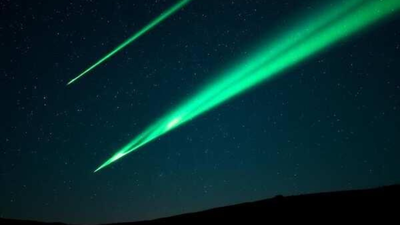
A rare long-period comet, C/2025 R3 (PanSTARRS), is currently visible in southern skies, offering a brief observing window before it fades from view. The object, which originates from the distant Oort Cloud, has already passed its closest approach to the Sun and is now moving away, causing its brightness to gradually decline. Astronomers estimate its orbital period at roughly 170,000 years, making this a rare observing opportunity. Over the next one to two weeks, observers in New Zealand, Australia, South Africa and parts of the Pacific have the best chance to view the comet shortly after sunset, provided skies are clear and the western horizon is unobstructed.
What makes this glowing comet so rare?
C/2025 R3 belongs to a class of long-period comets, objects that spend most of their existence far beyond the planets in the outer solar system. These bodies are considered remnants from the early stages of planetary formation, preserving ancient material that has remained largely unchanged for billions of years. The comet was identified in 2025 by the Pan-STARRS survey, which specializes in detecting moving celestial objects. Its highly elongated orbit brings it close to the Sun only once in tens of thousands of years, and because of gravitational influences and mass loss, its future path remains uncertain.
When and where to see this comet
Observers in New Zealand and Australia currently have some of the most favorable conditions to view the comet, although visibility extends to other southern regions as well. The best time to look is shortly after sunset, when the sky begins to darken but the comet is still above the horizon. It appears low in the western sky and remains visible for a limited period before setting. The comet is not reliably visible to the naked eye, so binoculars, a small telescope or a camera will significantly improve the chances of spotting it.
Why it glows blue-green
The comet can appear blue-green due to its coma, the cloud of gas that surrounds its nucleus when it is heated by the Sun. As frozen gases subliminate into space, molecules such as diatomic carbon become energized by sunlight and emit a characteristic blue-green glow. Alongside the coma, the comet develops a dust tail and an ion tail, both of which extend away from the Sun. These features combine to give the comet a diffuse, glowing appearance, often described as a fuzzy object with a trailing streak rather than a sharply defined point.
Why the viewing window is short
The visibility of the comet is already declining as it moves away from the Sun. During its closest approach, solar heating increased the release of gas and dust, making it brighter. As that activity decreases, the comet is gradually dimming. Over the next one to two weeks, it will become increasingly difficult to observe and will eventually fade beyond the reach of most amateur equipment.
An uncertain future
Although astronomers estimate that C/2025 R3 takes about 170,000 years to complete one orbit, such projections are not exact. Comets are fragile objects, and as they lose material near the Sun, their trajectories can shift slightly. In some cases, they fragment or disintegrate, while in others, gravitational interactions with planets can alter their paths significantly. There remains a possibility that this comet could be ejected from the solar system or fail to survive future passages.
A fleeting cosmic visitor
C/2025 R3 PanSTARRS represents a brief encounter with one of the solar system’s oldest remnants. After this short period of visibility, it will continue its journey back into the distant reaches beyond the planets. For observers in the southern hemisphere, this is a limited opportunity to witness a celestial object that connects the present moment with the earliest history of the solar system, before it disappears into deep space once again.