


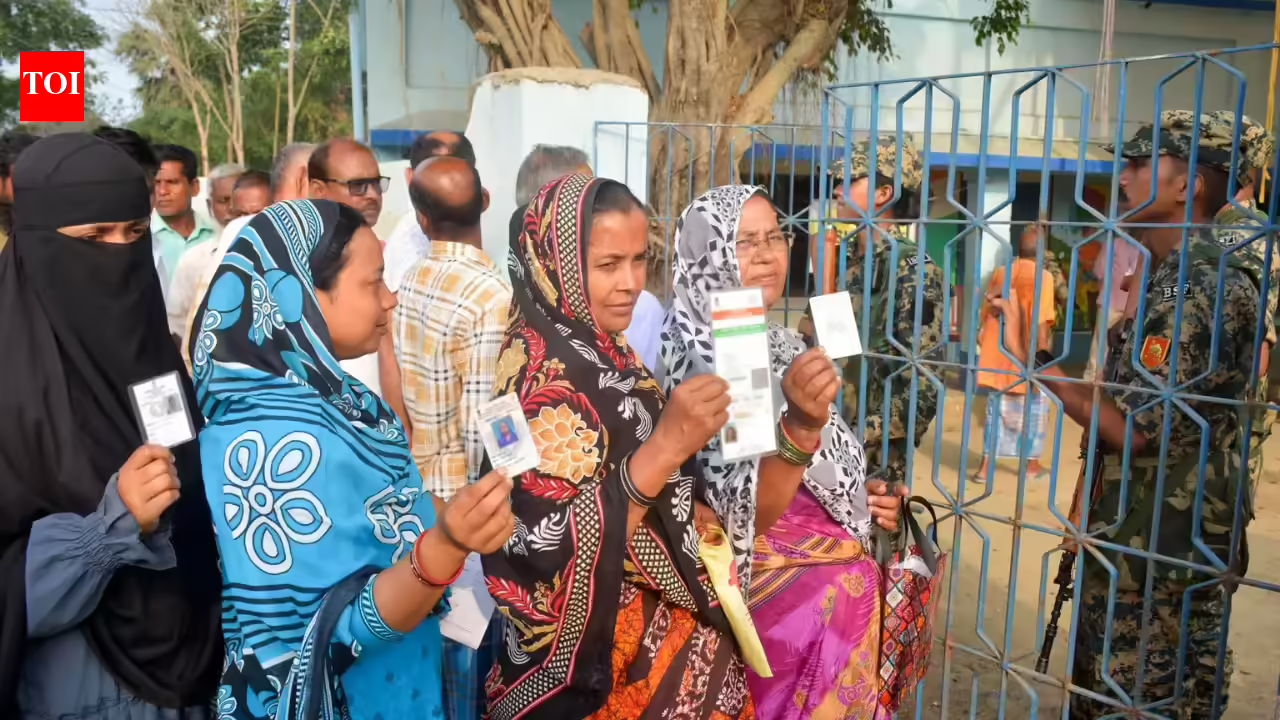
KOLKATA: SIR may have knocked out lakhs of Bengal voters, but the crores who have stayed on the roll have sent out an unmistakable signal on how important they consider their voting rights to be. An electorate of 3.6 crore, spread over 152 assembly seats and 16 districts, pushed the polling percentage to 92.6% in the first phase—significantly higher than the total 2021 assembly poll turnout of 81.5%. Thursday’s figure was also higher than the 2011 turnout of 84.3%, an all-time record in Bengal. Election Commission officials confirmed that the 92.6% turnout in the first phase was without precedence anywhere in the country. That 2011 turnout had swept the Left Front out of office, ending its run of seven consecutive assembly poll wins and a 34-year stint that began in 1977.
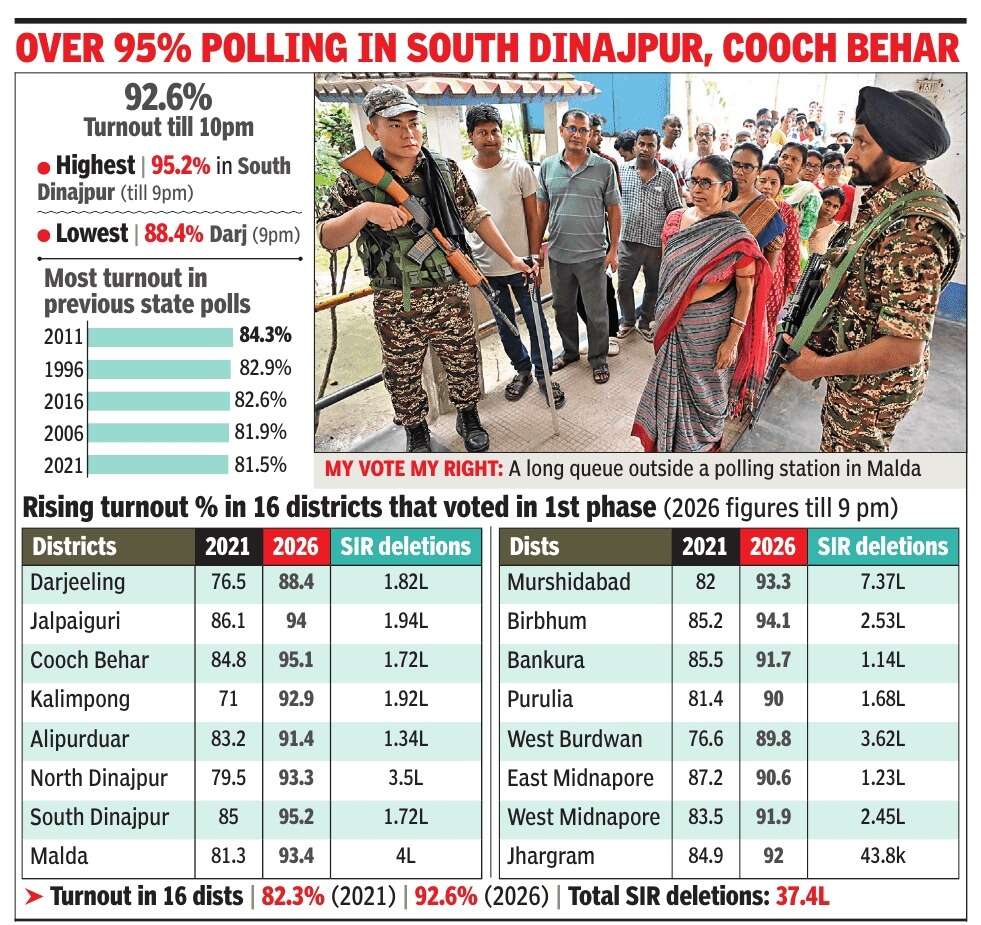
We will have to wait till next Wednesday to see whether the second-phase turnout matches the first phase’s and whether the overall percentage breaks the 2011 record. And we will have to wait till May 4 to see whether the first-phase turnout reflects voter restlessness against the incumbent Trinamool administration or anger at the manner in which SIR was carried out in Bengal. The surge in turnout prompted both major players—Trinamool and BJP—to claim an edge in the race to form the cabinet after May 4. The high turnout indicated a decisive voter preference for Trinamool, largely because of anti-SIR sentiment, CM Mamata Banerjee said. PM Modi, however, saw in the turnout “a storm of change” that would take BJP to Nabanna. But there may also be a third—more politics-neutral—reason behind the turnout surge: the deletion of dead and absent voters (58.2 lakh across all 294 seats) weeded out a large chunk of non-existent voters, automatically pushing up the turnout percentage. One undeniable factor, however, was the large number of voters who took leave from their out-of-Bengal workplaces and returned just to cast their vote, largely driven by SIR fears.
‘Came back for polls as I feared not voting could create more trouble’
Lakimuddin Sheikh, who voted at a booth in Murshidabad’s Panchla Bazar after returning from Maharashtra, said: “I came back to vote this time only because I was scared that not exercising my franchise could lead to further problems later.” “Two of my brothers’ names were under adjudication and four of my nephews’ names were deleted. I did not want to risk losing my voting rights,” he added. “It may be premature to interpret this huge turnout as an anti-incumbency wave,” Presidency University political science teacher Zaad Mahmood cautioned. “It may instead point to the insecurity created around voting rights and reflect how important voting is for a large section of citizens.” Two constituencies that led the phase-one vote surge were Raghunathganj and Bhaganbola, both in Murshidabad—the district that saw the maximum number of voter deletions during the SIR exercise. Nearly every eligible voter turned out in these seats, each recording an identical turnout of 96.9%. Shamsherganj, also in Murshidabad and the constituency with the highest number of SIR deletions, recorded 96% polling. South Dinajpur topped the district-wise turnout chart with 95.2%, despite over 1.7 lakh deletions. It was followed by Coochbehar (95.1% turnout; 2.2 lakh-plus deletions) and Birbhum (94.1% turnout; 2.5 lakh deletions). Even Darjeeling, the lowest performer, recorded a robust 88.4%. Bengal chief electoral officer Manoj Agarwal attributed the unprecedented turnout to the deletion of “absent, shifted, dead/duplicate” voters, which reduced the electorate size and weeded out non-existent names. (With inputs from Tamaghna Banerjee in Behrampore and Dipawali Mitra in Kolkata)