

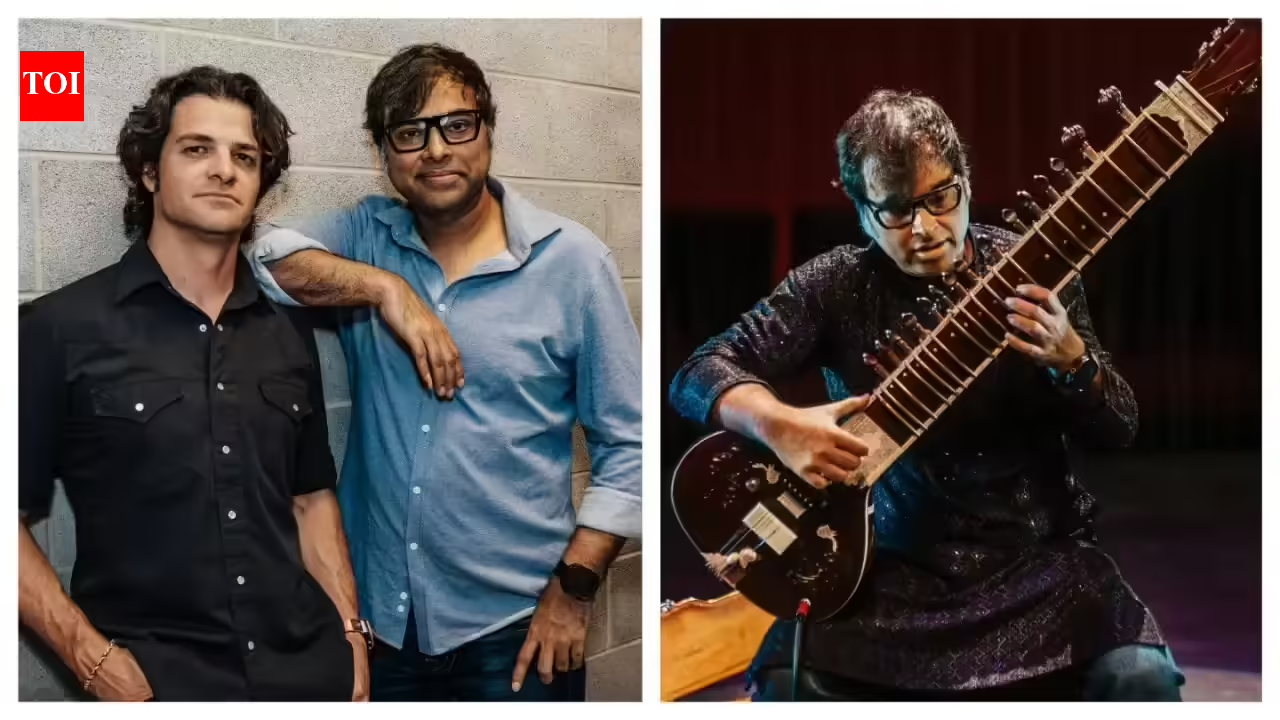
Few musicians navigate the distance between the ancient and the contemporary with as much ease as sitarist Purbayan Chatterjee. A disciple of the storied Senia Maihar Gharana and a direct artistic descendant of the legendary Ravi Shankar, Chatterjee has spent decades expanding the vocabulary of Indian classical music without ever losing sight of its roots.From collaborations with jazz guitarist Pat Metheny and tabla maestro Zakir Hussain to his latest project, Feathered Creatures, alongside American guitarist Mark Lettieri, he moves fluidly between ragas and grooves, tradition and experimentation. Now, with an India tour on the horizon and a role advising actor Farhan Akhtar for an upcoming Beatles biopic that will bring Ravi Shankar’s story to a global audience, Chatterjee finds himself at a remarkable intersection of legacy and possibility.We spoke to him about creative trust, the weight of tradition, and why he believes you don’t need to understand classical music, you just need to feel it. Excerpts…Your upcoming album Feathered Creatures with Mark Lettieri brings the sitar into a dialogue with electric guitar—how did you strike a balance between preserving the grammar of the raga and embracing the spontaneity of global fusion? I don’t see it as a tug of war, I see it as a conversation. The raga provides the grammar, the emotional architecture, while the guitar brings a certain rhythmic irreverence. With Mark Lettieri, the key was trust, we let the music lead. If the raga wanted space, we gave it space. If the groove wanted to take over, we let it fly.As a torchbearer of the Senia Maihar Gharana, how do you negotiate the weight of tradition while constantly pushing boundaries with projects like Unbounded – Abaad and Sukhino Bhavantu? Tradition isn’t a cage, it’s a compass. Coming from the Senia Maihar lineage, you inherit a depth of thought, not just repertoire. Projects like Unbounded or Sukhino Bhavantu are not departures, they’re extensions. If the roots are strong, the branches are allowed to explore.You’ve collaborated with an eclectic mix of artists—from Zakir Hussain to Pat Metheny—what have these cross-cultural exchanges taught you about the universality (and limitations) of music? Working with artists like Zakir Hussain or Pat Metheny teaches you two things: music is deeply universal, and yet, beautifully stubborn. Rhythm travels easily. Emotion travels instantly. But nuance, especially in Indian classical music, needs time and patience. That tension is where the magic happens.With Farhan Akhtar preparing to portray Ravi Shankar in an upcoming Beatles biopic in collaboration with your foundation, how do you view this moment for Indian classical music on the global stage? It’s a powerful moment. Ravi Shankar wasn’t just a musician, he was a cultural bridge. With Farhan Akhtar stepping into that role, there’s an opportunity to introduce not just the man, but the philosophy behind the music to a global audience. If done right, it won’t just be a film, it will be an invitation. I am delighted to be able to share some knowledge with Farhan bhai to be able to give him some insights about this beautiful instrument. I’m thankful to my student Ruthvik Rao for helping me with this.As you embark on your India tour with artists like Rakesh Chaurasia and Ojas Adhiya, what kind of live experience are you aiming to create for audiences who may be encountering classical or fusion music for the first time? I want first-time listeners to feel included, not intimidated. Whether it’s with Rakesh Chaurasia or Ojas Adhiya, or Shikharnaad, the idea is to create an arc, from meditative to explosive. You don’t need to “understand” classical music. If you feel something, you’re already in the conversation.