


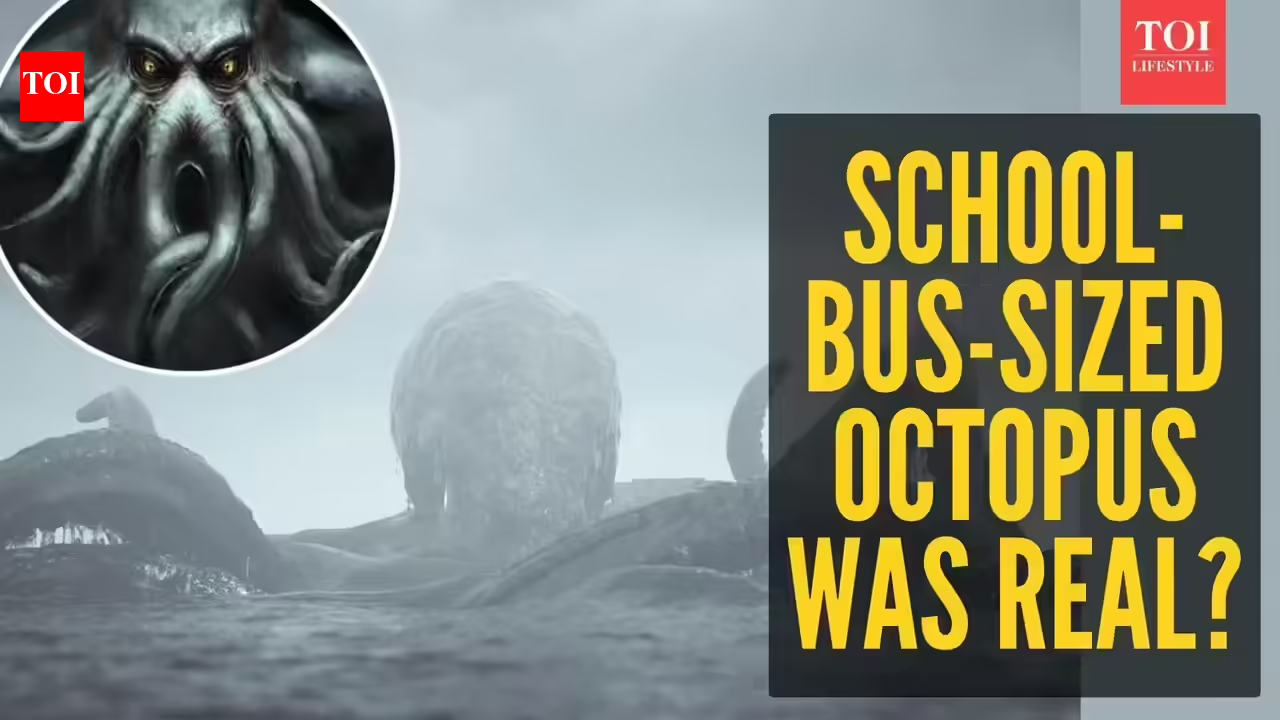
There was a time when sailors would whisper among themselves about the Kraken – a legendary sea monster thought to exist in the depths of the ocean, able to pull entire ships down into the void. It was dismissed as folklore, a product of fear and imagination but in 2026, science has done something remarkable: it has brought the Kraken closer to reality than ever before.A break grounding study published in Science now suggests that Earth’s ancient oceans were once ruled not just by giant reptiles but by enormous, intelligent, octopus-like predators, creatures so powerful they could crush bones and they were not just large. They were dominant.
A discovery hidden in fossils
The challenge with studying ancient octopuses is simple: they almost never fossilise. Unlike dinosaurs or marine reptiles, octopuses have soft bodies that decay quickly. For decades, this left a major gap in our understanding of prehistoric oceans. Scientists assumed that the seas of the Cretaceous period, around 100 to 72 million years ago, were ruled almost entirely by vertebrate giants like mosasaurs and plesiosaurs. That assumption is now collapsing.Instead of bones, researchers turned to the one part of an octopus that can survive deep time: its beak. By analyzing 27 fossilised beaks, some newly discovered, others reclassified – scientists uncovered evidence of a previously misunderstood predator. What they found was astonishing.
Meet the ocean’s forgotten giant
The study identified ancient species belonging to the genus Nanaimoteuthis, particularly Nanaimoteuthis haggarti, a creature that may have grown up to 19 meters (62 feet) long. That is longer than a bus, longer than many marine reptiles of its time and possibly even the largest invertebrate ever recorded. This was not a passive drifter or a deep-sea scavenger, it was a hunter. Scientists now believe these giant octopuses rivaled top predators like mosasaurs, lived at the very top of the food chain and used intelligence and physical strength to capture prey.As one researcher put it, these were not just oversized versions of modern octopuses, they were “giant predators at the very top of the Cretaceous marine food web.”
The bone-crushing evidence of giant octopuses
The most compelling clue lies in the wear patterns on the fossilized beaks. Unlike delicate feeding structures, these beaks showed chips and scratches, rounded and worn edges and signs of repeated heavy impact. This kind of damage does not come from soft prey. It comes from crushing hard materials like shells, skeletons, even bones. In other words, these creatures were not just eating small fish or plankton.They were likely attacking hard-shelled marine animals, large fish and possibly even other apex predators. Modern octopuses already dismantle prey with surprising efficiency. Scale that behavior up to a 60-foot body and you begin to see why scientists are rethinking entire ecosystems.
Giant octopuses: A predator with intelligence
The surprises did not stop at size and strength. Researchers noticed something even more intriguing and that is the asymmetrical wear on the beaks. This suggests that these ancient octopuses may have had a form of “handedness”, favoring one side of their body over the other, much like humans are right- or left-handed. It matters because it points to complex neural behavior. Modern octopuses are already among the most intelligent invertebrates on Earth. They solve puzzles, escape enclosures, and display problem-solving skills that rival some vertebrates.Now imagine that intelligence combined with massive size, crushing bite force and apex predator status. This wasn’t just a monster, it was a thinking predator.
Rewriting the rules of prehistoric life
For decades, the textbooks showed ancient oceans as places where huge reptiles ruled the world and invertebrates were just a minor part of the food chain. This discovery flips that hierarchy.According to the new researchthese giant octopuses were not secondary players. They were central architects of marine ecosystems, shaping food webs in ways scientists had never considered.It also raises uncomfortable questions about were mosasaurs sometimes prey and not just predators or did intelligence evolve as a competitive advantage in ancient oceans or how many other “invisible giants” we have missed due to poor fossil records.
Why we are only discovering these giant octopuses now
The answer lies in technology. Using advanced imaging and “digital fossil mining”, scientists were able to detect previously overlooked beaks hidden in rock formations. Combined with modern comparisons to living cephalopods, researchers could estimate the body size, feeding behavior and ecological role. This is a reminder of something profound: the fossil record is not complete, it is just incomplete evidence waiting for better tools.
The rise and disappearance of the real Kraken
One lingering mystery remains and that is if these creatures were so dominant, where did they go because unlike dinosaurs, there is no clear extinction narrative yet. Possible explanations include evolutionary competition, changing ocean conditions and gaps in fossil evidence.Some scientists even suggest that they may not have vanished entirely from evolutionary lines but instead gave rise to smaller, more specialized descendants. Either way, their disappearance is as intriguing as their discovery.This discovery does not just add a new species to the fossil record. It forces a complete rethink of ancient life as intelligence was not limited to vertebrates, soft-bodied animals could dominate ecosystems and the ocean’s most powerful predator might not have had bones at all. Perhaps most importantly, it blurs the line between myth and reality because for the first time, the idea of a Kraken-like creature ruling the seas does not sound like fantasy. It sounds like history.
bottom line
The oceans have always been Earth’s most mysterious frontier. Even today, much of the deep sea remains unexplored. So if a 60-foot, bone-crushing, intelligent octopus could dominate the planet and remain hidden from science for over 100 million years, what else are we still missing?The Kraken, it turns out, may not have been a myth. Just a memory we had not uncovered yet.