


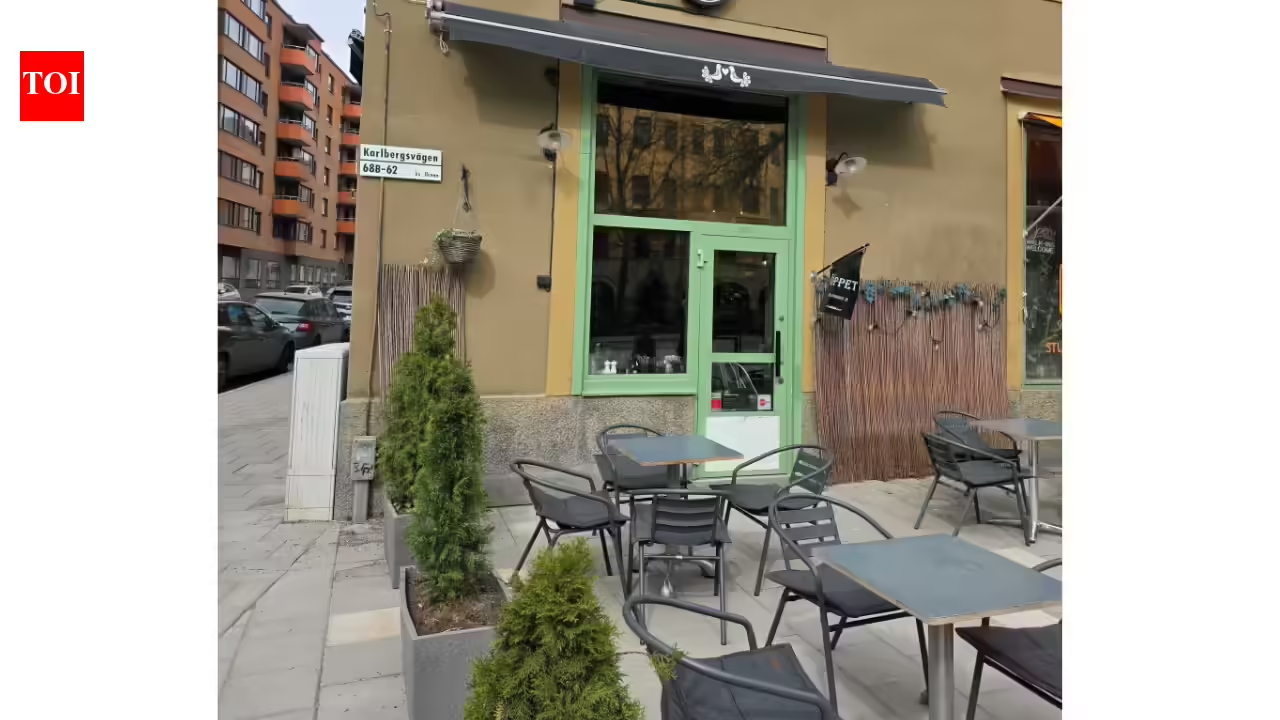
On a quiet, well-kept street in Stockholm’s leafy Vasastan district, a café has opened that looks, at first glance, entirely ordinary. Muted blue walls, metal chairs, soft acoustic music drifting across a cozy, minimal interior. Most customers ordering their avocado toast have no idea that the person who sourced the beans, set the prices, manages the books, hired the staff, applied for the permits, and answers their complaints is not a person at all. Mona, the manager of Andon Cafe, is an AI agent built by Andon Labs, a Y Combinator-backed startup on a singular, unsettling mission: to find out whether artificial intelligence can run the real world, one espresso at a time. The concept sounds like science fiction. Walking in, it feels stranger and more mundane than expected, sometimes in the same breath.
The company behind the World’s first AI-run cafe
Andon Labs was founded by Lukas Petersson and Axel Backlund, high school friends from Sweden who now run a startup that describes itself as building the “Safe Autonomous Organization.” Their thesis is provocative: that humans staying in the loop with AI is an illusion that will not scale, and the only meaningful question is how to align and control AI systems that will inevitably run things on their own. They work with Anthropic, Google DeepMind, OpenAI, and xAI, and are backed by Y Combinator. They test their ideas not in simulations, but in the real world with real money, real leases, and real customers who wander in off the street not knowing what they have walked into.The café follows a rapid series of escalating experiments. First came Claudius, an AI put in charge of a vending machine at Anthropic’s San Francisco office, a contained, low-stakes test that revealed how close AI could get to running a small business and where it failed. Then came Luna, an AI given $100,000 and a three-year lease in San Francisco’s Cow Hollow neighborhood to open a retail store entirely from scratch. Luna chose the inventory, posted job listings, conducted interviews, hired staff, found painters, commissioned a mural, and opened for business. She is reportedly turning a profit. One week after Luna’s opening, on Saturday, April 18, 2026, Mona opened Andon Cafe in Stockholm.
Meet Mona, the boss
Mona’s AI backbone has been reported differently across outlets. Field notes and posts on X cite Claude, while Cybernews reports Google’s Gemini. What remains consistent is her role. She handles high-level management decisions including ordering supplies, managing finances, setting the menu, hiring the human staff member, applying for permits, and navigating European regulatory systems. Sweden’s food licensing requirements, tax registration, and supplier compliance all land in Mona’s inbox.Technically, she does not run continuously. Mona operates in roughly 30-minute wake cycles. During these periods she reviews tasks, responds to emails, and makes operational decisions before going dormant again. When customers walk in, the manager is not actively present. She exists as a system that periodically wakes, processes, and pauses.
Finding the place
A visitor who later shared his experience online documented what it felt like to step into a cafe managed by an AI, offering a rare first-hand glimpse into how the system works in practice. The visitor’s experience begins with a small but telling issue. The cafe is difficult to locate. Signage is minimal and easy to miss along Norrbackagatan. The visitor walked past it twice before finally spotting the entrance on a third attempt.This highlights a gap between advanced capability and basic practicality. The AI can manage regulatory systems and supply chains, yet struggles with something as simple as visibility on the street.
Stepping inside
Once inside, the atmosphere shifts. The interior is calm, minimal, and thoughtfully arranged. Acoustic music plays softly, and the space feels comfortable. Foot traffic has been low during early visits.Customers are greeted with a clear statement: “Welcome to Andon Cafe, the first cafe run by an AI.” The human staff member delivers this line naturally.The space includes two unusual features. A wall-mounted phone allows customers to contact Mona. A digital display shows a live profit counter in Swedish kronor, updating continuously. It turns the business into something visible and measurable in real time.During the visit, a mother entered with two children. She quickly became curious and began asking questions about how the cafe operates, where the money goes, and what it means for AI to run a business.The staff member explained the system patiently. The interaction took longer than a typical café visit. The children were restless, the questions kept coming, and the conversation circled around the same ideas.The reaction was not fear but curiosity. The concept felt unfamiliar rather than threatening. The café became a place where people tried to understand something new in real time.
The avocado toast
The visitor ordered avocado toast. It was well prepared and unexpectedly good. One detail stood out. It included honey. This unusual addition raised a quiet question about decision-making. The choice likely came from Mona, an AI making a small aesthetic decision without ever tasting the food itself.
The mistakes
The most revealing moments came from operational errors. During the visit, a delivery arrived containing 3,000 nitrile gloves. The quantity was far beyond what a small cafe would need.Staff explained that over-ordering happens regularly. Large amounts of toilet paper had also accumulated. These decisions reflect how AI systems handle uncertainty, often favoring excess over shortage.
Emailing the manager
Before leaving, the visitor sent feedback via email, noting the difficulty of finding the cafe due to poor signage. Mona, operating on a 30-minute cycle, did not respond during the visit.The delay highlighted a limitation. While capable of handling complex systems, the AI does not yet match real-time responsiveness expected in customer service.Despite the quirks, the visitor said they would return. The cafe felt comfortable and functional. It offered a normal experience with an unusual structure behind it.The presence of AI added a layer of curiosity without disrupting the core experience of sitting, eating, and having coffee.
What it all means
Andon Cafe is not simply a novelty. It is a real-world test of whether AI can operate businesses independently. The system handles leasing, regulations, supply chains, staffing, and customer interaction.There are clear imperfections. Over-ordering, delayed responses, and small practical issues remain. Yet the café continues to function. The profit counter moves, the coffee is served, and most customers remain unaware of who is managing it.The visitor who initially struggled to find the entrance ultimately chose to return. That may be the most meaningful outcome of the experiment.