

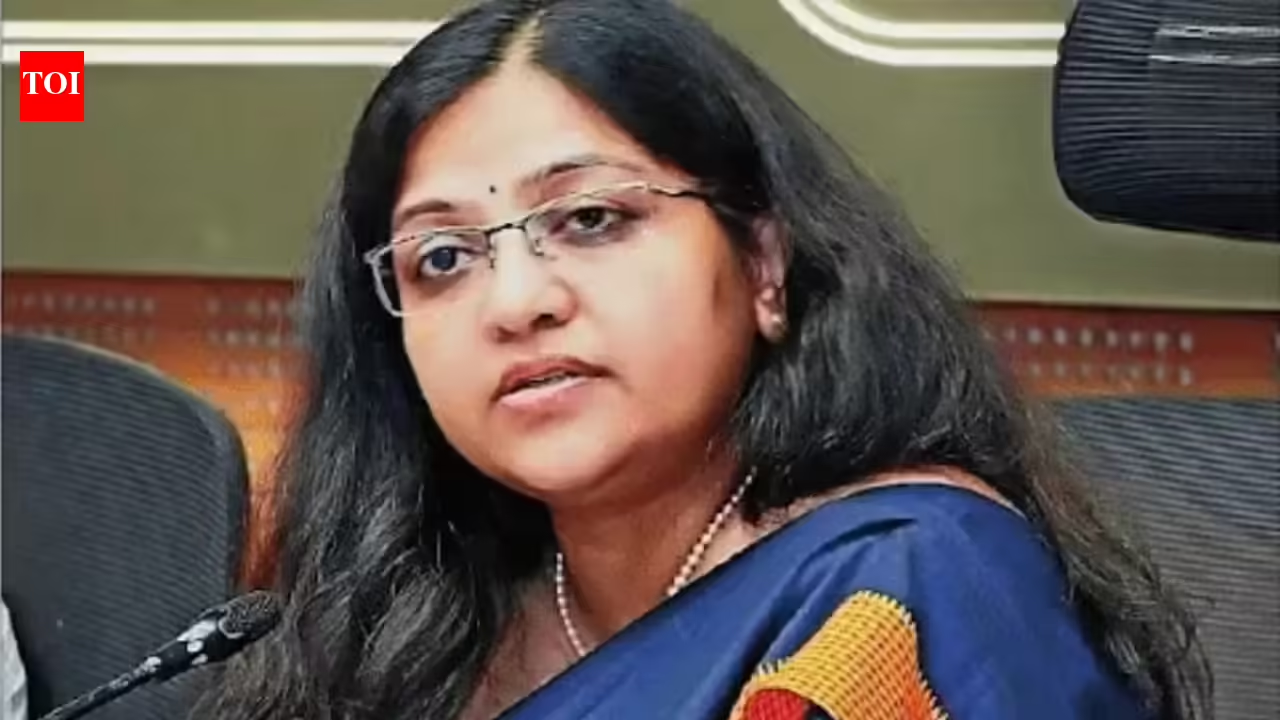
Dr Nirupama J Dange | joint secretary to Government of India and chief principal census officer for Maharashtra
Self-enumeration begins in the state from Friday for Census 2027 and questions about digital access, data privacy, inclusion and accuracy are swirling. In an interview with Nisha Nambiar, Dr Nirupama J Dange, joint secretary to Government of India and chief principal census officer for Maharashtra, outlines how the state plans to balance technology with on-ground verification.Self-enumeration is online. What challenges do you foresee in Maharashtra considering the wide digital literacy gaps?Dr. Nirupama J Danger | We certainly do not expect all respondents to do the self-enumeration. Those who cannot be covered by the census staff between May 16 and June 14, this year, who will visit all buildings and cover all homes and households without exception. Nobody will be left out.What safeguards will the department exercise to address privacy, cybersecurity, hacking and data breach concerns?ND | Digital data collection reduces the complex, costly and lengthy extraction of data from paper to electronic records. The collected data is transferred directly from a house to the central server. It minimizes the time taken to prepare the electronic database and publication of results can be quicker. Both methods will result in accurate data collection. Systems are in place to ensure data privacy and security. All data will remain encrypted at rest and during movement.A three-tier security system has been incorporated__ on cellphones, during data transmission and at the server level. Only designated personnel have access with password and OTP and data will be stored in an encrypted format. ISO/IEC 27001:2022 certified data centers have been declared as critical infrastructure and a security audit is being conducted by reputable organizations.What key demographic and socio-economic indicators will the census capture?ND | The questions for phase I and phase II of the census are different. In the houselisting phase (phase I), data including the house, household information, amenities and assets possessed will be collected. The set of 33 questions covers developmental aspects such as housing, sanitation, toilets, drinking water, cooking fuel, source of lighting, availability of vehicles and other assets.The population enumeration (phase II) will collect data on each individual, including questions on socioeconomic status, cultural, linguistic, and demographic characteristics, among other things. Earlier censuses covered questions on religion, education, fertility and migration. Currently, questions for the house-listing phase have been notified but those for the population enumeration phase, common for the entire nation, have not. No additional questions will be allowed once the questions are notified.How will enumerators overcome areawise challenges?ND | Enumerators are trained in different languages with the same content and local officers can address local challenges with local strategies for accurate data collection. The mapping applications will help us cover the entire area without omission or duplication.How will relationship status, including live-ins, be recorded?ND | The relationship of an enumerated individual to the head of the household will be recorded. The census defines a household without prejudice. The members can be either related or unrelated or a mix of both. Blood or nuptial relation is therefore not a prerequisite. There is a provision to record ‘unrelated’ as an option to the question. The enumerator will record the status as provided by the respondent.Is Aadhaar required?ND | No document is required. Any request for bank details, UPI credentials, OTPs or copies of Aadhaar or PAN is a red flag. Census officials will never ask for any such details or charge any fees.What if a geolocation mapping is wrong?ND | When the enumerator visits for data collection and matching of self-enumeration ID, errors can be edited or fresh data collection can be added. Accurate geolocation marking of the residence will help in assigning an SE ID to the enumerator who will collect data afresh during the field visit, if it is incorrectly mapped.How will inter-state migrants and people living abroad be counted?ND | Our census follows the extended de-facto method in counting. All those living in a household will be counted even if they are temporarily absent, but are citizens of India. If no members are available for the entire period of houselisting and the enumerator is not able to collect the data, it will be marked as locked. In the population enumeration, all members of a household available at least for a day during the period of enumeration will be included.What about the homeless and other vulnerable groups?ND | The homeless will be counted during the night on the last day of the population enumeration under special guidelines. Similarly, separate enumeration blocks will be created for slum areas in both phases. Data for these groups will be published separately.
About the Author

Previous Post
Next Post