


Walk into most corporate offices and you’ll find the same investment priorities on full display. A gleaming espresso machine in the pantry. A foosball table nobody uses after the first week. Branded mugs. And then, if you look past all of that, rows of people hunched over laptops at poorly lit desks, sitting in chairs that are slowly compressing their spines, breathing recycled air, with not a single plant in sight. The coffee is excellent. The environment is quietly destroying them.This isn’t hyperbole. The McKinsey Health Institute estimates that investing in holistic employee health could generate between $3.7 trillion and $11.7 trillion in global economic value, roughly $1,100 to $3,500 per person, or between 17 and 55 percent of average annual pay. And yet most offices keep spending that money on the wrong things, solving for morale optics rather than the physical environment where people actually spend the majority of their waking lives. More than 3.5 billion people will each spend approximately 90,000 hours, about 45 years, of their lives at work. What that environment does to their bodies over those 45 years is rarely part of the conversation.
The chair you’re sitting in right now
Let’s start with the most basic, most ignored problem in modern office life: the chair. Not whether it looks nice or matches the brand palette, but whether it’s actively harming the person sitting in it for eight to ten hours a day. research published in 2025 found that two in three workers experience pain or discomfort from their workstation setup, a statistic that translates to millions of preventable health issues worldwide. Two in three. In most offices, that means the majority of the people in the room are quietly suffering through their workday.Office workers frequently experience musculoskeletal issues, with the most reported symptoms affecting the neck at 53.5%, lower back at 53.2%, and shoulders at 51.6%. These aren’t minor inconveniences. They’re chronic, cumulative injuries that compound over years. Time spent in sedentary positions is associated with cardiovascular conditions, cancer, and type 2 diabetes, as well as mortality from all causes. Sitting isn’t just uncomfortable, it’s metabolically dangerous when it goes on long enough without interruption.The fix isn’t complicated or necessarily expensive. A proper ergonomic chair with lumbar support, armrests set at the right height, and a seat adjusted so feet rest flat on the floor changes the physical equation significantly. So does a sit-stand desk. A CDC-studied project found that introducing a sit-stand device reduced sedentary time by 66 minutes per day, reduced upper back and neck pain, and improved mood states, and when the device was removed, all observed improvements were largely negated within two weeks. Two weeks. The body responds that fast in both directions.
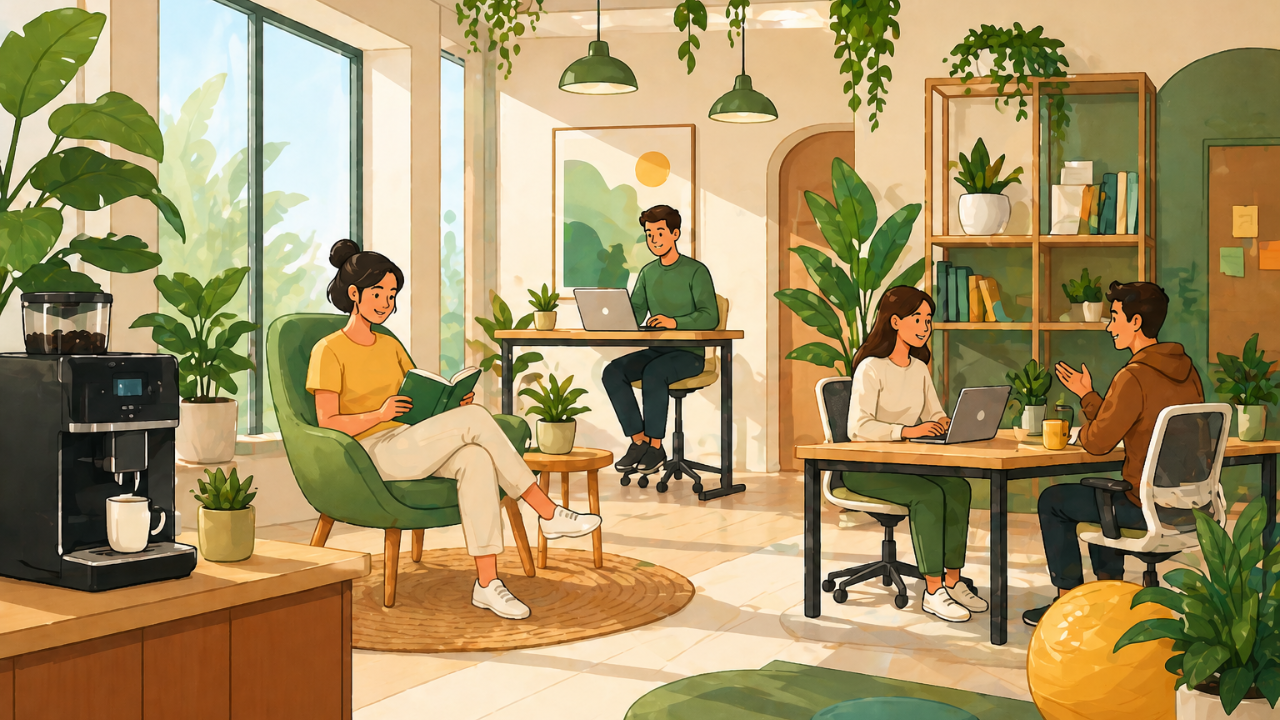
Image: AI
The air nobody is talking about
Here’s something most office managers have never considered: the air inside their building may be more polluted than the air outside. And it’s directly affecting how well their employees can think. In a double-blind study by researchers at Harvard’s Center for Health and the Global Environment, SUNY Upstate Medical University, and Syracuse University, it was found that people who work in well-ventilated offices with below-average levels of indoor pollutants and CO2 have significantly higher cognitive functioning scores in crucial areas such as crisis response and strategic thinking than those working in offices with typical pollutant levels.The lead researcher put it plainly: “We have been ignoring the 90 percent. We spend 90 percent of our time indoors, and 90 percent of the cost of a building are the occupants, yet indoor environmental quality and its impact on health and productivity are often an afterthought.” Poor ventilation, elevated CO2, and airborne irritants don’t just make people feel stuffy, they impair judgment, slow reaction time, and reduce the quality of decision-making. In an office full of knowledge workers whose entire value lies in thinking clearly, bad air is a direct performance tax.The solution involves proper ventilation, air filtration where needed, and, more cheaply and beautifully than either plants.
Plants are not decoration. They’re infrastructure.
The potted plant in the corner of the lobby isn’t a design choice. It’s one of the most cost-effective health interventions an office can make, and the research behind this has been building for decades. A study from the University of Technology Sydney, most commonly cited in several reports, found that offices with plants saw a 37% reduction in tension and anxiety, a 44% decrease in anger, and a 38% reduction in fatigue among employees. Another study published in the Journal of Environmental Psychology found that workers in offices with natural elements including plants, flowers, and natural light reported 15% higher creativity levels than those in traditional offices.And it gets more specific than mood. Office workers with access to windows providing natural light sleep an average of 46 minutes longer each night than those without windows, which means the decision about where to seat employees, whether near a window or in a windowless interior, is quietly affecting their sleep, recovery, and next-day performance. Research by the UK Green Building Council found that employees in workplaces with good access to daylight reported 18% fewer sick days compared to those with limited access.
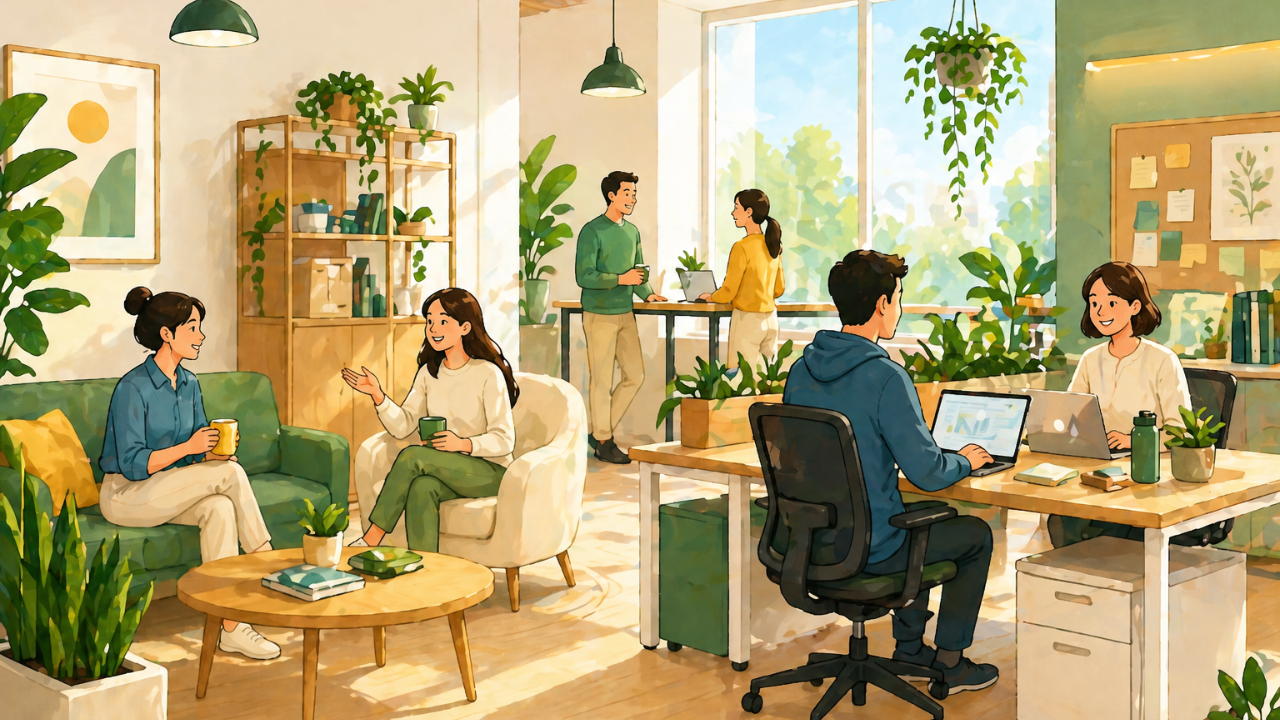
Image: AI
Research suggests that offices incorporating biophilic elements, plants, natural light, organic materials, see a 15% increase in employee well-being and productivity. That’s not a marginal gain. For a team of 50 people, a 15% lift in productivity is the equivalent of getting seven and a half extra people’s worth of output from your existing headcount, just by making the environment less hostile to human biology.
The water cooler was actually the point
And then there’s hydration, the simplest, cheapest, most consistently ignored factor in cognitive performance. Most office workers are mildly dehydrated for large portions of their workday. They don’t notice because thirst is a lagging indicator; by the time you feel thirsty, you’ve already been running below optimal cognitive capacity for a while. research has consistently shown that even mild dehydration of 1 to 2 percent of body weight impairs attention, working memory, and psychomotor skills. The water cooler wasn’t just a social gathering point. It was, inadvertently, one of the more important health tools in the office.So what actually matters in an office? A chair that supports the spine properly. A desk that allows for posture variation. Air that isn’t slowly fogging everyone’s thinking. Plants that cost a few hundred rupees and return the investment many times over in mood and focus. A window, or at least light that mimics one. And water that’s easy enough to reach that people actually drink it. None of this is glamorous. None of it photographs as well as an espresso machine. But every single one of those things will do more for the people sitting in that office every day than any perk that’s ever been written up in a company culture deck. The coffee can stay. But it shouldn’t be leading the conversation about what employees actually need.