


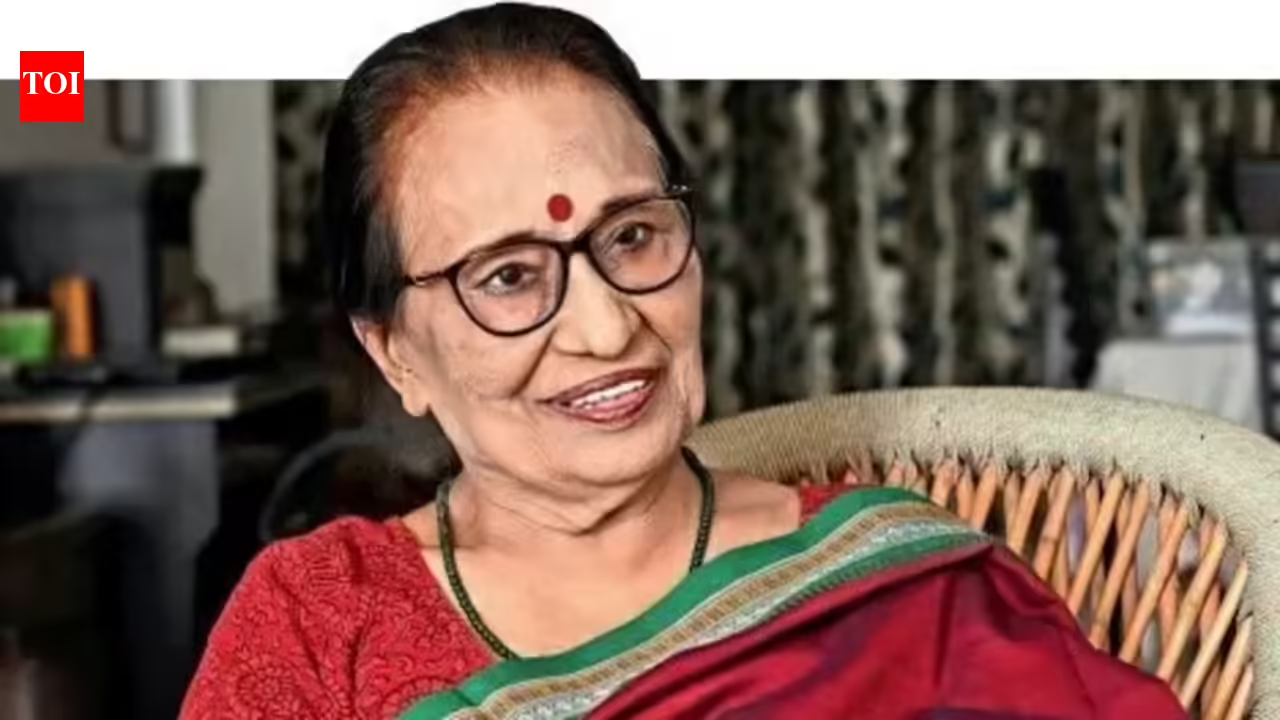
You can leave a city, but does a city ever leave you? Can you discard it like books in a bedroom, or a suitcase on a highway? How does one ever leave a city that was part of your fecund summers, your fond youth? The city, writes Hindi litterateur Mamta Kalia, morphs into memory and flows in our veins, transforms into an ache and needles the heart, before settling down like a landscape in the theater of our eyes.
A city like no other
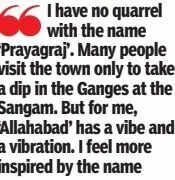
Mamta is talking about Allahabad, which has now reverted to its older name, Prayagraj. “I have no quarrel with the name ‘Prayagraj’. Many people visit the town only to take a dip in the Ganges at the Sangam. But for me, Allahabad has a vibe and a vibration. I feel more inspired by the name,” says the writer, who recently received the Sahitya Akademi award for her memoir ‘Jeete Ji Allahabad’, which roughly translates to ‘Alive in Allahabad’.‘“Allahabad is a city of guavas. To fully enjoy the fruit, you eat the skin, the flesh and the seeds. To understand and appreciate a town, you must live there for a long time,” says the 86-yearold author of acclaimed novels such as ‘Beghar (Homeless)’ and perceptive short stories like ‘Pachees Saal Ki Ladki (The 25 yearold girl)’. Age hasn’t dimmed either her ability to conjure up an apt simile or a sparkling turn of phrase — even in conversation. Sample this: “Sumitranandan Pant was soft-spoken and artistic-looking, just like his poetry.”
Mamta Kalia quote
Her reminiscences, though, are anything but gentle. Mamta lived in Allahabad for three decades starting 1970. Her book is an intimate love letter to the town, but also reads as an unfiltered and unsparing account of its literary and publishing circle.Few cities have drawn such a wide range of reactions across centuries, as collated by poet Arvind Krishna Mehrotra in ‘The Last Bungalow’. To recall a few, Chinese scholar Hiuen Tsang wrote about Prayag in the 7th century CE. Ralph Fitch, an English traveler in Akbar’s time, talked about it. Urdu poet laureate Ghalib found the place hellish and wondered if it deserved to be called a city. Mark Twain detailed Allahabad in his travelogue, ‘Following the Equator’.
Mark Twain quote
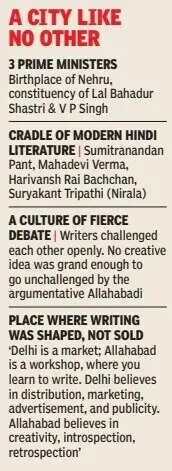
The city was also a central figure in key moments of modern Indian history: an active participant in the 1857 revolt; an incubator of the 20th century national movement; the birthplace of first PM Jawaharlal Nehru; the electoral constituency of two PMs: Lal Bahadur Shastri and VP Singh; and the site of a high court ruling against Indira Gandhi, which led to the dreaded Emergency in 1975. Allahabad’s modern portions emerged from the needs of an expanding colonial state — the court, the printing press and the university were logical fallouts. Over time, the political prominence faded, and the university was more favored by wannabe student politicians, rather than serious scholars. But the city endures in memoirs and memories. Allahabad, Unfiltered To most lovers of Hindi literature, Allahabad is the beating heart of iconic poems (Nirala’s ‘Woh Todti Pathar’), unforgettable novels (the first para of Dharamvir Bharti’s ‘Gunahon Ka Devta’ is among the finest odes to any city), and seminal short stories (Gyanranjan’s ‘Ghanta’, Ravindra Kaliya’s ‘Kala Register’). But just read some more names, slowly and aloud — Sumitranandan Pant, Mahadevi Verma, Amrit Rai, Sripat Rai, Harivansh Rai Bachchan, Upendranath Ashk, Bhairav Prasad Gupt, Markandey, Amarkant, Laxmikant Verma, Shekhar Joshi, Doodhnath Singh and, of course, Mamta herself — and you can hear the rolling thunder of a language’s changing themes and evolving rhythms. As Gyanranjan recounted in ‘Vagabond Nights’, “To some extent, the history of modern Hindi literature begins in Allahabad.” And it only gets better when you add the biggies of Urdu: poet Akbar Allahabadi, who wrote ‘Hungama Hai Kyun Barpa’, the epochal Firaq Gorakhpuri, who taught English at Allahabad University, and the modernist Shamsur Rahman Faruqi. Not to forget that detective novelist Ibn-e-Safi was born near Allahabad and published his early works there. It wasn’t just what they wrote, but the subculture that was born out of it. Writers seemed to have formed an alternative version of how life could be lived as an everyday coffee house debate amid ferocious creative output. And that’s even though, for most, life was a struggle — for the next advance from the publisher, or the long wait for the rare cash award. “This,” says Mamta, “was a place where you learned how to write in the face of criticism, where peers/seniors kept your ego in check.” Irreverence was integral to the culture. “University students would even challenge (top literary critic) Dr Namwar Singh. Someone would say, ‘Namwar ji, that’s not right, please update your reading’,” she says. Differing opinions generated debates. Tomes were penned to seal them. The book recalls the fight between the progressive writer, Bhairav Prasad Gupta, and Upendranath Ashk. Gupta wrote a novel on Ashk, ‘Antim Adhyay (Last Chapter)’ and Ashk replied with ‘Chehre Anek (Many Faces)’ years later. Ashk also wrote ‘Manto Mera Dushman’, recounting his fractious relationship with the Urdu writer in Bombay filmdom. In a city of three rivers, including one invisible (Ganga, Yamuna and the mythical Saraswati), no creative idea was grand enough to go unchallenged by the argumentative Allahabadi. Hierarchies didn’t matter. Neither did reputation. The book recounts that during the launch of Pant’s book, ‘Lokatayan’, another writer, Vijayadev Narayan Sahi, said, “I have neither read ‘Lokatayan’, nor will read it.” Pant replied, “Aap na padhein.” Aani wali peedhiyan mujhe padhengi (You don’t; future generations will.)” Yet, this was a town where writers were stars. Gyanranjan, who passed away in Jan, once wrote how he would be “standing in front of Pant’s house for a long time, rather in a way that people once waited in front of the film actress Suraiya’s flat on Marine Drive, or today wait outside Amitabh Bachchan’s bungalow in Juhu.” In Allahabad, writing and publishing went hand in hand. Mamta writes how the publishing press, Lok Bharti, and its coowner, Dineshchandra, became cultural institutions. Many writers were also publishers, most of them unsuccessful. Mamta’s husband, Ravindra Kaliya, later a major editor, also ran a press that published both emerging and established authors. So did the unconventional Ashk. When Mamta and Ravindra arrived in Allahabad in 1970, the post-Nayi Kahani (new story) generation had taken charge. Writers such as Gyanranjan and Doodhnath Singh, among others, were fashioning new idioms and thematic concerns. Their language was caustic and cynical, in every sense the opposite of the earlier literary dons. “When the earlier generation wrote about the common people, they offered a window view, but the later generation gave a more lived-in experience of their lives,” she says. Largely, though, this was a man’s world. Literary women, such as Mamta, who also taught and wrote, were rare. They mostly operated on the periphery. “Mine was an unusual household because I had an equal voice as well as independence,” says Mamta, who also taught English and served as principal in the city’s Mahila Seva Sadan Degree College.Delhi Calling Mamta, who was born in Vrindavan, had a taste of many cities. Her father’s Akashvani job took the family to Delhi, Bombay, Poona, Nagpur and Indore. She experienced Delhi first in the early 60s as a student at Hindu College. Two chapters are dedicated to the capital in her collection of city-based reminiscences, ‘Kitni Shehron Mein Kitni Baar’. “Delhi was sincere and simpler then,” she says. Her next stint in Delhi was from 2006- 2014, when the family shuttled from one part of Lajpat Nagar to another. “There were so many shops selling clothes, electronics, and food, but not a single bookstore,” she says with exasperation. “In Allahabad, Civil Lines and University Road had any number of bookstores and publishing houses those days.” After Independence, Delhi emerged as an official hub of literature and the arts. Institutions like Sahitya Akademi, Lalit Kala Akademi, Sangeet Kala Akademi and Doordarshan, among others, were set up in the national capital. Newspapers, magazines and leading universities, such as DU and JNU, attracted academics and the literary-oriented like moths to a flame. Some, like Kamleshwar, first shifted to Mumbai to make a name in Hindi cinema before moving to Delhi. Mamta was struck by the stark contrast between the literary cultures of the two cities. “Delhi is a market; Allahabad is a workshop, where you learn to write. Delhi believes in distribution, marketing, advertisement, and publicity. Allahabad believes in creativity, introspection, retrospection,” says the writer who now lives in an unfinished apartment complex in Ghaziabad. In her view, the people, too, are different. In Allahabad, she says, ordinary people live with self-pride. “They have opinions and are not afraid to voice it. In Delhi, people avoid giving opinions. Even at coffee houses, I don’t find people willing to share a table or thoughts. I feel lonelier when I go there.” But cities change with time. Delhi has, and so has Allahabad, which is now a half-cosmopolitan world in retreat. In 2002, Gyanranjan noted in ‘Vagabond Nights’ that “nobody comes to write in Allahabad anymore”, and that “Allahabad is beginning to look more and more like any other town in eastern Uttar Pradesh…. It’s neither a city nor a village, nor anything in between. There is no category in which to put it. It cannot go back to what it was, nor can it strike out a new path.“ Two and a half decades have passed since then. But the truth, as Mamta’s memoir tells us, is that cities also live in our heads, where the noise of old debates still ring in the ears and the coffee always smells of youth.