



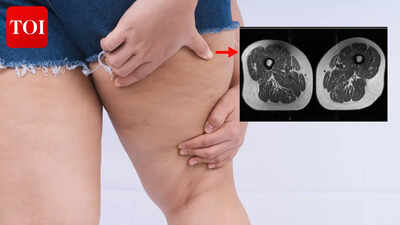
Representative axial T1-weighted spin-echo thigh MRI scans in (A) a 61-year-old female participant and (B) a 62-year-old female participant. Both participants were of similar age and body mass index (BMI, calculated as weight in kilograms divided by height in meters squared). Both had Physical Activity Scale for the Elderly scores above the mean score in the study. According to the World Health Organization definition, the participant in B qualified as having abdominal obesity (abdominal circumference ≥ 88 cm). Abdominal circumference is a measure of central obesity that captures fat distribution and serves as an indicator of cardiometabolic health. Compared with the participant in A, the participant in B had a higher proportion of ultra-processed food (UPF) in their diet (87.1% vs 29.5%) and exhibited fattier thigh muscles bilaterally, with Goutallier grade (GG) for all thigh muscles summing to 25 for the participant in A and 38 for the participant in B.
credit
Radiological Society of North America (RSNA)
Crispy chips, decadent chocolate cookies, fizzy drinks, and ready-to-eat meals may satisfy your craving in the moment, but they are doing something far more insidious beneath the surface. A new study has found that a diet high in ultra-processed foods is changing your muscle structure, leading to fat build-up in the thighs that looks strikingly similar to the marbling seen in steak. The findings of the study are published in Radiology, a journal of the Radiological Society of North America (RSNA).
UPFs linked to worse muscle health
While marbling in the steak you eat may be good news, having it in your body isn’t. Why? Researchers found that people who eat more ultra-processed foods (UPFs) tend to have more fat stored in their thigh muscles, regardless of their calorie intake, physical activity, or sociodemographic factors, especially among those at risk of knee osteoarthritis. Higher amounts of intramuscular fat in the thigh could potentially increase the risk of knee osteoarthritis.
What are ultra-processed foods?
Think cookies, chips, soft drinks. UPFs usually have longer shelf lives and can be highly appealing and convenient. What makes them highly palatable? They contain a combination of sugar, fat, salt, and carbohydrates, which affects the brain’s reward system, making it hard to stop eating.Not just chips and cookies, some of the foods you think are ‘healthy’ also belong to the category. These foods include breakfast cereals, margarines/spreads, packaged snacks, hot dogs, soft drinks and energy drinks, candies and desserts, frozen pizzas, ready-to-eat meals, and mass-produced packaged breads and buns, all of which include synthesized ingredients.
Obesity and knee osteoarthritis are on the rise
The researchers observed a close connection between UPFs and obesity. “Over the past decades, in parallel with the rising prevalence of obesity and knee osteoarthritis, the use of natural ingredients in our diets has steadily diminished and been replaced by industrially processed, artificially flavored, colored, and chemically altered food and beverages, which are classified as ultra-processed foods,” the study’s lead author, Zehra Akkaya, MD.researcher and consultant for the Clinical & Translational Musculoskeletal Imaging group at University of California, San Francisco, Department of Radiology and Biomedical Imaging, said in a release.Dr Akkaya and the research team examined the relationship between UPF intake and thigh intramuscular fat. To understand this, the researchers analyzed data from 615 individuals who participated in the Osteoarthritis Initiative, a nationwide research study sponsored by the National Institutes of Health that helps researchers better understand how to prevent and treat knee osteoarthritis. These participants were not yet affected by osteoarthritis.“Osteoarthritis is an increasingly prevalent and costly global health issue. It constitutes one of the largest non-cancer-related healthcare costs in the United States and around the world. It is highly linked to obesity and unhealthy lifestyle choices,” Dr Akkaya said.Of the 615 individuals, 275 were men and 340 were women. The average age was 60 years. On average, the participants were overweight, with a body mass index (BMI) of 27. Forty-one per cent of the foods they consumed over the prior year were UPFs.
The more the UPFs, the more the fat
What the researchers found was striking. The more ultra-processed foods people consumed, the more intramuscular fat they had in their thigh muscles, regardless of caloric intake. On MRI, this was seen as fatty degeneration of the muscle, where streaks of fat replace muscle fibers.“In addition to investigating the quality of our modern diet in relation to thigh muscle composition, in this study we used widely available, non-enhanced MRI, making our approach accessible and practical for routine clinical use and future studies. These MRIs do not require advanced or costly technology, which means they can be easily incorporated into standard diagnostic practices,” Dr Akkaya said.“This research underscores the vital role of nutrition in muscle quality in the context of knee osteoarthritis. Addressing obesity is a primary objective and frontline treatment for knee osteoarthritis, yet the findings from this research emphasize that dietary quality warrants greater attention, and weight-loss regimens should take into account diet quality beyond caloric restriction and exercise,” Dr Akkaya added.
The takeaway
How do we prevent obesity? It’s simpler than you think. Target modifiable lifestyle factors such as a healthy, balanced diet and adequate exercise. These are also tools for the initial management of knee osteoarthritis. Reducing the intake of UPFs will also help to preserve muscle quality, which in turn could alleviate the burden of knee osteoarthritis.“In recent years, several researchers have shown the detrimental impacts of ultra-processed food on various health outcomes, but data on the relationship between ultra-processed food and body composition in the context of knee osteoarthritis are limited. This is the first study assessing ultra-processed food’s impact on thigh muscle composition using MRI. By exploring how ultra-processed food consumption impacts muscle composition, this study provides valuable insights into dietary influences on muscle health,” Dr Akkaya. concluded.
About the Author

Previous Post
Next Post