


About 1,500 earthquakes strike the island nation Japan every year, with minor tremors occurring on a nearly daily basis, the University of Tokyo has said. Most of them you’d barely notice, a slight rattle of the windows, a glass shifting on the shelf. But some of them have changed the country forever. Japan sits in one of the most seismically volatile places on earth, positioned along the notorious Ring of Fire, where approximately 20% of the world’s earthquakes with a magnitude of 6 or higher occur. And Japan, more than almost any other nation, has had to learn to live with it and build around it.
1923 Great Kanto earthquake
If you ask anyone to name the most devastating earthquake in Japanese history, this is usually the one that comes up first. The Great Kanto Earthquake struck the Kanto Plain on September 1, 1923, devastating Tokyo, the port city of Yokohama, and surrounding prefectures including Kanagawa, Chiba, and Shizuoka. The timing made everything worse. It hit just before noon, when families across the city had cooking fires burning for lunch. The fires that broke out in the aftermath tore through densely packed neighborhoods faster than anyone could contain them. The quake and ensuing fires resulted in the deaths of over 140,000 people (as per Britannica)
The 1995 Kobe earthquake
By 1995, Japan had modern buildings, early warning systems, and decades of earthquake preparedness behind it. And then Kobe happened. Known as the Great Hanshin Earthquake, it killed 6,000 and injured 415,000 people. Over 100,000 homes were completely destroyed and 185,000 severely damaged. What shocked people wasn’t just the scale, it was that a modern, wealthy, well-prepared Japanese city could be brought to its knees so quickly. Many of the buildings that collapsed had been built before stricter codes were introduced. It exposed gaps that nobody had fully reckoned with.The 1995 Great Hanshin earthquake spurred nationwide improvements in earthquake-resistant architecture and disaster preparedness. New construction codes were tightened. Emergency response plans were overhauled. The lessons were expensive, but they weren’t wasted.
2011 Tohoku earthquake and tsunami
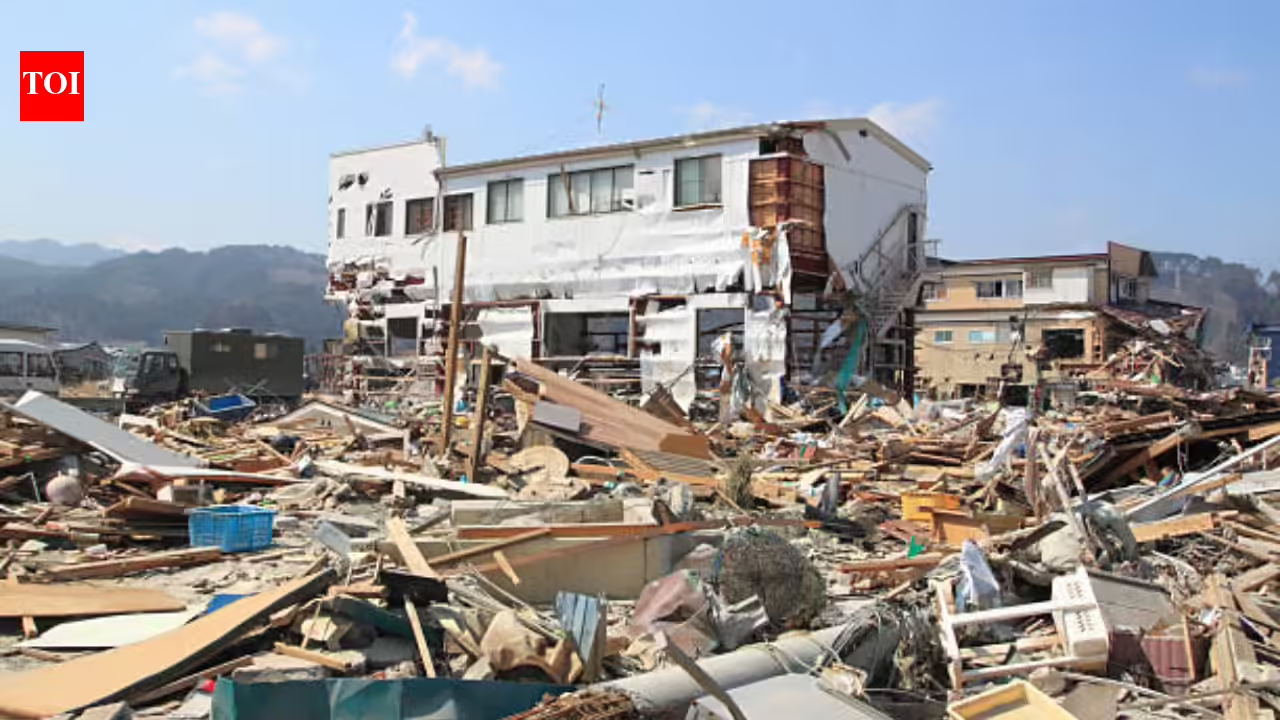
Nothing in Japan’s recorded history comes close to March 11, 2011. At 2:46 pm local time, a magnitude 9.0–9.1 megathrust quake struck off the Oshika Peninsula in Miyagi Prefecture at a shallow depth of about 29 kilometers. The rupture spanned roughly 300 kilometers along the Japan Trench and generated tsunami waves reaching up to 40 meters in some areas.The tsunami is what most people remember. It moved inland with a speed and force that made the footage almost impossible to believe, entire towns swallowed in minutes. The earthquake and ensuing tsunami killed nearly 20,000 people and caused a nuclear accident at a power plant in Fukushima Prefecture. That nuclear disaster added a layer of long-term fear that a straightforward earthquake couldn’t have produced on its own. Families displaced. Farmland contaminated. A region that’s still rebuilding its identity more than a decade later. The total disaster is estimated to have caused $220 billion in damage.
What Japan does differently because of all this
The weight of these events isn’t just historical, it shapes how Japan builds, plans, and prepares right now. Annual drills, earthquake-resistant architecture, and widespread awareness campaigns reflect lessons from past disasters. Children practice earthquake drills the way other countries practice fire drills. Buildings are designed to sway rather than snap. So Japan doesn’t pretend the threat is gone. It just keeps preparing. That quiet, persistent readiness is perhaps the most lasting impact these earthquakes have had, not just on infrastructure, but on the national character itself.Disclaimer: These numbers are based on reported estimates from common sources like University of Tokyo and Encyclopaedia Britannica. Figures can vary slightly depending on updates, methods, or sources, so treat them as close approximations, not exact counts.