


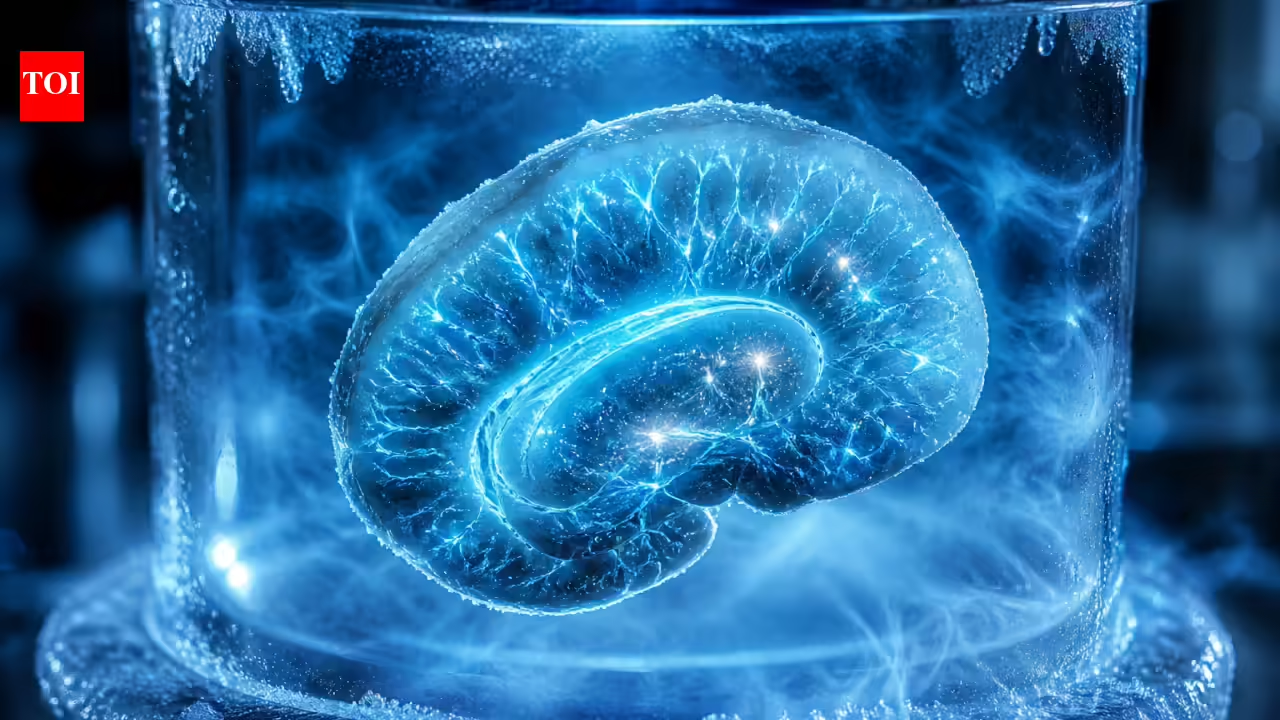
German researchers at Friedrich-Alexander-Universitat Erlangen-Nurnberg and University Hospital Erlangen have shown that adult mouse hippocampal tissue can be cryopreserved using vitrification, cooled to liquid nitrogen temperature, and later rewarmed with key functions intact. In the study, the tissue regained electrical activity and synaptic communication after thawing. The work marks an important step in cryobiology, but it focuses on isolated mouse brain tissue, not whole brains or living animals, and does not demonstrate cryosleep or suspended animation in humans.
How brain tissue was frozen to −196°C and started working again
The researchers used a cryoprotectant solution to prevent ice crystal formation, which is the main cause of cellular damage during freezing. This process, known as vitrification, allows tissue to enter a glass-like state rather than forming ice. The hippocampus, a brain region associated with learning and memory, was then cooled to around −196°C using liquid nitrogen before being carefully rewarmed under controlled conditions.After rewarming, the tissue showed more than just structural preservation. Its cellular architecture remained intact, and neurons resumed electrical activity. Signals were able to pass through neural networks, and researchers observed restored synaptic function. Importantly, long-term potentiation, a process linked to learning and memory, could also be triggered again, indicating that key functional properties of the tissue had survived the freezing process.The hippocampus plays a central role in forming new memories and processing information. By focusing on this region, scientists were able to test whether the core mechanisms underlying memory-related activity could endure extreme conditions. The results suggest that certain brain functions can be preserved at very low temperatures, at least in controlled laboratory settings.
What the study does and does not prove
While the findings are significant, they have clear limitations. The experiment was conducted on thin slices of brain tissue, not on whole brains or living organisms. It does not show that a brain can be frozen and revived in its entirety, nor does it demonstrate the preservation of consciousness, identity or complete memory systems. Concepts such as human cryosleep or suspended animation remain far beyond current scientific capability.
Why scientists care
The study represents progress in preserving both the structure and function of delicate biological tissue. This has potential applications in areas such as organ preservation, neurological research and drug testing. It could also improve how scientists store and study brain samples over long periods.The key takeaway is that complex brain tissue can survive deep freezing and regain activity under specific conditions. This does not bring science closer to reviving frozen humans, but it does push the boundaries of what is possible in cryobiology. By showing that function can return after extreme preservation, the research opens new directions for studying and protecting living systems.