




A standing committee in Canada has proposed a 10-point tightening of its international student program, including higher financial threshold requirements for international students, country-based caps and stricter institutional oversight all of which signal a decisive shift towards a more selective system that could significantly impact Indian students, the largest cohort.Indians form the largest international student cohort in Canada, with nearly 5 lakh Indian study permit holders as of Sept 2024, though in the subsequent years, the intake of new students has sharply declined owing to policy decisions.The recommendations, set out in the report ‘Reconstituting Canada’s International Student Program’, come against the backdrop of a system that the committee says has reached a “breaking point” after years of rapid expansion that outpaced housing, healthcare and regulatory capacity.
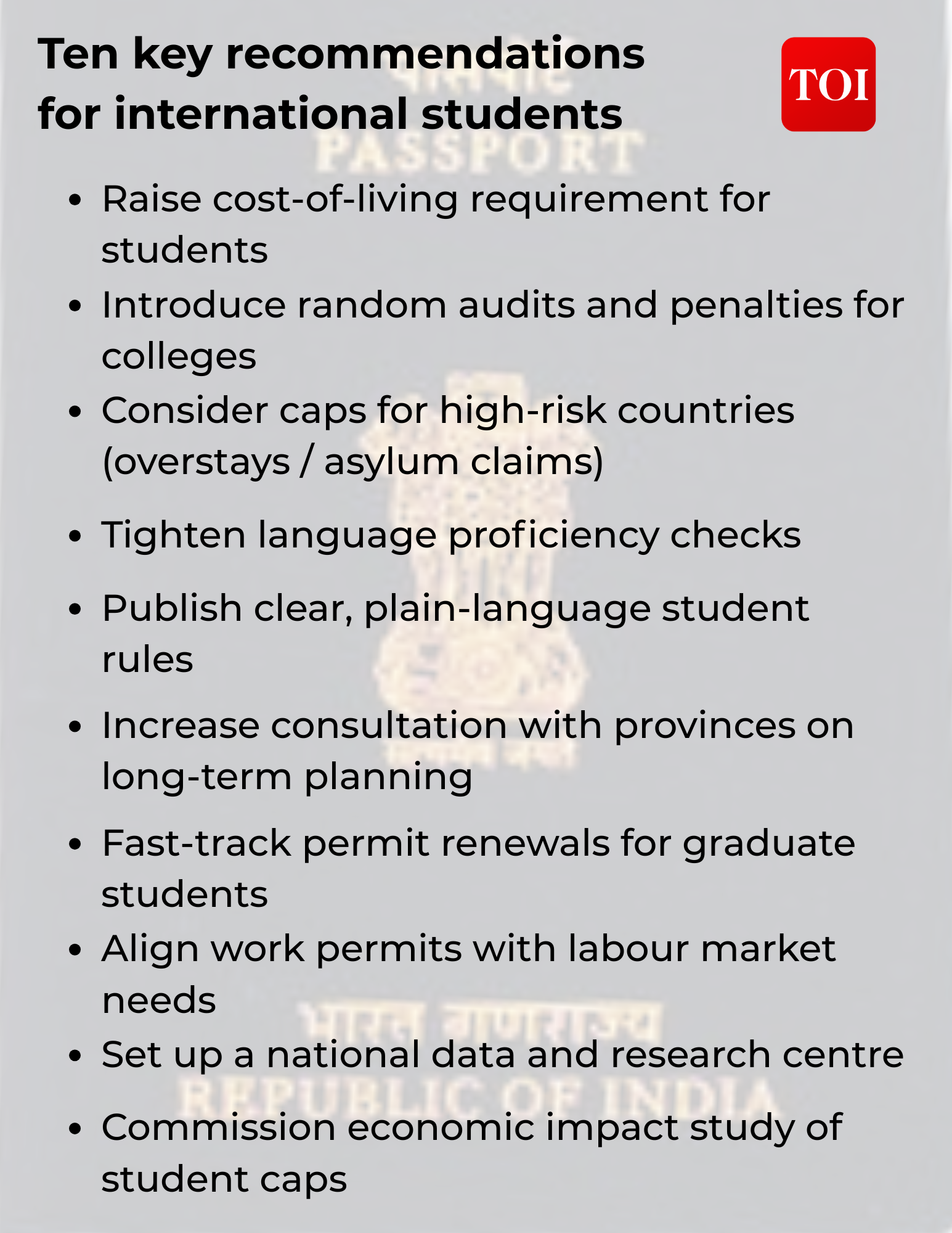
Ten key recommendations for international students
At the top of the list is a proposal to raise the cost-of-living requirement for international students beyond current benchmarks, effectively increasing the financial threshold for applicants. The current official cost-of-living requirement for international students set by Immigration, Refugees and Citizenship Canada (IRCC) is Canadian dollars 22,895 (for a single student). These funds are needed in a bank account to showcase financial stability, it applies to study permit applications submitted on or after Sept 1, 2025 and excludes tuition fees and travel costs.More controversially, the committee has recommended caps on study permits and extensions for applicants from countries with high rates of visa overstays or asylum claims. While no country is named by the standing committee, India is one of the largest source countries and aspiring students could be adversely impacted.Canada had introduced an annual cap on international student study permits in 2024 and later announced further reductions as part of its long-term immigration plan. In Nov 2025, when Canada unveiled its new Immigration Levels Plan for 2026–2028 it sharply curbed the number of intake of international students to 1.55 lakh for 2026, with a marginal decline over the next two years. Experts point out that while this drop in threshold seemed significant, the number of new students in 2025 had already declined significantly. The committee has also called for stricter monitoring of language proficiency requirements, indicating tighter screening at the entry stage.A central pillar of the reform is improved accountability. The committee has proposed random audits of Designated Learning Institutions (DLIs) and clear penalties for institutions issuing misleading documents. This follows concerns that uneven standards particularly among some colleges and aggressive recruitment practices have contributed to rapid, and at times poorly regulated, growth. The report also flags the role of third-party agents, callingfor greater transparency and accountability in how students are recruited.According to Lisa Brunner, research associate, at the University of British Columbia Center for Migration Studies, “The report recognizes the need for better research and policy innovation in international education, as well as more collaborative, long-term planning. This is crucial as Canada doesn’t just need tighter controls, it needs a predictable international education system with clearly defined entry and transition pathways over a multi-year horizon.“A Toronto based education specialist points out: “The risks flagged by the committee and need for better accountability are not theoretical. In 2022, the sudden closure of three Quebec-based colleges left nearly 2,000 students, mostly Indians, stranded after paying hefty fees, forcing many to seek help from the Indian High Commission. In recent years, abrupt enrollment suspensions and loss of institutional accreditation has left hundreds of international students in limbo.“To address misinformation, the committee has recommended that governments and institutions publish plain-language rules outlining costs, housing realities and the fact that pathways to permanent residence are competitive rather than guaranteed.While this much needed clarification could reshape expectations among prospective students, Brunner points out that the report overlooks an urgent issue. “A large cohort of international students, many from India, came to Canada expecting a credible study-to-permanent-residence pathway – yet they now face a situation where that pathway is unrealistic under current policy constraints. This is unfair, and there is little clarity about what will happen to those who are now effectively stuck between temporary status and no viable long-term options.“Several recommendations focus on governance and long-term planning. The committee has called for deeper consultation with provinces and territories, and proposed that eligibility for post-graduation work permits (PGWPs) be more closely aligned with regional labor market needs. It has also suggested creating a center for excellence to consolidate data, improve transparency and support evidence-based policymaking — addressing longstanding gaps in tracking student outcomes.“Beyond this report, the government is sending additional signals that it plans to prioritize graduate students as both international students and potential immigrants. In the current consultation on potential reforms to Canada’s immigration selection system, one proposal is to remove Canadian study points from candidates who complete studies in Canada below the graduate level,” points out Brunner.At the same time, the standing committee has also asked the Parliamentary Budget Officer to conduct a comprehensive economic analysis of the programme, including the impact of study permit caps on enrolment, housing and economic growth — reflecting concerns about potential overcorrection.Not all measures are restrictive. The committee has recommended expediting study permit renewals for graduate students, recognizing their role in research and innovation.