

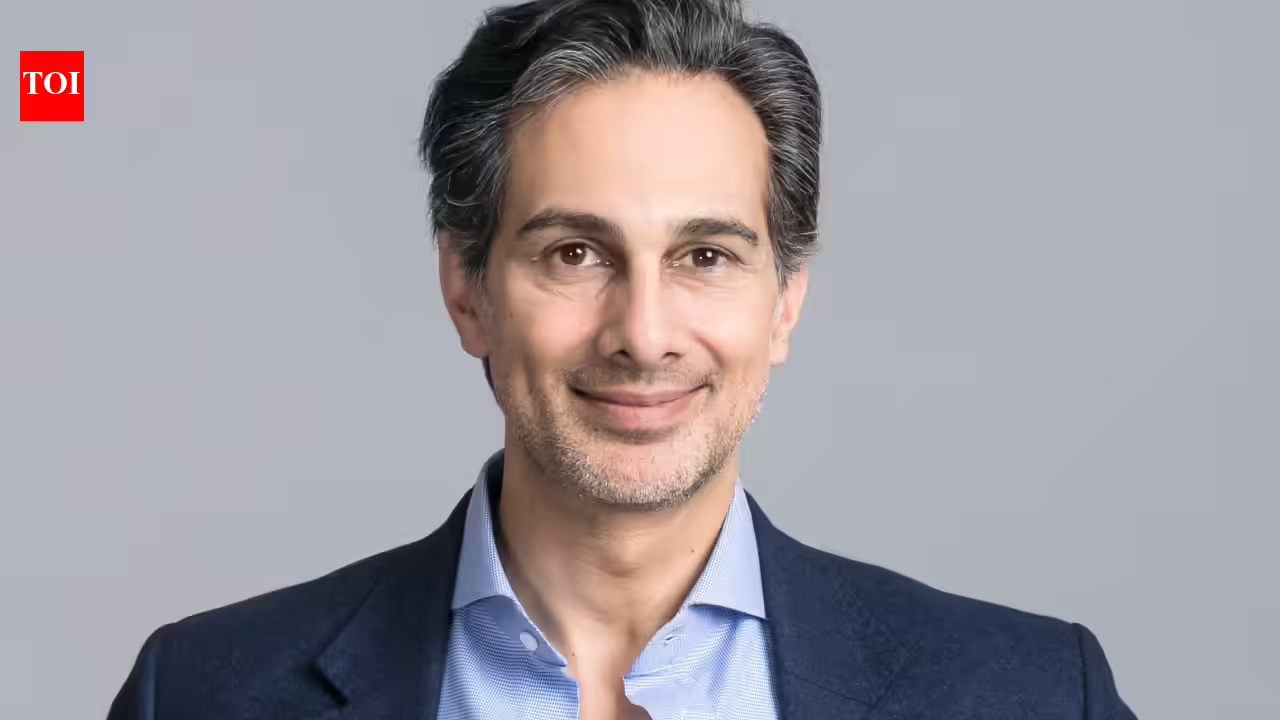
The Venice Biennale is not just an art event, it’s a soft power flex for nations. After a seven-year absence, India returns to this global stage—often dubbed the Art Olympics—with a national pavilion. In an interview with Sunday Times, curator and art historian Amin Jaffer explains his curatorial vision and why this is a big moment for Indian artWhat, in your view, makes India’s return to the Venice Biennale particularly significant?I think India’s absence at Venice was very deeply felt because we have a rich visual culture. And I think the fact that we were not represented in Venice meant that, for the global audience at large, something was missing. This is a very proud moment for all of us involved in the project and for Indians interested in culture worldwide.There is a persistent notion that Indian art is figurative and decorative. In showcasing five less familiar contemporary artists, were you also pushing back against that cliché?Absolutely. Nothing in the pavilion is done by chance. It’s all very considered and consciously conceived. I wanted to showcase artists who, though they have already been recognized in museums and among collectors, may not yet be household names. The idea was to present artists of true international caliber who hadn’t been shown in Venice before. I also wanted to break stereotypes about India and Indian art. Very often, exhibitions are self-referential—in imagery, verbiage, colouring, and figuration. This project is deeply rooted in Indian civilization because all of these artists work with materials and techniques that have existed in India for hundreds, sometimes thousands, of years. But their artworks are not predictable. They feel fresh, contemporary in conception, and impressive in their execution. These works are remarkably complex, entirely handmade, and produced over weeks of labor.Is the focus on labor a deliberate counterpoint to an increasingly digital, AI-driven visual culture?In this very synthetic world of ours, where we’re increasingly relying on artificial and digital works of art that are developed through our own ingenuity, but not through our own hands, I wanted to propose something that’s really quite the opposite. India has been a civilization with its own very rich aesthetics and a celebrated tradition of craftsmanship. So, I wanted to bring that to the fore. When you see Ranjani Shettar’s flowers, Alwar Balasubramaniam’s (Bala) fractured land, Asim Waqif’s scaffolding, Skarma Sonam Tashi’s organic materials or Sumakshi Singh’s house, they all speak of Indian technique. The materiality is Indian, yet the works are adventurous, contemporary, and provocative.You center the pavilion around the idea of home. Can you tell us more about that?As I’ve traversed through life and lived and worked on different continents, I increasingly ask myself, where is my home? This is tied up with my Indian identity, because I’m 100% ethnically Indian but born in Central Africa. Although my parents were very westernised, India was very deeply ingrained in my cultural identity through its food, music, textiles, and jewellery. As I moved abroad for education and for life, I began to reflect on how families like ours maintain Indianness despite geographical distance. How is it that Indians, even after several generations abroad, still feel so deeply Indian? It’s quite remarkable.The project really began when I saw Sumakshi Singh recreating her demolished family home in Delhi through embroidery, which raises questions about how urban environments are transforming in India. From Sumakshi’s work, I expanded the idea of home. While Bala’s fractured soil sculptures reflect our relationship with land, Ladakhi artist Tashi’s work reflects how traditional homes in Ladakh are being replaced by modern structures, which distance you from nature. Together, all these works form a narrative.There’s also a significant Indian presence beyond the pavilion this year. How do you see that shaping the overall moment for Indian art in Venice?It’s truly a remarkable moment. Nalini Malani will be part of the Kiran Nadar Museum of Art’s major exhibition. Kiran Nadar has consistently presented important projects in Venice, including a video work on MF Husain in 2024. This year’s Nalini Malani show is highly anticipated. Dayanita Singh is opening an exhibition at the State Archives, which is very exciting, and Amar Kanwar is already showing at the Palazzo Grassi to a strong response. Himali Soin, meanwhile, is part of the Biennale’s international exhibition. Later in the year, Homo Faber, an important showcase of global craftsmanship, will feature around 30 Indian artisans. And alongside all of this, Serendipity Arts Foundation is organizing a series of performances across Venice—music on boats, poetry, readings, and collaborations with local institutions. The idea is to extend India’s presence beyond the pavilion. While the pavilion itself is a powerful, static space, these parallel events allow people across the city to encounter Indian culture in different forms. Taken together, it makes for a much more expansive and immersive Indian presence in Venice.A Ravi Varma The painting recently sold for a record Rs 167 crore, yet the debate about whether Indian art remains undervalued globally refuses to go away. What do you think?The value of art is closely linked to the strength of the economy that produces it. Artists from the US, Europe—countries with strong art infrastructure—command the highest prices. Indian art is rising, but this is only the beginning. As India’s economy grows, so will the value of its art. What’s important is institutional recognition—museums, exhibitions, and global platforms like Venice. These help establish Indian art as significant not just nationally, but internationally. The more we invest in cultural infrastructure and global engagement, the more the market will reflect that strength.How does your theme of home connect with the Biennale’s theme, In Minor Keys?When I think of ‘minor keys’, I think of the minor keys on the piano keyboard. They’re not the triumphant, confident, noisy, victorious keys. Those are the keys that are tender, self-reflective, and elegiac. Sometimes melancholic. The theme of home aligns with this. It’s reflective, introspective. It asks: Where do we belong? What defines home? Is home a physical place? Or is it a portable condition that we carry through language, food, memory, and relationships?The pavilion draws support from private institutions like NMACC and Serendipity Arts Foundation. Is this public-private model the route to putting Indian art on the global map?This project is a fascinating one because it really represents close collaboration between the ministry of culture and private institutions like NMACC backed by Isha Ambani and Serendipity, led by Sunil Munjal. And indeed, myself as an international curator. I think that private-public is the way forward, not just in India, but everywhere. If you look at Paris today, of course you have great state museums like the Louvre and the Musée d’Orsay. But the cultural life of Paris is also very revitalized by the Cartier Foundation, by the Pinot space, by the LVMH exhibition halls. So, it is in Venice and New York.