


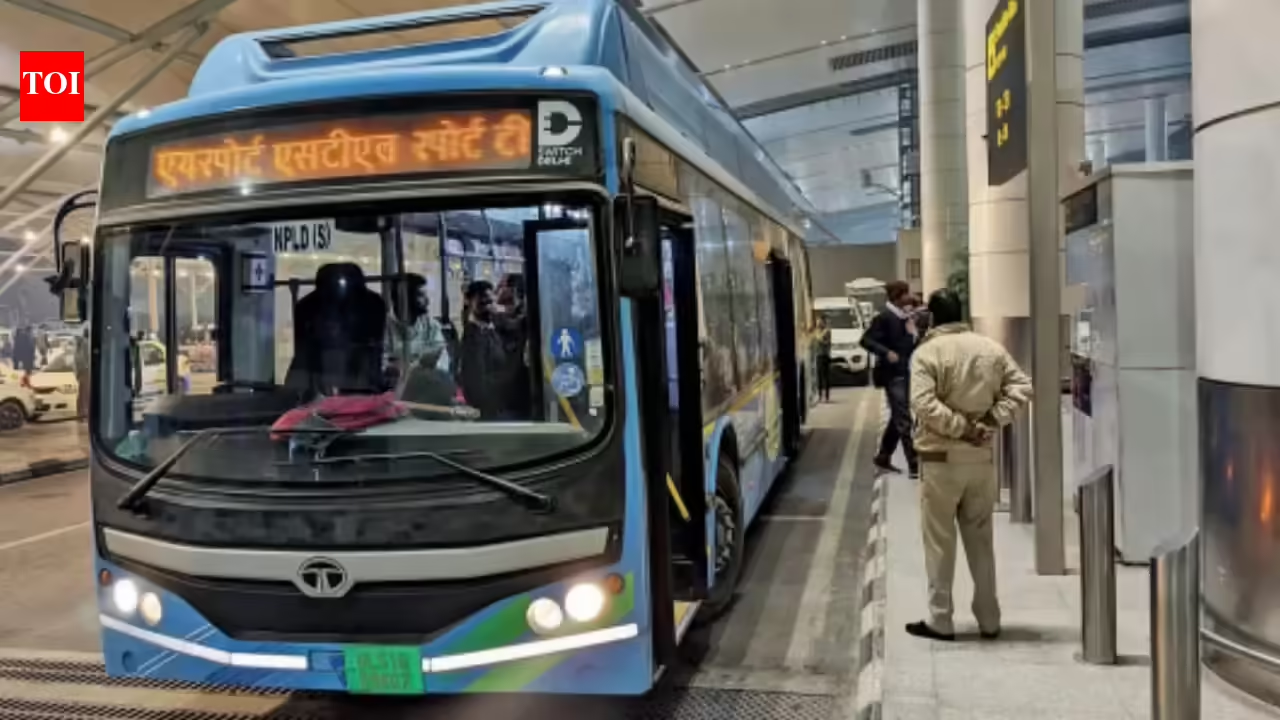
NEW DELHI: Come July, almost all transfers at Delhi airport — between Terminals 1 and 3; and Terminals 1 and 2 — will happen via the airside, in a huge relief to connecting passengers. Only the adjacent T2 and T3 will continue seeing passengers shuttling between them fr-om the cityside with a relatively short walk.Airside is the restricted operational area of an airport that sits beyond the terminal building that houses aprons, taxiways, runways and parking stands, among other vital infra.Currently, T3/2-T1 transfers take place on DTC buses from the cityside in peak traffic, a major pain point for transit passengers.
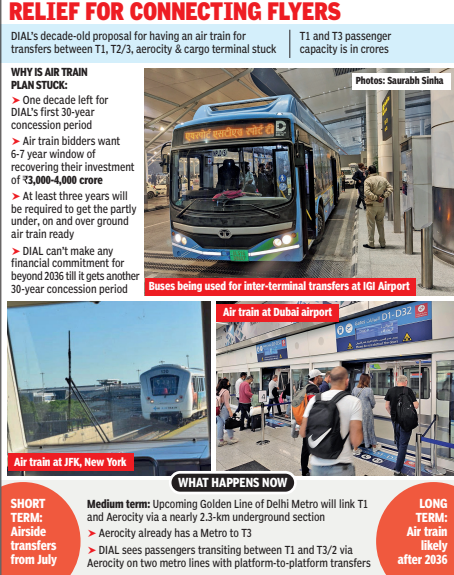
The upcoming change – being implemented exactly two decades after IGIA went the PPP way – is a key part of the aviation ministry’s plan for Delhi airport to start hub-and-spoke operations from the first week of June, allowing seamless connectivity for transit passengers – similar to what hubs like Dubai, Abu Dhabi, Doha, Singapore, Changi, London Heathrow and New York JFK have been offering for decades.“Delhi International Airport Ltd (DIAL) expects to get Bureau of Civil Aviation Security (BCAS) nod for the airside transfer plan by the end of May. Implementing it could take about a month. So, airside transfers should start from June-end or early July,” said a source.DIAL will deploy buses on the airside to take passengers between T1 and T3 — which will see international (I)-to-domestic (D), D-to-I and D-to-D transfers. Similarly, buses will take passengers between T1 and T2, which will be all D-to-D as T3 is IGIA’s only integrated international-cum-domestic terminal.T1 is and will remain only domestic, given its straight, long shape for housing boarding gates that makes segregating the two traffics (D and I) virtually impossible. The 1986-era T2 (which started as all international and gave the city airport, known until then as Palam, its new IGI name) will remain domestic in its remaining final years. T4, which will be built in T2’s place in the next decade or so and complete IGIA’s development, will be the airport’s second terminal handling both domestic and international flights. T3 has been doing so since 2010.Explaining how the airside transfers will take place, the source said, “DIAL will deploy buses on IGIA’s internal periphery. Operating on the airside, the buses will have speed governors fixed to ensure they don’t go beyond 20 kmph. A one-way journey will take about 20 minutes. BCAS, CISF, airlines, DIAL and all other stakeholders are implementing the plan to make IGIA a true hub that enables seamless transfers.”BCAS is closely looking at the flow of passengers once they enter a terminal from the airside, with the focus being on T3 to ensure there’s no mix-up of domestic and international passengers. The ministry’s hub policy states that transit passengers will be issued boarding cards clearly marked D and I at the origin airport for the connecting flights they take.Airside transfers are the key to all elements supporting the hub-and-spoke plans for IGIA. At T3, a domestic pier has been converted to an international one. Now, the terminal has three piers for foreign flights and one for domestic, raising its annual international passenger handling capacity to over 3 crore.Apart from international passengers originating from Delhi, transit flyers coming from T1 and T2 will “feed” the wide-body aircraft heading to different parts of the world from T3. It will be the same on the way back.The management, operation and development of Delhi Airport was handed over to the GMR Group two decades ago for 30 years, extendable by another 30 years. During these two decades, IGIA has seen two new terminals — T1 and T3 — and two new runways, along with supporting infra like an elevated taxiway and a new ATC tower that have made it India’s busiest and one of world’s top 10 busiest airports.However, despite the growing traffic and increasing transfer passengers, IGIA continues to lack an air train, with the plan for an automated people mover remaining on paper for about a decade now. It may become a reality only when GMR’s likely second 30-year concession period begins in May 2036. In the prolonged absence of the air train, passengers transit between T3 and T1/2 – nearly 9 km apart -by DTC buses from the citysi-de with their bags. For an airport that boasts being one of the busiest in the world, it is less than ideal.Dubai, the hub closest to IGIA, also transfers passengers between its dedicated Emirates terminal and the other one for low-cost Flydubai by buses plying on the airside. While offering great views of planes landing, taking off and taxiing, the journey seems to take an eternity due to speed restrictions on vehicles plying on the airside.Now, get ready for the same great views from low-speed buses starting this July.