


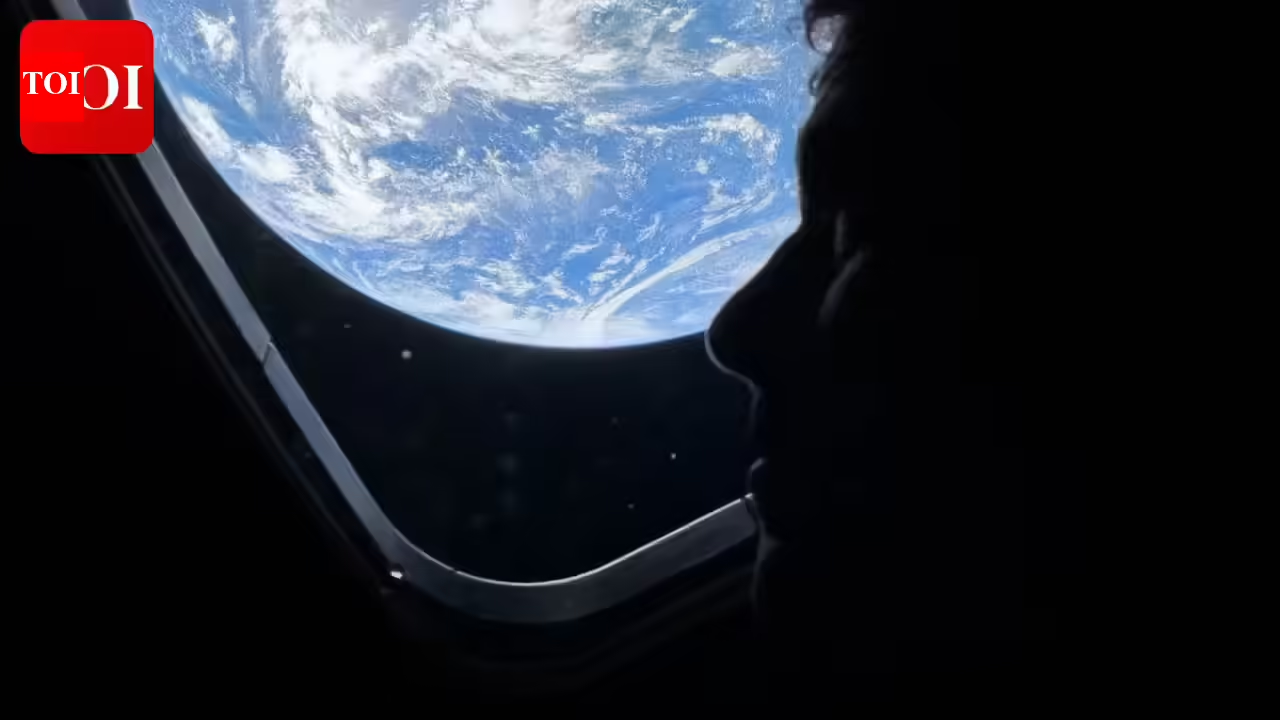
At a press conference recently, Artemis II Commander and astronaut Reid Wiseman said about his 10-day Moon mission: “When I got back on the ship—I’m not really a religious person—but there was just no other avenue for me to explain anything or to experience anything. So I asked for the chaplain on the Navy ship to just come visit us for a minute, and when that man walked in, I’d never met him before in my life. But I saw the cross on his collar, and I just broke down in tears. It’s very hard to fully grasp what we just went through.” His teammate and mission pilot, Victor Glover, replied: “The only thing I would add is I am a religious person, but everything else is the same.”It’s an age-old question. But each and everyone of us thinks of it often – whatever our beliefs, or, whether at all we believe in God or not. Science and religion have long been locked in opposition. Science demands empirical proof and falsifiability. Religion, on the other, is all about having faith in the unseen. Wiseman isn’t the first astronaut either who has grappled with the question of God, after seeing the Earth from Space.
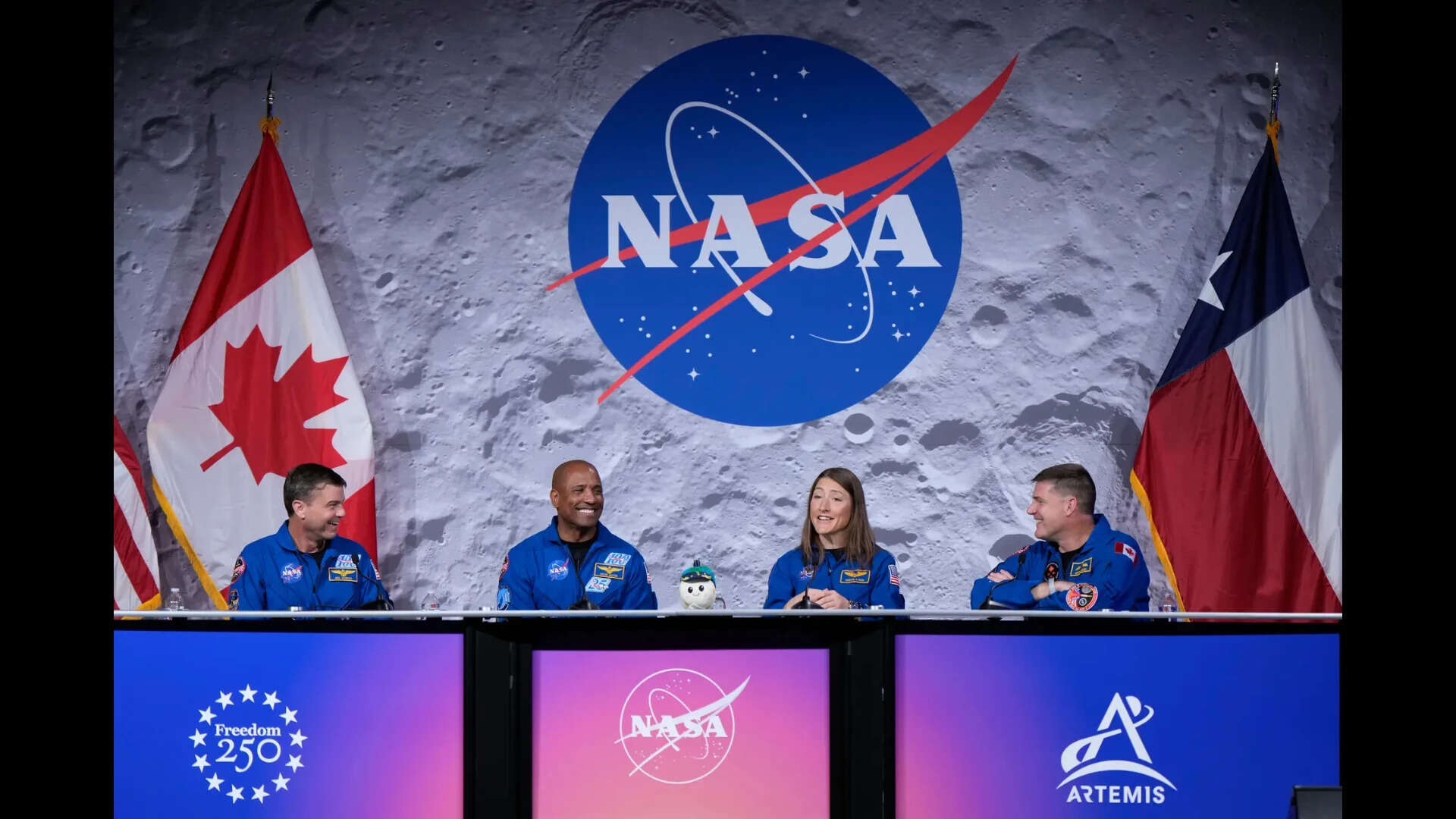
Wiseman isn’t the first astronaut either who has grappled with the question of God, after seeing the Earth from Space. (In pic. from left to right: Reid Wiseman, Victor Glover, Christina Koch, and Jeremy Hansen at a press conference on Thursday, April 16, 2026, in Houston). AP/PTI(AP04_17_2026_000003A)
James Irwin (Apollo 15) walked on the lunar surface and later said the experience “changed a man…has to make a man appreciate the creation of God and the love of God.” Russian cosmonaut Boris Volynov spoke of the psyche being “reshaped” by the sight of Earth from orbit. These people are no fringe mystics; they are test pilots and physicists whose job was to measure, calculate, and survive.Victor Glover’s public statements during Artemis II echoed the same awe and splendor, and belief. He quoted Jesus from the lunar orbit. “Love God with all that you are… and love your neighbor as yourself in an Easter message. He reflected on Earth as “a spaceship… created to give us a place to live in the universe and the cosmos.” Even while acknowledging the scientific wonder, Glover framed it within a sense of purposeful creation.No matter how far we go, no matter which century we live in, the God question has always been alive. In the 21st Century, after a pandemic and what seems to be an undeclared world war, Wiseman’s ambivalence seems like the most sane question all of us are asking at the moment. Is God alive, in our times? To search for answers it’s always best to go back into the past.
When the universe stares back
More than three decades ago, author Frank White coined the term “Overview Effect” to describe the cognitive shift that results among space travelers from the experience of viewing the Earth from space. In this cognitive shift the Earth appears as a fragile, borderless oasis suspended in infinite blackness. Astronauts, over decades, have reported instant global consciousness, a profound sense of interconnectedness, and an almost mystical awe. Edgar Mitchell, the sixth man on the Moon (Apollo 14), described it this way: “You develop an instant global consciousness, a people orientation, an intense dissatisfaction with the state of the world, and a compulsion to do something about it… My view of our planet was a glimpse of divinity.”
The 20th-century crisis: “Is God dead?”
The twentieth century was plagued by the same questions, the same theological crises. But the answers were different. It was a different world. It was a world that had lost faith in humanity. Two world wars, the Holocaust at Dachau and Auschwitz, the atomic horror of Hiroshima — these events did not merely challenge faith; they made the very relevance of God feel obsolete. That cultural turning point was captured perfectly on the cover of Time magazine in 1966: a stark, picture-less black page with three stark words in red: “Is God Dead?”
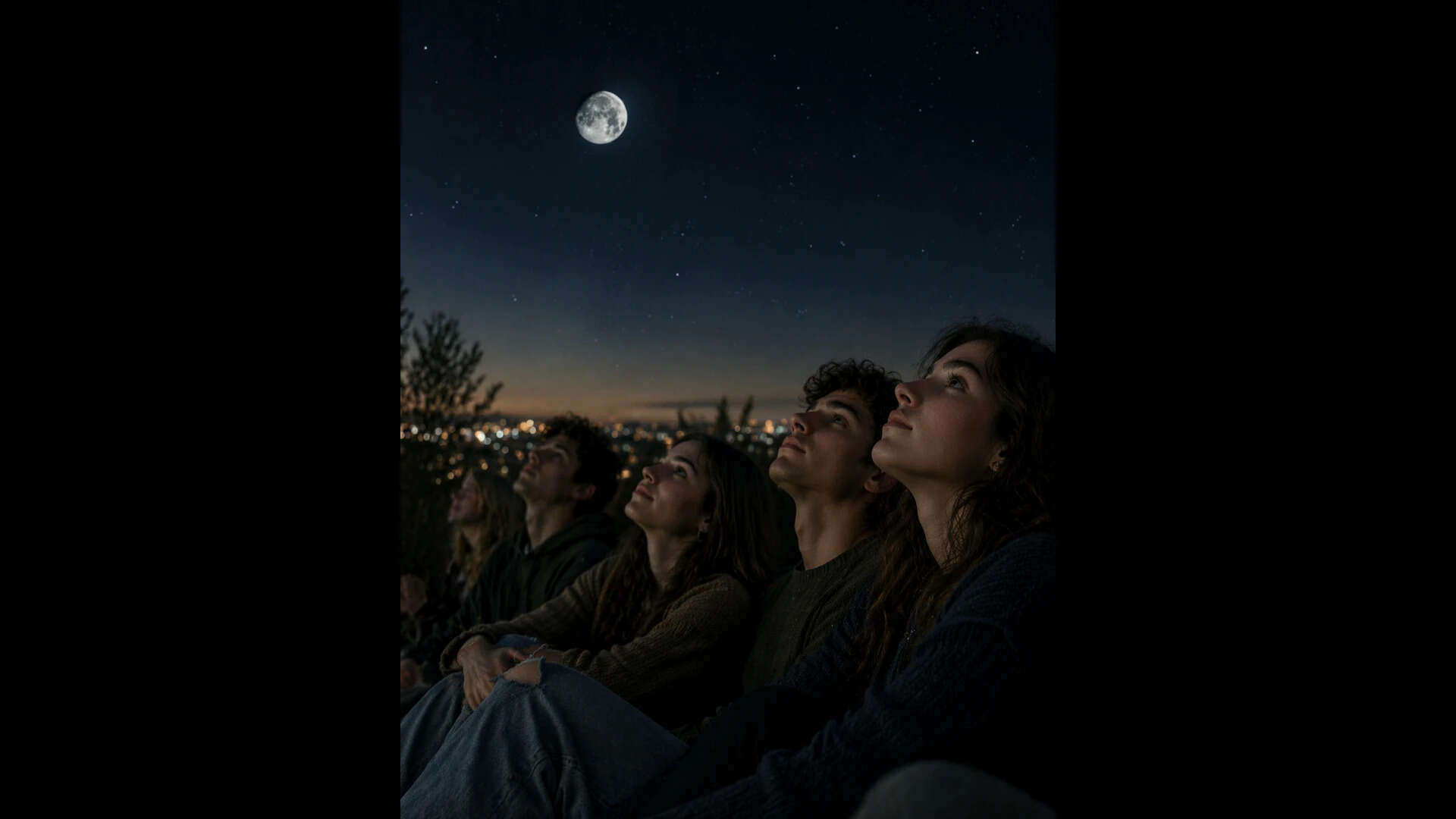
In our post-truth world, the question of God no longer arises from intellectual skepticism. It arises from an overwhelming urge to lean on a Higher Form when we cannot control even the smallest details of our immediate environment. (AI generated)
The accompanying essay explored a profound doubt about God’s place in a world scarred by mechanized evil and scientific hubris. The 1960s counterculture, anti-Vietnam protests, and rising secularism amplified this gradual loss of faith. Pessimism reigned; the old certainties crumbled under the weight of history’s nightmares. The 21st Century is asking the God question again. But a lot has changed.
God in the post-truth era
We live in a post-truth world where facts feel negotiable, algorithms amplify outrage, and institutions that once anchored us seem hollow. The COVID-19 pandemic left a silent legacy: not just physical illness but a collective, unacknowledged mass PTSD. Global prevalence of anxiety and depression surged 25 percent in the pandemic’s first year alone; Fatigue, fear, and emotional exhaustion still linger. We can all feel it. We may not have yet said it aloud, but we are all exhausted — bone-tired of navigating a reality that feels surreal from the White House to the daily grind of simply staying alive.In this climate, the question of God no longer arises from intellectual skepticism. It arises from an overwhelming urge to lean on a Higher Form when we cannot control even the smallest details of our immediate environment.The 1960s showed a slow erosion of faith amid protest and disillusionment. Our times are doing the opposite: a quiet, urgent tilt toward belief. We want to believe. We crave normalcy, decency, awe, splendor, goodness, and camaraderie. We want to believe the Earth itself is a crew — bound together, inescapably, beautifully, dutifully linked, as Artemis II astronaut Christina Koch summed up this feeling after the mission: “A crew is inescapably, beautifully, dutifully linked… Planet Earth, you are a crew.“Looking back at our fragile blue marble from lunar distance, she saw not just science but a shared human voyage that demands something larger than ourselves. The God question is no longer about proving or disproving; it is about leaning into belief when everything else feels hopeless.The existential question of God echoes through the minds of history’s most brilliant skeptics. Werner Heisenberg, the architect of quantum mechanics, captured the tension when he said: “The first gulp from the glass of natural sciences will turn you into an atheist, but at the bottom of the glass God is waiting for you.”Albert Einstein rejected a personal God yet spoke of “Spinoza’s God”—the orderly harmony of the universe itself. “Science without religion is lame,” he said, “Religion without science is blind.” Charles Darwin, whose theory is often misread as faith’s death knell, admitted in his autobiography that the impossibility of conceiving the universe arising by pure chance remained, for him, the strongest argument for some divine intelligence—though he called himself an agnostic unable to decide its “real value.” Carl Sagan, the eloquent voice of cosmic secularism, still insisted: “Science is not only compatible with spirituality; it is a profound source of spirituality.”Even Richard Feynman, the ultimate scientific pragmatist, described a “religious feeling of a special kind” born from contemplating nature’s laws. These minds—trained to doubt, to test, to discard—nevertheless found themselves ambivalent. They did not convert to dogma, but they could not dismiss the awe, the sense that something permanent, ineffable, and perhaps purposeful lingers at the edge of knowledge.
Evolutionary wiring or cultural residue?
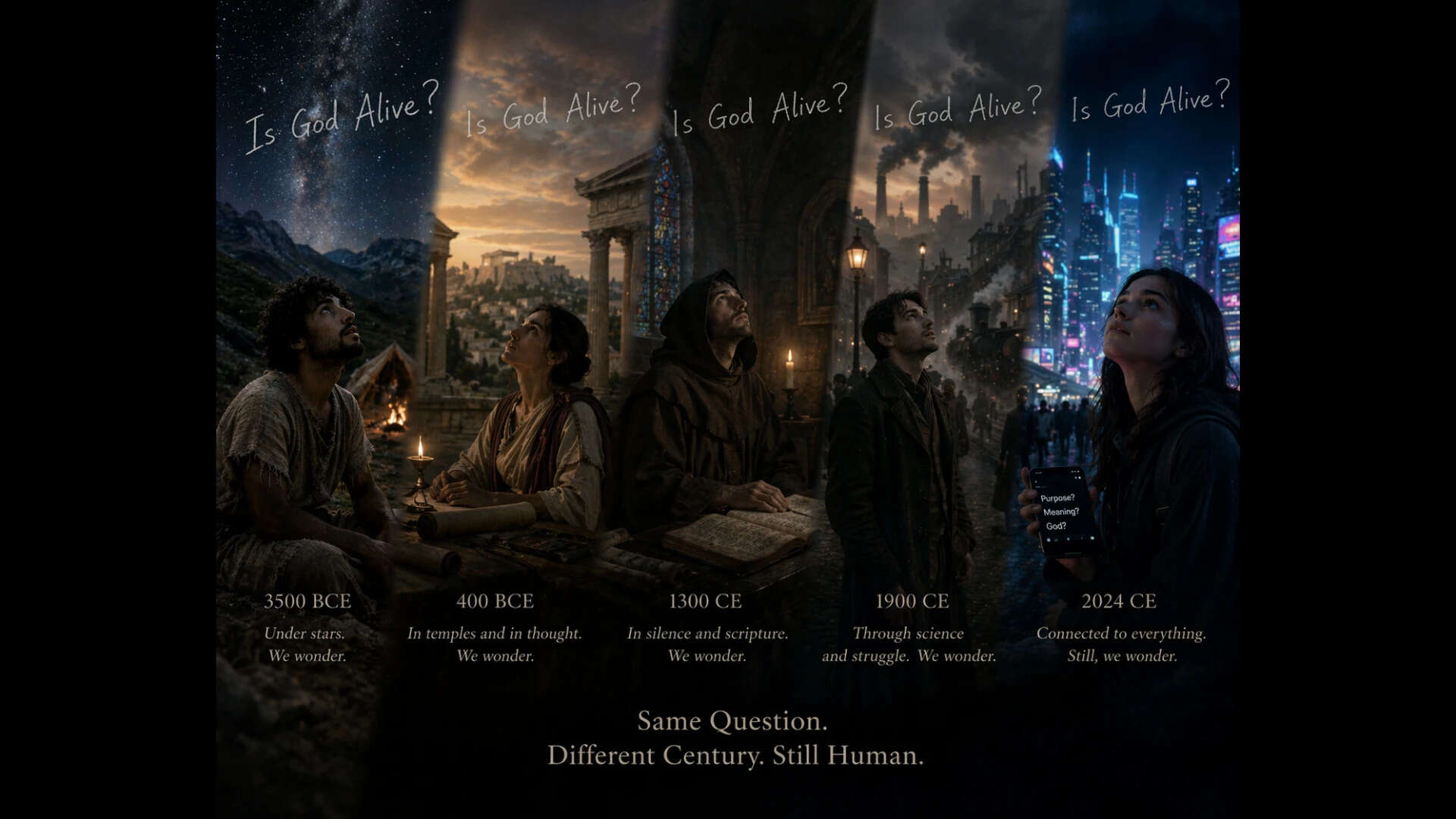
In every century, people have grappled with the God question. The answers may differ, but the question still remains.
Critics may call the God Question conditioning. It’s our species’ evolutionary wiring for pattern and agency. Or, maybe a cultural residue from childhood stories. But even Soviet cosmonauts raised on state atheism still felt reshaped by Earth’s vista, even as secular astronauts today report the same overview effect. If it were mere conditioning, greater scientific literacy should have erased it. Instead, the more we learn, the more the mystery deepens.In our post-pandemic, post-truth exhaustion, that mystery feels less like a luxury and more like a lifeline. Physicist Paul Davies once remarked that the more we study the universe, the more it resembles “a put-up job.” The Artemis II crew possibly did not “find God” in the evangelical sense of sudden conversion. Wiseman saw a Cross and had no other words; Glover reached for scripture; Koch saw one planetary crew. These are not isolated anecdotes. They are symptoms of a broader turn: when control evaporates and the world feels surreal, we lean harder on the intuition that something—call it God, Higher Power, cosmic order—holds us.We want to believe. We want to believe in normalcy returning, in decency prevailing, in awe and splendor still possible amid the grind. We want to believe that Earth is indeed a crew, bound together in shared vulnerability and shared wonder. The brilliant minds who began as atheists or agnostics yet remained ambivalent understood this pull instinctively. In the twenty-first century, that pull has become a tidal force.