


Imagine eating 100,000 calories a day. Just constant, relentless feeding to keep your 80-ton body running. That wasn’t a fantasy diet, that was just Tuesday for a sauropod dinosaur during the Jurassic period.The sheer scale of what it took to keep these creatures alive is difficult to wrap your head around. These weren’t just big animals. They were so impossibly, structurally massive that feeding them required rethinking everything about how a body could function. Every evolutionary decision they made was essentially about solving a problem: how do you fuel something this enormous?A young adult Mamenchisaurus, for example, needed to consume 100,000 calories a day to maintain itself. This nutrition came from leaves and other plant material they snipped and stripped before gulping down their meal. That’s roughly what a human would eat in forty days, consumed in one day by a single dinosaur. These weren’t random estimates—they came from actual paleontological calculations based on metabolic rates and fossil evidence.
The efficiency problem
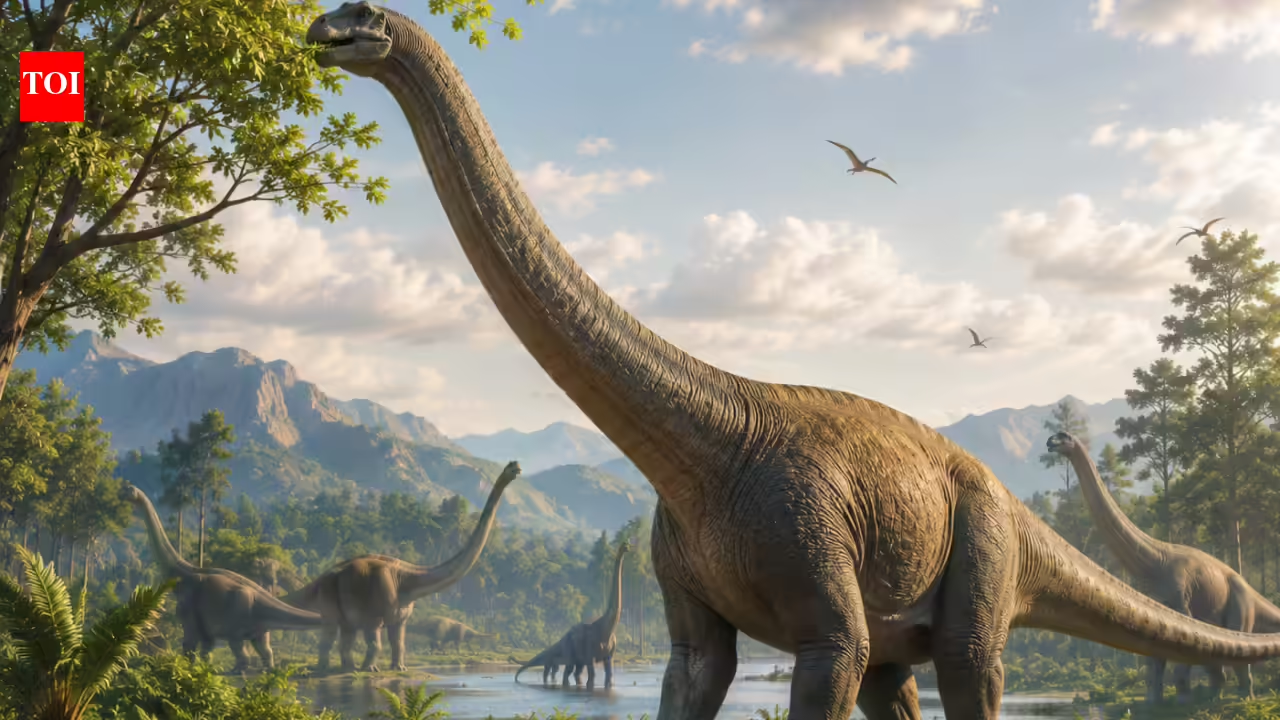
Here’s where sauropods got clever. If they’d tried to actually chew their food like we do, they would’ve needed massive jaws, powerful teeth, and time to process every bite. But that would’ve required an enormous head, and an enormous head would’ve thrown off the weight balance of an animal trying to survive on a relatively fragile planet.So they did something different. The herbivorous giant dinosaurs had relatively small, light skulls. This meant that sauropods were able to grow extremely long necks, allowing them to make food intake as efficient as possible. They did not constantly have to heave their 80-ton body over the Jurassic savanna while looking for their greens. According to research published in PLOS One and backed by studies at the Natural History Museum of Los Angeles County, sauropods developed a strategy completely unlike any other animal: they kept their teeth incredibly simple and replaced them at lightning-fast rates.“In nearly every other animal we look at, the complexity of a tooth relates to the animal’s diet. In sauropods, they found that the more complex the tooth, the more slowly teeth were replaced,” according to Dr. Keegan Melstrom at the Dinosaur Institute. This meant they could eat constantly without worrying about dental damage—just wear out a tooth and grow a new one.The long neck was actually a design solution to a feeding problem. Instead of having to move their enormous bodies around constantly searching for food, sauropods could stand in one place, extend their 30-foot necks, and reach leaves and vegetation that smaller animals couldn’t access. It was like having a crane attached to your body. More efficient. Less exhausting.But even with this adaptation, the numbers were still staggering. A 10 tonne Diplodocus with an assumed energy requirement of 280 kJ of metabolisable energy per kilogram of body weight per day, feeding exclusively on ferns would need to eat 33.2 kg per day. If it dined exclusively on horsetails it would need to eat 23.8 kilograms per day, according to research published in the journal Palaeontology.That doesn’t sound massive until you realize a Diplodocus was one of the smaller sauropods. The biggest ones, like Argentinosaurus, were up to 90 tons. The math scales up, and quickly.
The digestion gamble
Here’s what makes dinosaur digestive systems even more interesting. They couldn’t chew thoroughly, so they had to rely on something else to break down the food. The digestion process itself probably took several days but their stomachs were so large that they still provided them with enough energy round the clock. Furthermore, the metabolism of these giant animals was incredibly powerful.Research from Current Biologybased on the first-ever sauropod gut contents discovered in Australia, provides direct evidence of this bulk-feeding strategy. The Diamantinasaurus specimen showed herbivory with “minimal oral processing of food”—meaning they barely chewed at all. They were essentially living fermentation tanks. The food would sit in their massive stomachs for days, being broken down by microbes in a process similar to what happens in modern cows’ stomachs. But a sauropod’s stomach was orders of magnitude larger. It had to be, because there was no way around the fundamental problem: you need huge amounts of food to fuel a huge body.Scientists at the University of Bonn found evidence that sauropods were equipped with “turtlelike beaks that buttressed their peglike teeth as they relentlessly stripped foliage from plants.” They were eating machines, pure and simple.
What they actually ate
The plants available during the Jurassic weren’t the same as what we have today. Sauropods were browsing on gymnosperms, ferns, and horsetails. According to research presented at the Society of Vertebrate Paleontology annual meeting and published in Science Magazine, researchers were astonished to find that horsetails released more energy than any other plant group, including 16 modern grasses. “Equisetum is rich in protein, and far more nutritious than the ferns, cycads, and conifers commonly available,” according to paleontologist Stephen Poropat at Swinburne University in Melbourne. These were essentially the “superfoods” of the Jurassic.But horsetails came with a problem. According to the California Academy of Sciences, horsetails are exceptionally nutritious. However, only a few animals feed off them today because they contain a lot of silica, which acts like sandpaper. Sauropods couldn’t afford to be picky about dental wear. They had those rapidly replacing teeth and simple dental design, so they just ate horsetails by the ton. Literally.The real accomplishment wasn’t having a massive stomach. Any big animal can have that. The accomplishment was having the whole system work—the long neck reaching food efficiently, the small head keeping weight manageable, the rapid tooth replacement preventing dental damage, the powerful metabolism keeping everything running, the massive fermentation chamber breaking down plant matter over days. Every piece had to fit together perfectly, or the whole thing falls apart.That’s what it took to be a dinosaur. Not just eating a lot. Having an entire body engineered around eating constantly, efficiently, and surviving on nothing but plants. It’s one of nature’s most improbable solutions to an impossible problem.