



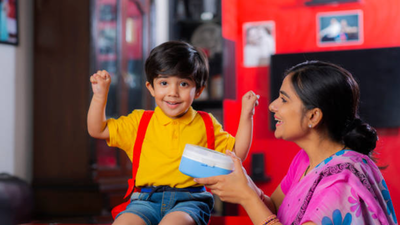
There’s something teachers notice that rarely comes up in parent-teacher meetings.Before a test, some children revise.Some children sharpen pencils again and again.Some children go to the washroom twice.And some children quietly open their snack box and start eating.Not lunch. Not because it’s break time. Just small bites. Something to chew.Ask them, they will say that they are hungry. Sometimes they are. In other cases they are simply nervous and have no idea what to do with the emotion.Adults don’t differ much, by the way. During deadlines, during long meetings, when watching something late at night, when stressed, when bored, when low, people eat. Not all individuals eat because they are hungry. They will eat because something is going on in their mind and eating will be a form of relaxation.
That habit doesn’t start suddenly when you’re 30. It usually starts much earlier, very quietly.Look at how often food appears in emotional moments in childhood. A child falls down and cries, someone says, “Come, I’ll give you something.” A child is bored on a Sunday afternoon, someone says, “Go eat something.” A child does well in exams, the family goes out to eat. A child has a bad day, parents order their favorite food to cheer them up.Food slowly becomes part of every emotion. Happy, eat. Sad, eat. Bored, eat. Celebrating, eating. Stress, eat.Nobody teaches this directly. Children just grow up watching this pattern and it becomes normal.Teachers sometimes see this pattern very clearly because they see children in stressful situations like tests, competitions, presentations, and social situations. Some children eat more on test days. Some don’t eat at all. Some keep chewing something when they are nervous. Some finish their entire snack before the exam even starts.If you watch carefully, food is sometimes doing a job that words are not doing. The child is not saying, “I am anxious.” The child is eating at an increased rate.The scholars conducting research on children eating behavior usually assert that emotional eating habits may be developed at a very tender age, particularly when food is regularly employed as a comforter or a reward. Over time, the brain starts connecting feeling better with eating something. So food is not just solving hunger anymore. It is solving boredom, sadness, stress, and even celebration.The difficult part is that this looks very normal. Nothing dramatic. Just small habits repeated for many years.A biscuit before studying.Ice cream after exams.Chips when bored.Chocolate when sad.Eating while watching something.Snacking while doing homework.Decades later, adults find themselves in front of the fridge not because they are hungry, but because they are frustrated, exhausted, or evading something.And, tracing that habit back, it will usually take you down to childhood, where food first ceased to be merely food, but something that helped to smooth the feelings.