


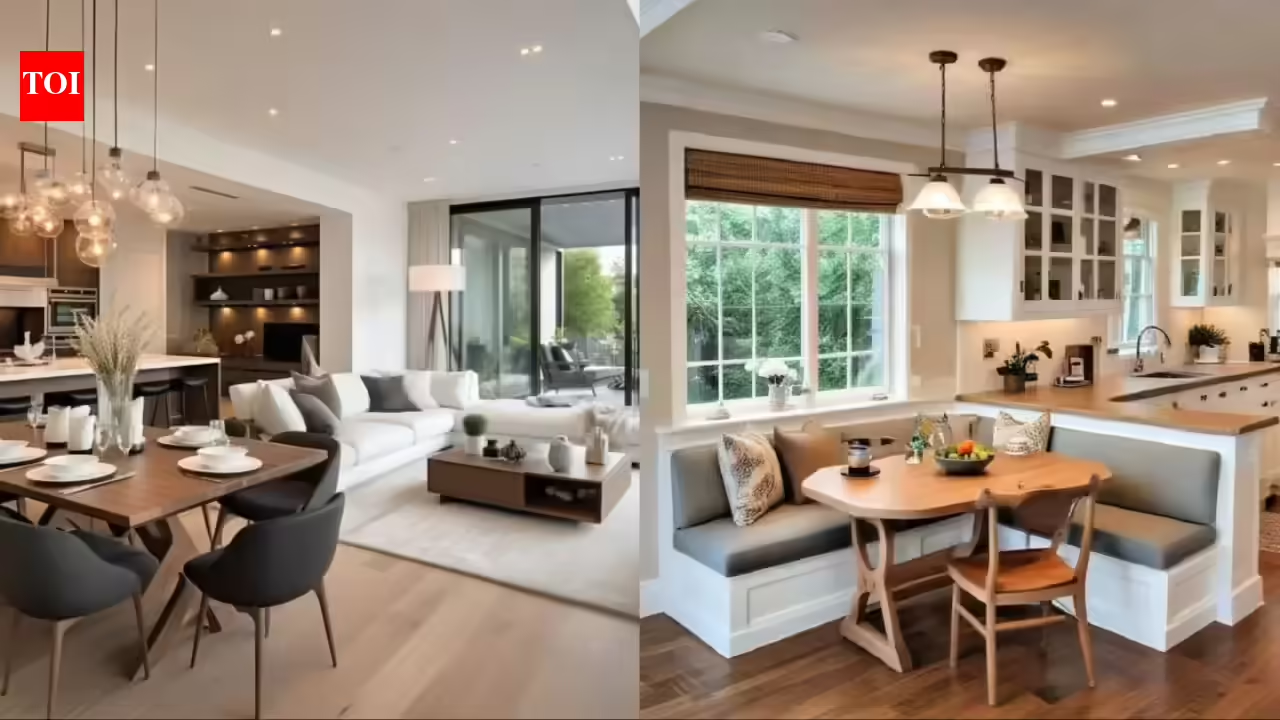
For years, open-plan living has been the default blueprint for modern homes. Knock down the walls, flood the space with light and let life spill freely from kitchen to dining to living room, sociable, spacious and visually impressive but living in one big room has its downsides. Noise travels. Work bleeds into relaxation. Privacy is increasingly hard to come by, particularly for households balancing hybrid working and busier home lives.Global design exhibitions are beginning to reflect this mood, pointing toward layouts that are more considered, flexible and attuned to how people actually live.
The rise of ‘broken plan’ living
Broken plan living takes the open-plan concept and refines it, introducing partial divisions that carve out distinct zones without closing spaces off entirely. Partitions, floor-to-ceiling shelving and low-level dividers break up larger rooms while keeping the sense of flow intact, where different areas have their own identity without requiring a door to separate them. The result is a home that feels connected but not chaotic.Sam Allen, Managing Director at Noisy&Co, a UK-based hybrid creative agency specializing in immersive brand experiences and exhibition design, draws on insights from international shows to reveal the layout trends set to filter into UK homes. In an interview with the Times of India, he shared, “What we’re seeing at major design shows is a big appetite for spaces that breathe but also function. Exhibition designers have long understood that how you divide a space affects how people move through it and how they feel within it. That thinking is now making its way into residential design in a meaningful way.”
Zoning for modern life
Rather than allowing a room to serve every purpose simultaneously, zoning introduces clear intentions: this corner is for work, this area is for unwinding, this space is for gathering. The approach draws directly from exhibition design, where guiding visitors through an environment in a deliberate, considered way is second nature. Each zone has a purpose, a feeling and a visual identity that sets it apart from the next.“Exhibitions are a masterclass in spatial storytelling,” Sam explained. “Every area is designed to make you feel something different. When you bring that level of intention into a home, rooms feel more purposeful and life within them becomes easier to manage.” Authors Elena Martínez et al shared in the study, Spatial Configuration, Sensory Load and Cognitive Performance in Open vs Partitioned Environmentspublished in the journal Architecture, “Open-plan environments significantly increase sensory exposure, negatively impacting attentional control and perceived environmental comfort compared to partitioned layouts.”It demonstrates measurable downsides of openness (noise, distraction, overstimulation), provides scientific grounding for why zoning and partial divisions improve usability and directly aligns with the argument around focus, privacy and functional separation.
Privacy is back
One of the clearest trends coming out of international design shows is a renewed desire for privacy. Quiet, enclosed spaces like a dedicated home office, a reading nook or simply a room with a door are back on the wish list for homeowners and designers alike.The rise of hybrid working is a significant factor. Millions of people now spend at least part of their week at home and the fully open layout offers little refuge when focused work needs to be done. Beyond the practical, there’s also a growing desire for spaces that allow for rest away from screens, noise and the general hum of household life.“Privacy has become a sought-after feature in home design,” said Sam. “We notice it at exhibitions too, brands are creating immersive, enclosed environments because they understand that people crave moments of stillness and focus. The home is starting to reflect that same need.” According to a recent 2026 study published in the MDPI Architecture Journal“Open-plan workplaces are often associated with increased sensory exposure… spatial configuration may influence perceived security and attentional states.” Although focused on workplaces, this peer-reviewed 2026 study provides scientific backing for a key argument that open layouts increase sensory overload and reduce focus. This directly supports the shift toward zoning, enclosure and controlled environments in homes, especially with hybrid work.
Multi-functional rooms with boundaries
Modern homes are asked to do a lot. The same room might need to function as a home office by day, a dining space by evening, and a relaxed sitting area at the weekend. The challenge is making all of that feel intentional rather than improvised.Furniture placement, rugs and lighting are being used strategically to signal where one zone ends and another begins, giving each function its own territory without permanent structural changes.“It’s about avoiding that feeling where everything happens in one room, and nothing feels defined,” said Sam. “Good design makes the purpose of each space immediately clear. When people walk into an area, they should instinctively know how it’s meant to be used.”Authors Hiroshi Tanaka and Laura Bennett noted in a 2026 study published in the Journal of Interior Architecture and Spatial Design“Households increasingly adopt ‘micro-zoning’ strategies, creating distinct functional areas within previously open-plan interiors to accommodate work, rest and social activities.” The study introduces the exact concept of zoning within open spaces, connects the shift directly to hybrid working patterns and validates multi-functional rooms with boundaries.
Doors, screens and soft dividers
Sliding doors, curtain panels, folding screens and flexible partitions are appearing in increasing numbers at international design shows. They offer something the open-plan layout never could: choose. The ability to open a space up for a Sunday lunch and then close sections off for a quiet Monday morning is, for many households, far more practical than a fixed layout in either direction.Authors Sophie Dubois et al established in an Environment and Behavior study“A marked preference shift toward adaptable interiors with controllable boundaries reflects a growing need for privacy, autonomy and emotional regulation within the home.” It confirms that privacy is a primary driver in modern home design, supports the rise of sliding doors, partitions and flexible dividers and shows that this is a global behavioral shift, not just a design trend.“Flexibility is everything,” Sam said. “The best exhibition spaces we work on are ones that can transform depending on what’s needed at any given moment. Homeowners are starting to want that same adaptability. It’s about being able to switch between open and closed when you need to.”
bottom line
Open-plan living is not disappearing but it’s no longer seen as the answer for every home. What global design shows us is that people want balance. They want spaces that can open up and breathe but also close off and provide focus when life demands it. Sam Allen revealed, “The influence of exhibitions like Salone del Mobile matters because these shows set the agenda. The ideas that appear on those floors tend to find their way into homes within a few years. Right now, those ideas are centered on flexibility, intention and the value of having spaces that actually support the way you live.”For homeowners, the message is straightforward: the best layout isn’t the most open one, it’s the one that works for you.